REVIEW · 2021-10-02
Turing Complete
Reading the review pool on a game that builds a CPU from a single NAND gate
Introduction
Turing Complete doesn't open on a test chamber or a paint gun. It opens on a single NAND gate. From there you build AND and OR, stack adders and registers, and finish by wiring a CPU that runs an assembly language you designed. I'm writing this from the Steam review pool, not from my own save file.
The numbers are lopsided: 96% of 5,202 all-language reviews are positive ('Overwhelmingly Positive'), 94% of the 2,723 English ones, and the recent 30 days sit at 93% (2026-07-06 snapshot). The verdict has barely moved since launch.
The word that recurs most across the reviews isn't a genre or a developer — it's 'now I understand.' The praise collapses into that phrase; the complaints collapse into 'I quit before I got there.' My job is to translate where the split happens into design terms.
 Wiring from NAND up to a CPU — Steam store
Putting the Mechanics into Words
What positive reviews keep marvelling at is how little raw material there is. 'Everything in a computer, out of one NAND gate' — nearly every top review writes that line as its highest compliment. In Puzzlebyrinth terms, the verb is subtracted to one — wire things together — and the material to a single part.
One part doesn't mean one rule. You name a circuit, turn it into a component, and feed it into the next level; that nesting abstraction is the whole grammar. 'The instruction set I made runs on hardware I built — it's mine,' one review says: a combinatorial space exploding out of a subtracted primitive.
Even the fans hedge. A software engineer's review calls the byte-only assembly encoding 'unfathomably restrictive' and blames it for abandoning a compact 16-bit design. Enjoying the game and cataloguing its rough edges in the same breath is the honest cost of cutting the material this far.
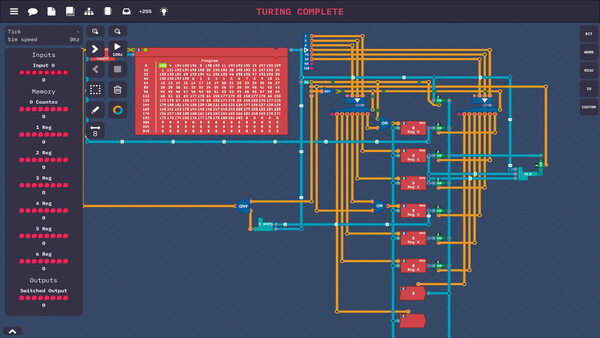 Turning a circuit into a reusable part — Steam store
Designing the Learning Curve
Almost every review talks about teaching. 'It doesn't give you answers, it asks you questions and makes you answer them.' The order in which it hands you NAND, then gates, then an adder, then a CPU is the learning curve itself — and here that curve isn't a side dish, it's the entire dish.
The moment fans single out is the mid-game reset: you throw your first computer away and build a more serious one, adding an instruction set and RAM the second time up. Turning the curve into a landing and a second climb, rather than one long slope, is a deliberate piece of teaching design.
The negative side reads that same 'no hand-holding' as a hole. 'It never says: this works, but there's a better way.' The game teaches you to build correct, not to build well — a missing rail at the top of the curve that the designer seems to have left off on purpose.
 A curriculum handed out one step at a time — Steam store
The Texture of Difficulty
Difficulty splits cleanly. The developer writes that the game is 'not artificially hard,' and a top review agrees. Others — inside otherwise positive recommendations — flag a difficulty spike and one 'space rats' level placed too early in the programming stretch.
My read: it's less about the amount of difficulty than the resolution you arrive with. Anyone can climb the logic-gate steps, but once assembly starts, people who already 'half-see' registers and stacks face a gentler slope than people meeting them for the first time.
So the split is a statement of range, not a defect. A colour-blind refund review (red, green and grey) marks a real gap that should be fixed. But most cries of 'too hard' are really about which prerequisites you walk in with — know that, and the slope becomes a virtue.
 From logic to assembly, the slope changes — Steam store
Place in the Lineage
Reviews reach for two yardsticks. One is the Zachtronics lineage — TIS-100, SpaceChem — the assembly-and-wiring puzzles I've covered in SHENZHEN I/O and Human Resource Machine. 'I played all of those; this was the itch,' one review says, placing the game at the end of that line.
The other yardstick is a textbook: 'From NAND to Tetris.' A reviewer rates the game its equal but less likely to scare off non-coders. Despite the name, it's a different bloodline from The Turing Test; this game's parent sits on the education side, not entertainment.
Inseparable from that is Early Access. The developer's 'we'll leave EA in 2025' hadn't happened by 2026, and Steam flags 'no updates in 3 years.' The dev (posting as Stuffe) says it isn't abandoned; some recent reviews still hold off because it looks abandoned. Confidence in the game and doubt about its finishing run in parallel.
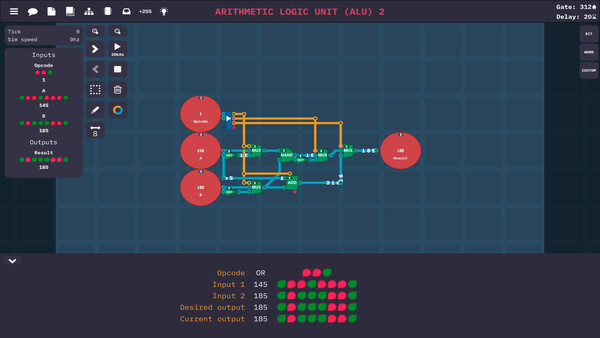 Building a machine and running your own language on it — Steam store
Sources
This piece was written by reading the Steam user reviews as they stood on 2026-07-06. No review text is quoted directly; typical claims are reconstructed.
・Steam: Turing Complete (96% of 5,202 all-language reviews positive, 'Overwhelmingly Positive'; English 94% of 2,723, 'Very Positive'; recent 30 days 93% of 66)
・Read the top 10 helpful positive reviews, the critical/refund reviews, recent reviews, and the 'Abandoned?' discussion via WebFetch
・(Reference) Metacritic user reviews (9.4), and the 'From NAND to Tetris' comparison several reviews invoke
Closing
Steam sits at 96% positive; my design score is 8.8, no great gap. The climb from one NAND gate to a full CPU is among the finest teaching designs of the last decade, and the flood of 'now I understand' reviews is the proof. The marks off are the cramped assembly, the thin feedback on building well, and the colour-blindness gap.
The review pool's verdict is clear. If logic or computers interest you at all, this is close to essential. If you want polished entertainment and generous hints for $20, it's out of range — 'wait for a sale' is the honest caveat. And the abandoned look, most reviews promise, is a false alarm once you play.
In the end the value depends on which prerequisites you bring to the foot of the slope. For anyone who wants to fill in the one step where a computer stops being magic, Turing Complete is still the cheapest, surest reveal on Steam.
Filling in the reveal with your own hands — Steam store
Where are you with this game?
Press one and the game goes on your shelf. You can see it on your account page.
Reactions (no login)
Anonymous • one of each per visitor per day
Read next
Related reviews
The Signal State
A 2D logic puzzler where you slot modules — AND, NOT, attenuators, sample-and-hold — into a rack and patch them with cables carrying voltages from -100 to 100 until the output waveform matches the spec. Reckoner Industries builds it on modular synthesis, framed as repairing the irrigation of a ruined farm.
Portal Reloaded
A free community mod built on Portal 2: alongside the familiar blue and orange spatial portals you fire a third, green time portal linking the present to the same facility twenty years on, and solve twenty-five test chambers by moving between them. Released in 2021 by the solo developer PORTANIS, with twenty cooperative puzzles added in 2023.
Myst
A first-person puzzle adventure: you arrive on an unknown island and move between an abandoned library and four Ages, piecing together a story of family betrayal from machines and journals alone. Cyan Worlds' own Unreal Engine rebuild of their 1993 original, walkable flat or in VR, with optional puzzle randomization.


