REVIEW · 2020-04-23
Filament
A single line that must never cross itself
Introduction
An alternate-reality 1983. Humanity left Earth long ago, and some are born and raised never having seen it. Pluto, a salvager, boards the research vessel Alabaster, abandoned in orbit around the planetoid Arnold-475M. Six crew — known by color codenames: Vermillion, Juniper, Pistachio, Marmalade, Canary, Aubergine — but only the pilot Juniper, trapped in the cockpit, is alive to answer (voiced by Abigail Turner). To free her you must deactivate the "anchors" standing around the ship, one by one — that is, solve the puzzles inside them. Made by the UK's Beard Envy and published by Kasedo Games in 2020.
I write this from the Steam review pool: 618 reviews from Steam purchasers at 86% positive, rated "Very Positive"; across all 755 reviews, 642 positive and 113 negative (snapshot 2026-06-13). The critics sit at Metacritic 82, so the temperature gap between users and press is unusually small. This is a game with a narrow band of opinion.
And what divides that band is neither story nor price. It is one thing: difficulty. Not its quantity but its texture — the same single stuck puzzle is written up by one reviewer as the finest insight and by another as pure luck. There is also a fact: the developers added a hint system after launch. It is a rare case where the makers' own reassessment of the difficulty is preserved in the patch notes. That is the line I want to read along.
 Filament — Steam screenshot
First Impressions
Line up the top helpful positives and the openings rhyme: "It's tough. I hate it. I love it." Reviewers half-brag about being stuck. The forum stock phrases are "brain-busting" and "fiendishly difficult" — and the recommend box is ticked anyway. The recurring praise vocabulary: beautiful, relaxing, Zen, a wonderful soundtrack, addictive, and "one mechanic done exhaustively well."
The other pattern is comparison. The most frequent proper nouns in the pool and forums converge on two: The Talos Principle and The Witness. "Haven't struggled this much since the Talos DLC"; "it's like that feeling halfway through The Witness when you sense you might not make it." Players declare their own experience by measuring its distance from those two.
The negatives and the hedged positives reach not for "easy" but for its opposite: "solving it feels like luck, not insight," "I'm going to burn out," "the final gauntlet," and "the ending is too vague." Recent reviews have not shifted the axes; the contested points were fixed at launch. The one element that did move is the temperature around the after-the-fact hint system.
 Filament — Steam screenshot
Putting the Mechanics into Words
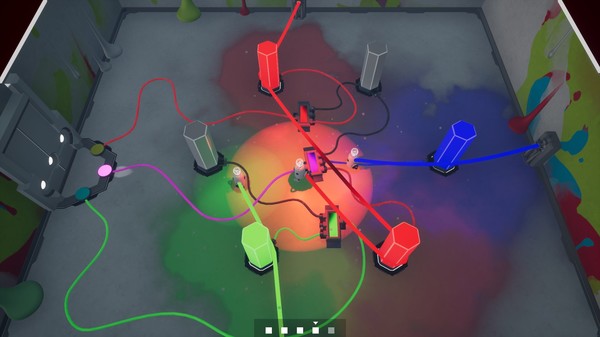
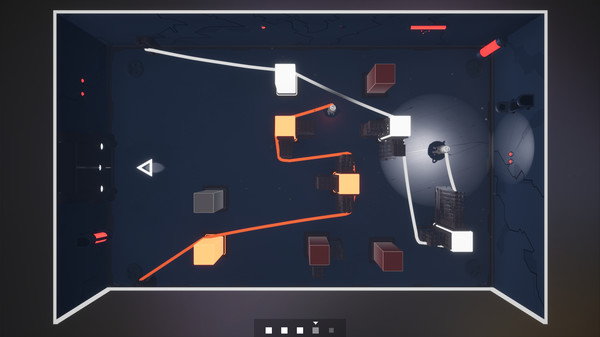
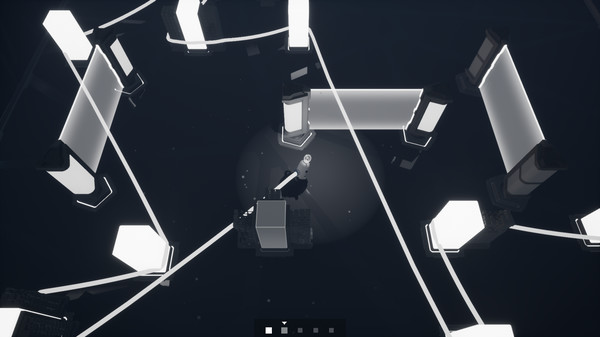
Cross-referencing the reviews and the press, the verb narrows to one. From a top-down view you steer a little robot that trails a cable behind it. You light the pillars in a room by looping around them. The crux: the cable you have laid can never cross itself. The entire route, exit included, must be drawn as one unbroken, non-intersecting line. So the verb is a single one — "draw a line" — and the grammar is "the line may not step over the line already drawn." This is, in plain terms, a self-avoiding walk dressed up as a cable.
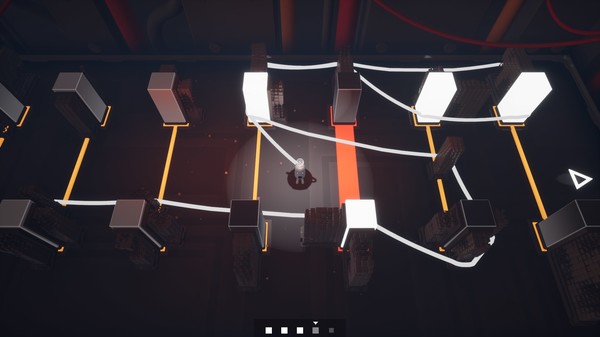
Onto that single line, only variations are stacked: pillars that behave like a color-mixing palette, pillars of different heights, pillars lit in a set order or in groups, lasers strung between them, floor switches, pillars that can only be looped from one direction, untouchable anti-pillars, and multiple robots each trailing its own cable. Over 300 rooms, all built on that one move. In this site's vocabulary, this is extreme subtraction: no inventory, no timer (in most rooms), no second verb. The positive chorus — "one mechanic, exhaustively" — is praise for subtraction itself.
But the weak point lives here too. Single-solution rooms times a wide board produce combinatorial explosion. When the chain of deduction grows long, the solution space outruns the player's ability to look ahead, and "solving" slides into trial and error. That is the structural root of "it feels like luck, not insight." The Turing Test, which I read recently, suffered from too few decoys; Filament is the opposite — a pure space with a single answer and, in places, signposting trimmed too thin. The moment subtraction cuts away what it shouldn't (the clues that support deduction), difficulty changes texture.
 Filament — Steam screenshot
The Texture of Difficulty
Tallied up, "hard" wins: clearly above Talos, the final engine-room gauntlet comes to break you. Two reliefs. The after-the-fact hint system (twice per room, pointing to the next move or an existing mistake), and the open structure that lets you roam most rooms in any order and flee a wall for another room. On the forums the stock advice is practically fixed: "leave the one you're stuck on, solve others, come back and the move appears."
Read side by side, though, "difficulty" is not one thing. First, deductive difficulty — following a long chain of inference, the good kind, and where most positives locate their pleasure. Second, the border between luck and insight — a board wide enough that you stumble onto the single answer, and where the hollow "I solved it but it felt like luck" collects. Third, the endgame gauntlet — one-off brutes far off the curve, where talk of dropping out rises. The positives mostly land on the first; the disappointed land on the second and third. What is divided is less the tuning than which difficulty a given player happened to meet.
The best reading key, again, is the hint system. A studio ships a hard puzzle game and then adds hints — that is an open reweighting of the objective function, from "purity of challenge" toward "completion rate, i.e. retention into the story." It points the same way as the open structure. The opposite pole is Stephen's Sausage Roll, which puts a no-hand-holding, no-escape difficulty at the core of its design. Filament wants you to reach the end; Sausage Roll does not care. Same sign on the difficulty, opposite design intent.
 Filament — Steam screenshot
The Feel of the Story
For a puzzle game, this review pool mentions the story a lot. Six crew, color codenames, back-and-forth emails and logs, and Juniper, the one voice. It is not rare for a positive to name Abigail Turner's performance and the lonely, lovely space-pop soundtrack as the real engine. Reviewers recount growing attached to five people they never meet, just by reading a ship that still shows signs of life — a floaty bobbing in the pool, a guitar in the corner of the library.
At the same time, both negatives and hedged positives name one friction: "when you get stuck on a puzzle, it feels like the story is taken away from you," as one put it. The story only arrives past the puzzles, so a wall in the puzzle is a wall in the story. And "the ending is too vague to pay off the emotion you've banked" recurs. This is the structural tension built into any narrative gated by puzzles; Filament's open structure softens it but does not dissolve it. The review pool points precisely at that seam in the design.
 Filament — Steam screenshot
Reviews Consulted
This article was written from the user reviews and community discussions on the Steam store page and community hub as of 2026-06-13. No review text is quoted; typical claims are reconstructed.
・Steam: Filament (Very Positive. 618 reviews from Steam purchasers at 86% positive; across all 755 reviews, 642 positive and 113 negative. Snapshot 2026-06-13.)
・Read the community discussions about difficulty — voices on both sides, including reactions to the hint system and the open structure. Clear time follows a professional reviewer who reports roughly forty hours for thorough completion.
・For professional press, consulted the Adventure Gamers review (verdict "Excellent," naming the endgame difficulty spike and the vague ending as flaws) and Metacritic (PC 82). Story and mechanical details follow that review and the store description.
Closing
Against Steam's overall 86%, I score it 8.0 as design criticism. The subtraction craft is first-rate: from a single grammar — "draw a line, the line cannot cross" — they draw 300 honest variations and bind them into one beautiful, warm whole. That is a feat beyond an ordinary studio. What keeps it under 8.5 or 9 is two things: the moments where deduction slides into luck, and an endgame gauntlet far off the curve. That is the whole structural reason the pool splits into "insight" and "luck."
What the reviews describe is not a defective product but a good one with a clear reach. For those who love the act of deductive walking and have the nerve to clear one more wall, it reads as an underrated tour de force. For those worn down by long trial and error, or who want a tight ending, the gauntlet stops their feet. The after-the-fact hint system is the trace of the makers widening that reach by a little, themselves. The pool's consensus — hard but worth it, the endgame aside — is accurate, and about as complete a prescription as you could want for whether to pick it up.
 Filament — Steam screenshot
Where are you with this game?
Press one and the game goes on your shelf. You can see it on your account page.
Reactions (no login)
Anonymous • one of each per visitor per day
Read next
Related reviews
Kine
Roll and rotate three musical machines — Quat the drum, Roo the accordion, Euler the trombone — through 120-plus 3D puzzles across a theatrical city, reading how each body tumbles like a weighted die. A spatial puzzle from Chump Squad (Gwen Frey).
Understand
A mouse-only minimalist puzzle where each level hides a ruleset: you draw a single line, read which rules it satisfied, and deduce the hidden rules themselves. Almost no instructions, you advance on hypothesis and refutation alone. By Artless Games, 2020.
Murder by Numbers
A 2D visual-novel-meets-picross set in 1996 Los Angeles, where out-of-work actress Honor and a discarded robot named SCOUT solve nonogram puzzles to uncover clues and chase a murder case. Published by The Irregular Corporation, with music by Ace Attorney composer Masakazu Sugimori and character art by Hatoful Boyfriend's Hato Moa.


