TAG
#hint-design
0 reviews · 4 essays
Related essays
Liquin: Told the answer would cost them, people wanted it just as much — Fukai Reads
A paper by Emily G. Liquin on curiosity and effort. Across three preregistered experiments with 419 participants, telling people how much effort an answer would cost reliably reduced whether they went after it, yet barely moved how curious they said they felt.
Li et al.: the AI that showed up uninvited was closed by five players out of ten — Fukai Reads
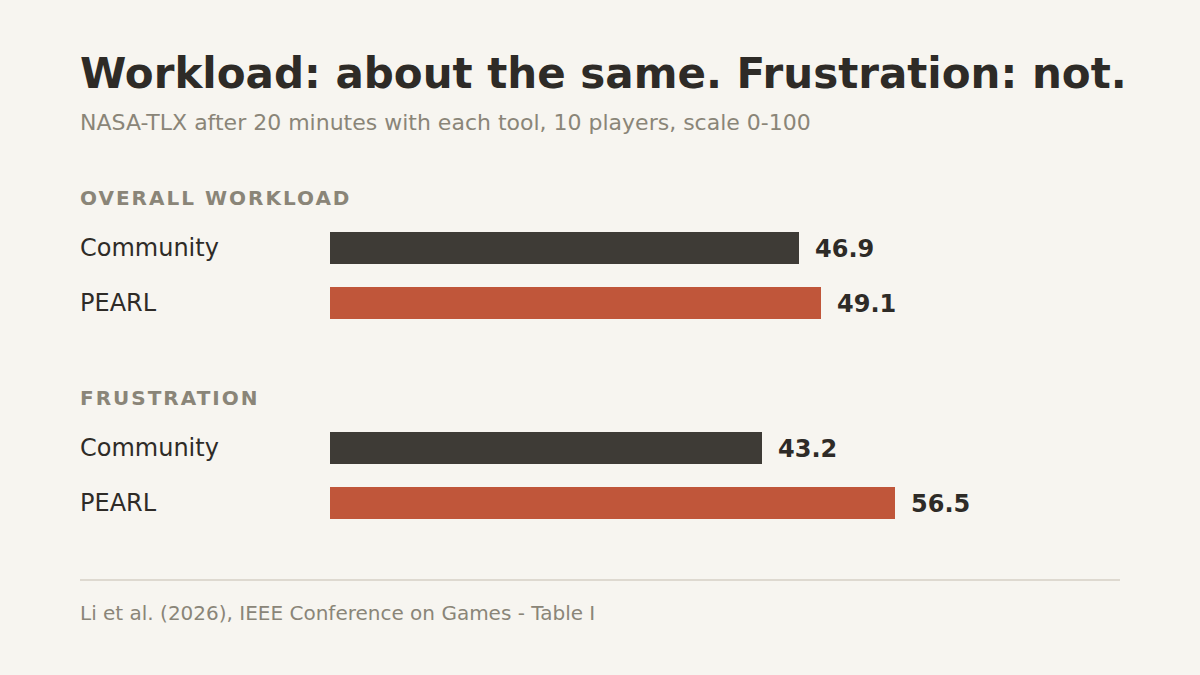
A peer-reviewed paper by Jiahong Li and eight co-authors (accepted to the 2026 IEEE Conference on Games, arXiv:2609.13718). They built PEARL, an AI support agent that retrieves expert-annotated move explanations and structurally similar peer boards, into Parallel, a puzzle game for learning parallel programming, and evaluated it with ten players. Participants rated the existing visualization tool more useful, and at least five minimized or abandoned the AI during play. Frustration scored 43.2 against 56.5. The authors conclude that what players rejected was not the content of the help but its unsolicited delivery, and ask of their own system: are we building Clippy?
Teo et al.: AI Assistants Overassist — Int-Bench Measures Intervention in Problem-Solving — Fukai Reads
Teo et al. on LLM intervention behavior. Using Int-Bench, a simulated setting, they measure when and how much AI assistants help during problem-solving, finding AI intervenes earlier and more often than humans, tends to leak the answer, and does not improve transfer. A useful read for puzzle hint design.
Liu et al.: AI Assistance Erodes Persistence — A Warning for Hint Design — Fukai Reads
A paper by Grace Liu and colleagues on how AI assistance affects independent problem-solving and persistence. Across RCTs with 1,222 participants, AI raised in-session performance but, once removed, left people solving less and giving up more. Those who got direct answers declined most while hint-users did not, a result that speaks directly to game hint design.