TAG
#player-modeling
0 reviews · 11 essays
Related essays
Guo et al.: humans drifted off the greedy move within about ten games; self-evolving AI did not — Fukai Reads
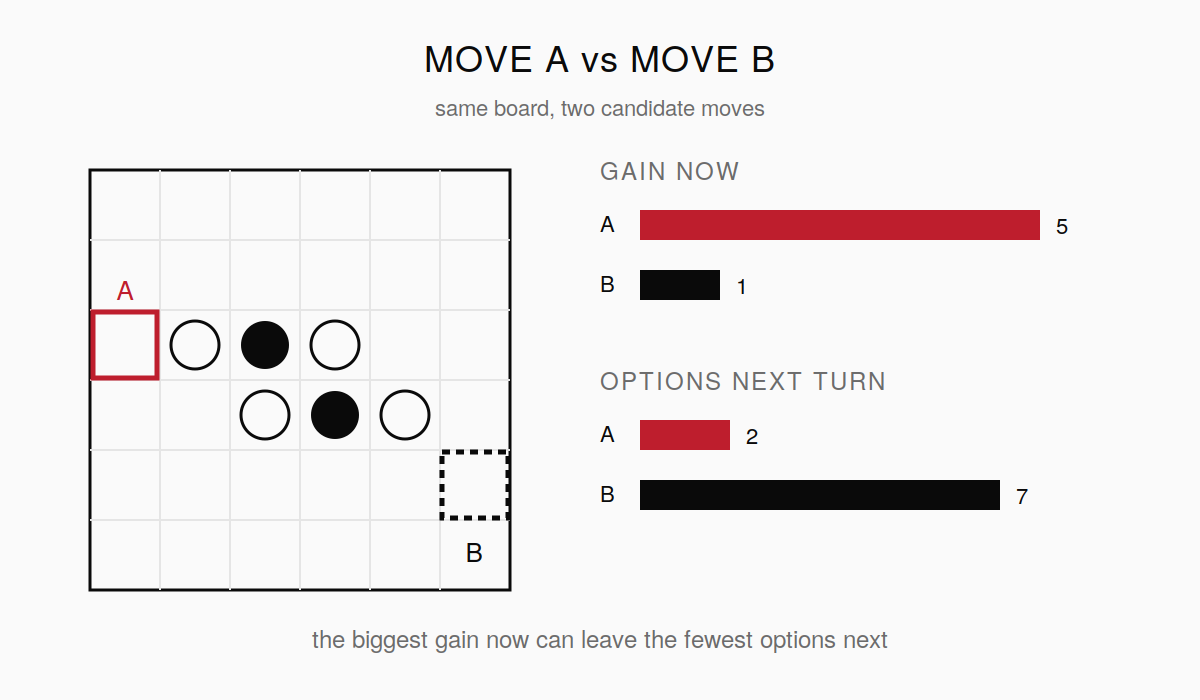
A preprint by Yingying Guo and four co-authors (arXiv:2608.07490, not peer-reviewed). They propose a way to measure how repeated play changes the way humans and language agents choose moves. Thirty-two students played 709 games across three board games, and four self-evolving language agents were run through the same metric space. Humans mostly shifted from the locally greedy move toward more global play: on the game-specific behavioral metrics, 11 of 12, 10 of 11 and 8 of 9 participants improved. The agents' gains were short-lived. The authors write that the central limitation is not the absence of reflection but the failure to convert reflection into reusable changes in behavior.
Melo Legarda et al.: Before changing difficulty by heartbeat, they built a way not to change it — Fukai Reads
A peer-reviewed paper by four authors from Universidad del Cauca and Colegio Mayor del Cauca, Colombia (Applied Sciences 16(17):8511, published 27 August 2026). They built a mechanism that adjusts game difficulty from a chest-strap heart sensor and logged eight sessions totalling 6 hours 48 minutes. Mean end-to-end latency was 2.06 s. The striking number: against 191 committed state transitions there were 83 flips the automaton withheld — nearly a third of the change-or-hold decisions land on “do not change”. No subjective data was collected, and the authors never claim the game became more enjoyable.
Tudor et al.: The scoreboard was one query away, and the agent never opened it — Fukai Reads
An arXiv preprint (submitted 2 September 2026) by seven authors from Oxford and elsewhere. They wired 76 tool endpoints into Sid Meier's Civilization VI and had language-model agents play whole games of 300+ turns. Agents queried victory progress only once every 30-75 turns (the supplied playbook recommended every 20), and in 7 of 20 losses that were foreseeable they never checked it in the final 20 turns. Commitments the agents wrote down for themselves were carried out within ten turns only 48.2%-65.8% of the time.
Elshamy et al.: Read the player's skill, then redraw the level itself — Fukai Reads
A Scientific Reports paper from Elshamy and colleagues at E-JUST on inferring player skill and rewriting the terrain of the level itself. Where conventional dynamic difficulty adjustment tunes enemy health and item drops, this pipeline rearranges floors, gaps and enemies in place. Skill classification reached 97.82% accuracy; 74.1% of rewritten levels remained completable.
Collins et al.: People judge a brand-new game with one move of lookahead and six imagined playouts — Fukai Reads
A peer-reviewed Nature paper by Katherine M. Collins and colleagues (MIT and others). More than 1,000 people were shown 121 novel games from the tic-tac-toe family and asked, before playing, whether each looked fair and fun. The Intuitive Gamer model - one move of lookahead spent inside six simulated playouts - explained the fairness judgements at R2 = 0.81 against a human ceiling of 0.82, beating the deep-searching Expert Gamer (0.65) and MCTS (0.60).
Tarun Kumar S: What Happens When You Tell a Human-Move Predictor the Last 20 Moves and the Clock — Fukai Reads
A paper by Tarun Kumar S of Peargent Labs on Otter, a chess AI that predicts human moves. Where earlier models treated each position independently, Otter conditions on the last 20 moves and on remaining clock time, reaching 55.23% top-1 accuracy with 15.3M parameters — 1.98 points above Maia 2. Of the +7.62 point gain over a board-only baseline, history contributes +5.24 and the clock +2.38. An arXiv preprint posted 5 August 2026, not yet peer reviewed.
Gould & Ward et al.: Measuring Puzzle Difficulty in Units of Human Solve Time — Fukai Reads
An AI evaluation paper by Gould, Ward and colleagues. They attached human solve times to 43 benchmarks and over 30,000 problems, and found that the human time of tasks a model completes at 50% success without externalising its reasoning has doubled roughly every 373 days over six years, reaching about three minutes for GPT-5.5. Their difficulty-measurement craft, built partly on Sudoku and crosswords, transfers directly to puzzle design.
Wang et al.: An LLM Agent That Reads Mental Busyness From Gaze — Fukai Reads
A paper from Meta Reality Labs and collaborators that estimates cognitive load (mental busyness) from eye gaze. It tackles the poor generalization and low interpretability of prior methods with GazeMind, a framework that structures gaze and has an LLM reason over it with context, individual traits, and worked examples, reporting 62.73% accuracy on three-way classification (over 20 points above prior methods).
Özkan: Co-Training the Level-Generating AI and the Level-Solving AI — Fukai Reads
A paper by Miraç Buğra Özkan that trains level generation and level solving together via reinforcement learning. In Unity, a hummingbird (solver) and a floating island (generator) learn while watching each other's results, reaching about 90.2% success across 100 unseen layouts.
Feng et al.: Can LLM Agents Bargain Well in a Trading Game? — Fukai Reads
A Tsinghua University team's benchmark, SidConArena, for evaluating LLM agents in a cooperative-yet-competitive trading game. Built on the board game Sidereal Confluence, it scores agents across negotiation, production, and sealed-bid auction phases, finding that frontier models are stronger but still misprice resources, bargain passively, and plan poorly over long horizons.
McConnell & Zhao: Generating Just-Right Puzzles in Real Time with a Genetic Algorithm — Fukai Reads
A paper by McConnell and Zhao on adaptive puzzle generation using a genetic algorithm. It generates Cosmic Express-style path puzzles in real time (about 7 seconds each) to match a player model built from how the player solves, and shows in an 18-person study that a time-only version lags on felt difficulty and sense of progression.