TAG
#problem-solving
0 reviews · 7 essays
Related essays
Dygert & Jarosz: People who repair a misread sentence also solve insight puzzles — Fukai Reads
A paper by Sarah K. C. Dygert and Andrew F. Jarosz on insight and sentence comprehension. Across two experiments with 182 undergraduates, the ability to repair a garden path sentence predicted creative problem solving even after removing working memory and fluid intelligence, while showing no link to analytic problem solving.
Zhao et al.: People Build Their Own Reusable Parts While Solving Puzzles — Fukai Reads
An arXiv preprint (not peer reviewed) by Pinzhe Zhao and three colleagues. Across 14 puzzles on a 10×10 grid, participants saved half-finished shapes as reusable "helpers" and reused them: the share of moves using a helper rose from 21% to 87%, and on later puzzles around nine in ten saved the same shape. Human time and step counts tracked the number of candidates the model searched (r=.82), not the length of the shortest program (r=-.20). Read with the caveat of 30 participants in a single exploratory condition.
Ahn et al.: Puzzle Difficulty Lives in Concepts, Not Looks — Fukai Reads
A paper (arXiv preprint) by Ahn et al. at Boston University introducing CogARC, a human-adapted version of the ARC abstract-reasoning benchmark. Logging 260 people's grid-puzzle solutions edit by edit, they find difficulty is driven by conceptual rule complexity rather than grid size or color count, and that people converge on the same wrong answers even when they fail.
Luo et al.: How AI Delivers Help Matters as Much as the Help Itself — Fukai Reads
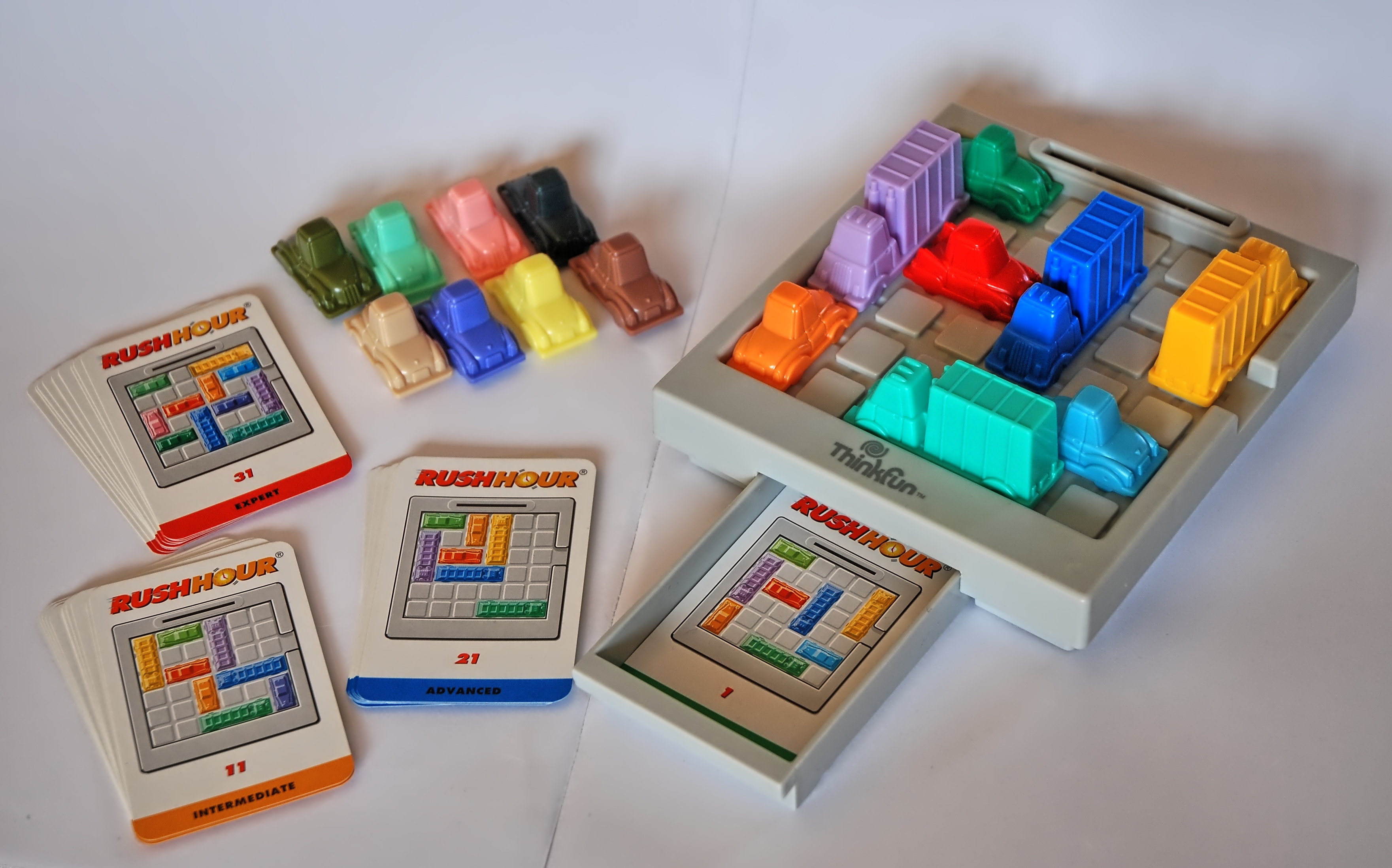
A paper by Luo et al. (UC Santa Barbara) on how a mixed-initiative AI delivers help. Using Rush Hour puzzles, they compare on-demand (Button) help with inactivity-triggered (Timer) help, and show that although task performance is nearly identical, the Timer mode earns more positive perceptions of the AI. Accepted to IUI '26.
Nasvytis & Fan: Insight and Transfer Show Up in How You Talk — Fukai Reads
A paper by Nasvytis and Fan (Stanford) that reads insight and transfer from think-aloud speech. With 189 participants solving five matchstick-arithmetic puzzles, the group that saw the same type repeated grew faster and more accurate after their first success (accuracy 0.75 by trial 5) and named the problem type roughly seven times as often. The mark of transfer, it reads, is being able to put the knack into words.
Li et al.: Making Geometry Problem Solving Verifiable with a Solver as Referee — Fukai Reads
An arXiv preprint by Can Li et al. on geometry problem solving (GPS). Their SD-GPS translates diagram-and-text problems into a form a symbolic solver can execute, and at impasses proposes helper lemmas verified by the solver itself. The abstract reports it consistently outperforms existing methods on Geometry3K and PGPS9K. Fukai reads it for its use in solvability-guaranteed puzzle generation.
Chao et al.: Insight Is About Searching Far — Fukai Reads
A paper on insightful problem-solving by Chao, Hsieh & Wu. Using a Japanese RAT and a simulation to quantify the search path to a solution, it shows that de-fixation is necessary for solving but is not what determines insight; the hallmark of insight is exploring the solution space over greater distances.