BLOG · 2026-08-29
Money Idol Exchanger (1997) — five 1-yen coins make a 5, and that is the whole tutorial
Today Is Release Day #42 — August 29, 1997, Game Boy
August 29, 1997: a puzzle game whose rules are just how change works
Hello, this is Toki. Episode 42 of “Today Is Release Day.” Today’s game has a rulebook one line long.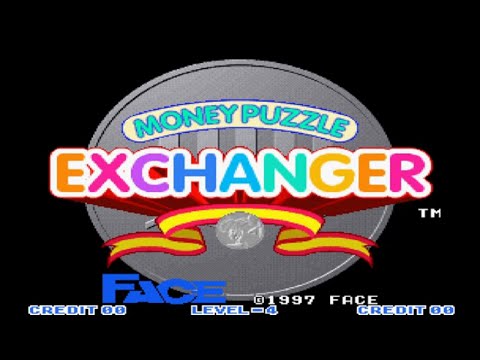 From the thumbnail of “Money Puzzle Exchanger - Neo Geo - Gameplay” (PC do Paulo, YouTube)
Money Idol Exchanger. It was published by Athena for the Game Boy in Japan on August 29, 1997.
Here is how you play. Put five 1-yen coins together and they become a 5-yen coin. Put two 5-yen coins together and they become a 10. That is it.
It started in the arcade. Face put it on the Neo Geo in January 1997, and SNK’s official page introduces it as the studio’s first Neo Geo title (as of 2026-08).
How do you actually play it?
Japanese coins appear on the board: 1, 5, 10, 50, 100 and 500 yen. When identical coins sit next to each other vertically or horizontally, they exchange into the next denomination up.
How many you need depends on the coin. Five or more for 1, 10 and 100 yen; two or more for 5, 50 and 500. The structure of Japanese money is the rule set.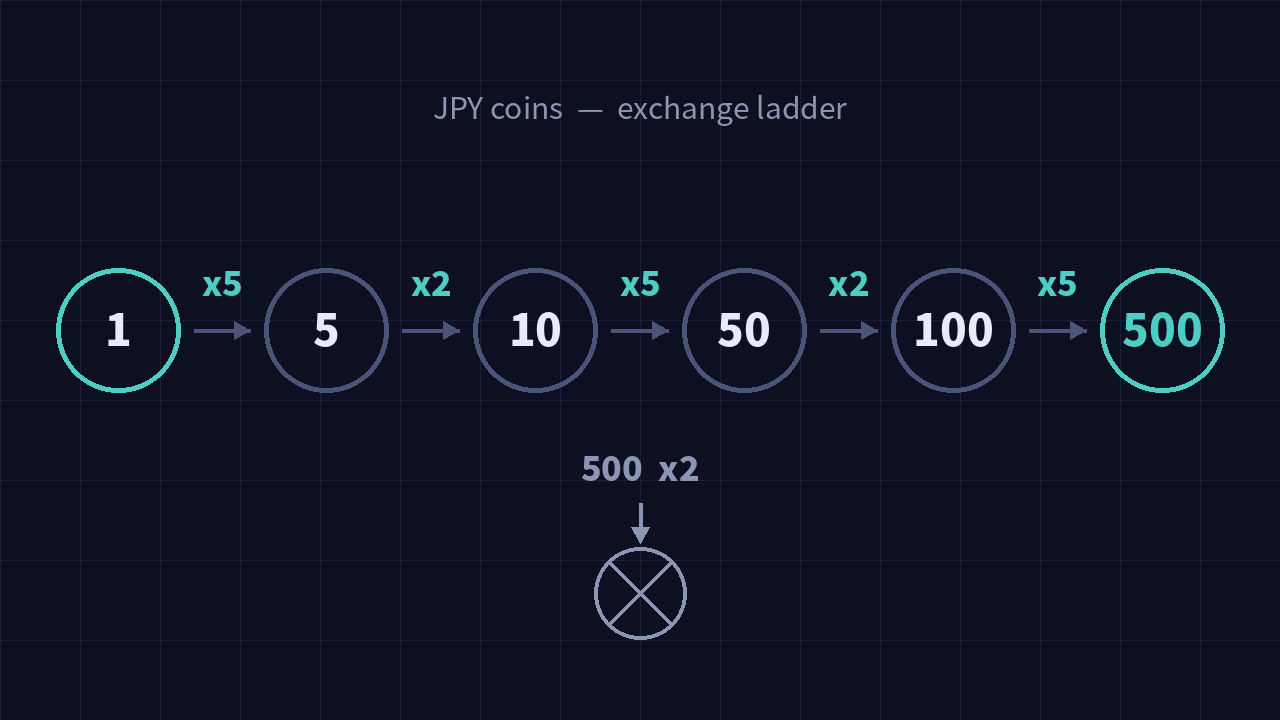 (Diagram) The structure of Japanese coinage is the exchange ladder itself — made by Puzzlebyrinth
The ceiling is the 500-yen coin. Two of those have nowhere left to go, so they vanish. That is this game’s version of clearing.
There are two buttons: pick up a coin, and throw it. The board is seven columns by twelve rows, and coins push in one row at a time. Fill it up and you lose.
Needing no explanation was the game’s sharpest weapon. Anyone living in Japan, child included, already knows how making change works. The time cost of learning the rules is close to zero.
How was it received at the time?
Japanese scores at the time were middling. Famitsu gave the Game Boy version 22 out of 40, and the PlayStation version released on November 5, 1998, 26 out of 40.
A Family Computer Magazine reader poll returned 19.4 out of 30. That is short of enthusiasm.
The reason probably lies in how chains work. The Japanese wiki Game Catalogue lists “accidental chains happen easily” as the game’s strength, while noting as a flaw that you cannot read where an exchanged coin will appear, which makes deliberate chains hard to build.
So the big chains do happen — you just cannot quite claim you built them. For players who wanted the pleasure of reading a board to the end, that was thin.
Chains in this puzzle game are not something you construct; they are something that happens to you. In exchange for a doorway made extremely wide by having almost nothing to learn, it gave expert players no foothold for planning.
Abroad, it is discussed as part of a lineage. MeriStation’s Rubén Martínez presented it as reminiscent of [Puzzle Bobble](/articles/puzzle-bobble-1994) and Magical Drop, praising its versus mode, anime-style art, soundtrack and addictive feel, while criticising the absence of items.
AllGame’s Kyle Knight likewise praised the presentation and the sheer stickiness of it, adding that the learning curve requires patience and practice.
Where can you play it today, 29 years on?
You can still just buy it. On June 28, 2018 it appeared as an ACA NEOGEO release for PlayStation 4, Nintendo Switch and Xbox One; the Windows 10 version followed on April 6, 2019 (as of 2026-08).
Which means that twenty-one years after the Game Boy version, it was the arcade version that came back into circulation. From the thumbnail of “[ACA NEOGEO Money Puzzle Exchanger] Gameplay 1” (NintenDaan, YouTube)
The port history, for the record: Game Boy on August 29, 1997, Windows 95 on March 20, 1998, PlayStation on November 5, 1998. The Neo Geo original went out in January 1997.
A word about the people who made it. According to the English Wikipedia, most of the development team were former Technōs Japan staff — the fighting-and-brawling studio known for Double Dragon. That is a long way from a game about making change.
Which puzzle game did you start playing without reading the manual?
August 29, 1997. Let me write the year down. Today, August 29, 2026, makes it exactly 29 years. Twenty-nine years on the twenty-ninth is almost too neat.
This game’s strength fits in one line. “Five 1-yen coins make a 5-yen coin.” That alone is enough to play.
Its weakness sat in exactly the same place. Having little to learn also meant having little to read ahead with.
Which puzzle game were you able to start playing without reading the manual?
Reactions (no login)
Anonymous • one of each per visitor per day
Comments (no login)
No comments yet. Be the first to say something.