BLOG · 2026-08-31
Bomber Boy (1990) — a port and a new game on one cartridge, and no agreement on which was the main one
Today Is Release Day #43 — August 31, 1990, Game Boy
August 31, 1990: a Game Boy cartridge holding both a port and a new game
Hello, this is Toki. Episode 43 of “Today Is Release Day.” Today’s game is one cartridge with two games inside it. From the thumbnail of “Atomic Punk (Game Boy) Playthrough - NintendoComplete” (NintendoComplete, YouTube)
Bomber Boy. Hudson Soft published it for the Game Boy in Japan on August 31, 1990, priced at 3,500 yen.
There are two things in there. A “Bomberman” mode holding the whole NES Bomberman, and a “Bomber Boy” mode built for this cartridge.
And here is the interesting part. Which of the two counted as the main game swapped places between Japan and Europe.
What was new about the Bomber Boy mode?
Bomber Boy is a bomb-laying action puzzle game that Hudson Soft released for the Game Boy in 1990. Blow up blocks, clear out the enemies, head for the exit. So far, this is Bomberman.
The difference comes after that. Clearing a round pays you in GP. The amount depends on how long you took and how many blocks you destroyed.
You carry that GP to a shop and buy upgrades called panels. Round panels keep working until you die. Square panels are spent after a single round.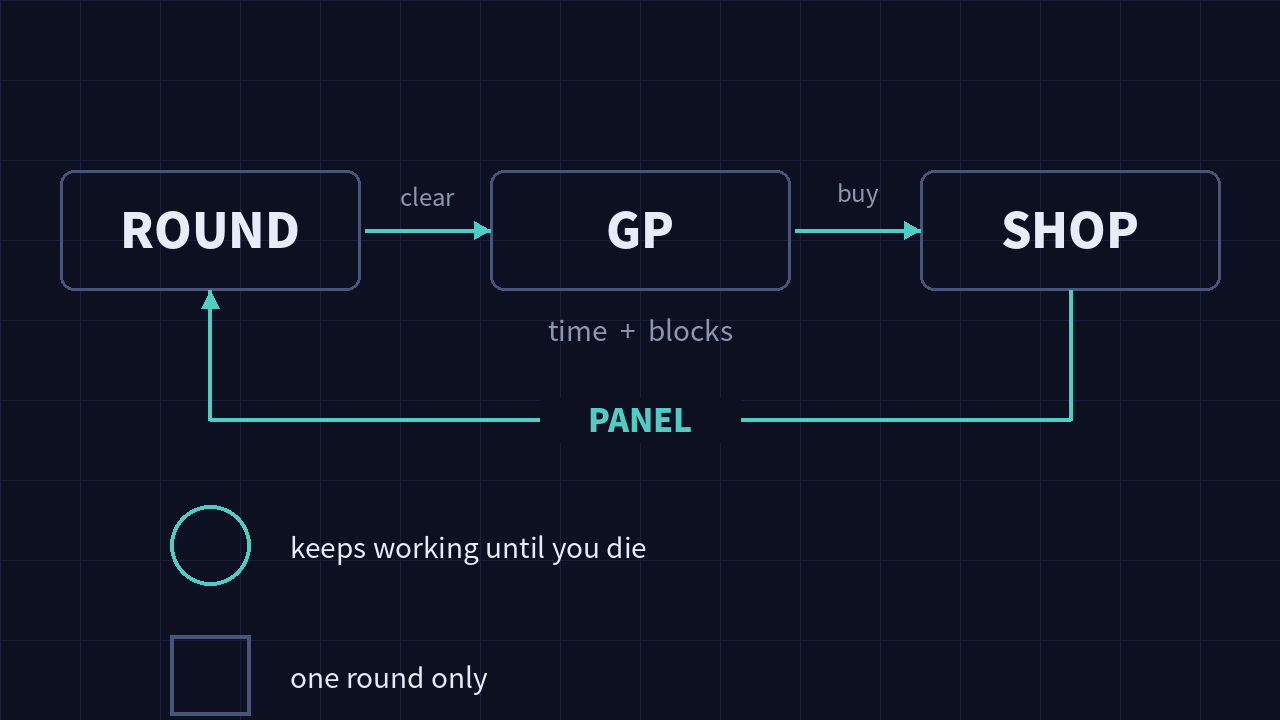 (Diagram) Made by Puzzlebyrinth. The loop of GP, shop and panels
Progression changed too. You do not play level one, then level two. Locations sit on a map and you pick your own order. Only the last one waits until the rest are done.
It is a design built for a handheld. Write down the password and you kept your cleared locations and the money in your pocket.
How was this cartridge received at the time?
It did well enough. Britain’s Mean Machines gave it a score of 81.
The interesting part is what those 81 points were praising. The magazine presented the game as a “highly addictive” port of Bomberman and welcomed the added password system. In Europe, in other words, the port was the main event. From the thumbnail of “工場に捕らわれた仲間達を救い出せ!GB『ボンバーボーイ』をプレイ♪” (Almeida channel, YouTube)
The Japanese assessment written up years later faces the other way. The wiki Game Catalogue lists among its strengths that “the shop and equippable items give it a customisation of its own,” and that stage select suits a handheld.
About the NES game, it says this: including the whole NES Bomberman was “quite a bargain for the time.” That is praise, but it files the port as the bonus.
So the main feature and the bonus on one cartridge changed places depending on where you were reading.
The weaknesses are on record too. The same wiki notes that the password does not save your items or your round-by-round progress, and that the game is “harder than you would expect.”
The strength you bought in the shop did not survive the power switch. A design built around shopping and a design built around passwords did not line up here.
Thirty-six years on, what is this cartridge called?
It has three names. Bomber Boy in Japan, Atomic Punk in North America, Dynablaster in Europe. The software is the same (as of 2026-08).
The North American version arrived on May 5, 1991, from Hudson Soft. The European version arrived in 1991, from Nintendo. Even the publisher differs.
When retro coverage names it today, it is usually introduced as “Bomberman under another name.” The shop and the panels rarely make it into the sentence.
The video below is an episode of Jeremy Parish | Video Works, which walks through the Game Boy library one title at a time. Its subtitle is “A Bomberman by any other name.” Starting from the names really does seem to be this cartridge’s fate.
Was there a game where you only ever played the bonus?
August 31, 1990. Let me write the year down. Today, August 31, 2026, makes it exactly 36 years.
What makes this cartridge interesting is the price tag. For 3,500 yen you got both a port and a new game.
And which of the two you thought you were buying probably differed from person to person — and all the more between a reader in Europe and a reader in Japan.
Was there a game where you only ever played the bonus?
Reactions (no login)
Anonymous • one of each per visitor per day
Comments (no login)
No comments yet. Be the first to say something.