DESIGNER-STUDY · 2026-08-31
Inside Daniel Benmergui's Philosophy — Making Soft Material Have a Right Answer
Storyteller / Today I Die / Dragonsweeper
Introduction — A puzzle that took fifteen years
One person spent fifteen years finishing a single puzzle game. He is Daniel Benmergui, from Argentina, and the game is Storyteller. You drop characters and props into comic-book panels until the panels produce the plot you were asked for. That is the whole game.
What interests me is what he said about himself across those fifteen years. At one point he recalls that "they were calling me a 'genius designer.'" At another, he says he told himself: "This version of the game is shit, I am shit, I am a fraud" (Buenos Aires Herald, 2023 ↗).
This is not a review. I read across his interviews and talks to find what he fixates on, where he stumbled, and how he carried it. Every quote here comes from a source I opened myself.
Background — The man who stepped down from managing 120 people
Benmergui is from Buenos Aires. He used to be a development director at Gameloft, a large studio, overseeing more than 120 developers. He left that job and started making small games on his own.
Between 2008 and 2009 he released a run of short experiments, including I Wish I Were the Moon (2008) and Today I Die (2009). Today I Die was a Nuovo Award finalist at IGF 2010.
Storyteller was born in that same period and won the IGF Nuovo Award in 2012. Yet the finished game shipped on 23 March 2023, published by Annapurna Interactive — eleven years after the award.
"It's been going on for almost 15 years, so it's been a while," he said just before release (Game Rant, 2023 ↗).
Philosophy — Don't make them read the story, make them build it
His core claim has not moved since the start. "I want Storyteller to be about playing with stories" (Game Developer, 2012 ↗). Not reading a story — assembling one.
To do that he turned the machinery of novels and films into parts: amnesia, sudden revelations, a character's initiative, a convenient rescue. In his GDC Next talk in 2013 he described the question he asks when building a level: "What plot device would make this level possible or more interesting?"
In that same talk he said some rather large things. "New mechanics always fit like missing pieces." "Storyteller proves that there's a vast territory of unexplored game ideas out there." "We can still redefine what 'video game' means" (GDC Next 2013 ↗).
He also keeps returning to the idea of not instructing the player. "We made a game carefully designed for people that don't play games. But we don't tell the player what to do — it doesn't have a tutorial" (Buenos Aires Herald, 2023).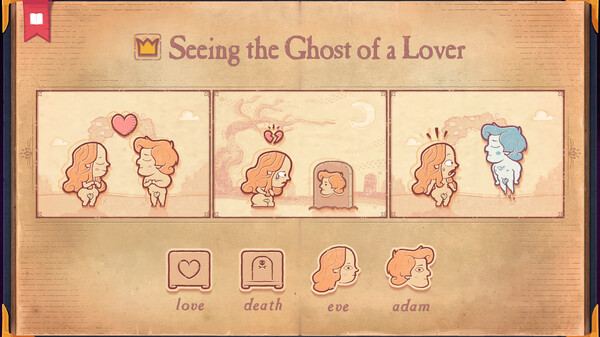 Storyteller (2023), from the official screenshots on its Steam store page
Obsessions — If a rule feels arbitrary, he has lost
Across the years he keeps coming back to how a rule feels. Already in 2012: "Each rule I add into the game must make sense with every other rule and also not feel arbitrary" (Game Developer, 2012).
Eleven years later, at launch, he said nearly the same thing in different words: "The hardest part of Storyteller is making something that feels that it works and it makes sense for most people playing the game" (Game Rant, 2023).
Why is that hard? Because the material is not rigid, by his own account. "The cool thing about Storyteller is that it's playing with soft elements, human elements, like how we interpret a comic strip" (ibid.).
So he chose not to narrow each level to one answer. "There is a simulator running the stories on each level. All that it does is check whether you fulfilled the goal. Some people will find solutions we didn't think of" (TheGamer, 2023 ↗).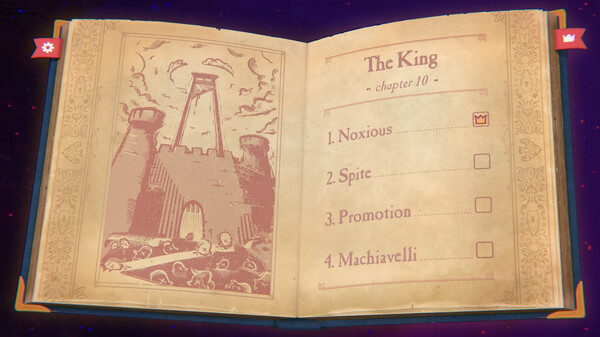 Storyteller (2023), from the official screenshots on its Steam store page
Failure, and how he carried it — "I am a fraud"
Early success became a weight. "I had an ego the size of Jupiter. They were calling me a 'genius designer.' You can imagine how that ended" (Buenos Aires Herald, 2023).
As development dragged on, he says he told himself: "This version of the game is shit, I am shit, I am a fraud." He explains why. "I was very insecure, as I hadn't had time to develop my game designer muscle. And I was making a game unlike any other. When I encountered a problem, I didn't have any references" (ibid.).
He even puts a proportion on what he threw away. "A lot of those 15 years was me taking detours to learn other things. There is a lot of work — I would say half of it — that I had to throw away because I replaced it with something else" (ibid.).
He names two ways through. The first is putting time between passes. "Some projects that are trying to do something very new, sometimes need clock time in order for you to figure it out." "Every time I went back to the game, some big problem had suddenly become so obvious after a fix" (Game Rant, 2023).
The second was accepting a limit. "When I was making the game, I didn't accept my limits. One of my limits is that I can't work by myself. I was made for working with people" (Buenos Aires Herald, 2023). Tellingly, when he talks about the finished Storyteller he almost always says "we."
Dilemmas — Freedom and its underside
He is candid about the price of leaving the big studio. "I come from a AAA background and then, if we ship something and people react badly, we can just push that blame up to the top." "As an independent creator, that blame falls on me" (Game Informer, 2021 ↗).
And then: "You're going to be judged on everything. You have more freedom, yes, but that in itself is also kind of scary, it's like a freefall" (ibid.).
Two years before release he also named his fear of the people who had waited. "One of my fears is you. Was it worth the wait?" "That scares me" (ibid.). The longer the wait, the more expectation grows on its own. He knew it.
He does not hide what finishing cost either. "There's so much stuff that could be in the game, but it didn't make it because we didn't find a good place for them yet. We just ran out of time." On the free-form editor mode: "Everything we tried so far doesn't make the editor mode feel interesting to play around with" (TheGamer, 2023).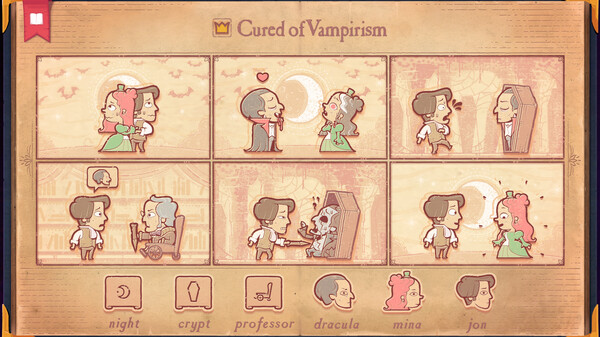 Storyteller (2023), from the official screenshots on its Steam store page
Influences — Picture books, a folklore study, comics
It starts with picture books. "I remember when I was a kid, the story was always the same in children's books. But looking at the illustrations, it felt like there was potential for other things to happen differently than the story they were selling you" (TheGamer, 2023).
Elsewhere he puts it more plainly. "You know those books that come with illustrations? When I was a kid, I knew the stories by heart because [my parents] had read them to me infinite times. I looked at the pictures and I thought 'I would love to intervene'" (Buenos Aires Herald, 2023).
On the theoretical side he names the Russian folklorist Vladimir Propp. "Propp's book gave me the idea of using 'roles' to split the behavior of game actors" (Game Developer, 2012).
The presentation he borrowed from comics. "The game makes use of some narrative devices that are used in real-world comics" (ibid.). In the same piece he places his own approach: "Storyteller goes the other way, and leaves it to the player to fill in the gaps."
Kizuki's reading — Between the big words and the small ones
What follows is my own reading. I read Benmergui as a designer who spent fifteen years swinging between the self that says big things and the self that checks small ones.
In 2013 he said, "We can still redefine what 'video game' means." In 2025, the blurb he wrote for Dragonsweeper on itch.io reads, in full: "A minesweeper game that requires observation." One line. The register has shrunk so far that it hardly sounds like the same person.
I read that not as retreat but as the practice of the limit he named himself. He did not drop the ambition to redefine things; he folded it into a single line of play. What he gained across the fifteen years of Storyteller may not have been the answer to making soft material yield a right answer, but a gauge of how much of that problem he can stand. That, again, is my reading.
Closing — Where to start
Dragonsweeper (2025) is the light way in. It is a browser minesweeper variant, and his own blurb is one line; the page adds, "Make sure to read the monsternomicon" (itch.io ↗). A board solved by observation rather than luck sits on the same line as his fixation on rules that never feel arbitrary.
From there, Storyteller (2023) shows the same fixation aimed at story as a material. The controls are easy. What blocks you is usually your own assumption about how a story is supposed to go.
In 2025 he also gave a talk at IDA in Buenos Aires on how he built Dragonsweeper, and the video is public. It is in Spanish, but he talks over the board, so it is easy to follow.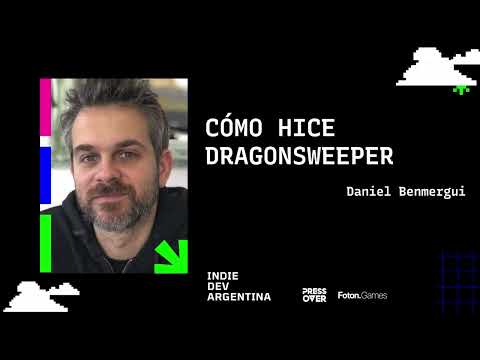 "Cómo hice Dragonsweeper, la evolución del Buscaminas" (IDA 2025), from the Press Over channel on YouTube
For neighbouring designers, we have pieces on Stephen Lavelle, equally obsessed with how a rule feels, and Emily Short, who works the seam between story and system. Read together, they place Benmergui more sharply.
Sources
Primary sources used in this article:
・Game Developer, "Road to the IGF: Daniel Benmergui's Storyteller", 2012-02-15 (interview)
・GDC Vault, "Using Plot Devices to Create Gameplay in Storyteller" (GDC Next 2013, his own talk)
・TheGamer, "Storyteller Interview", 2023-03-24 (interview)
・Dragonsweeper official page (itch.io, blurb written by the developer)
Career and award facts were checked against his Wikipedia entry and the Storyteller store page on Steam.
Reactions (no login)
Anonymous • one of each per visitor per day
Part of these series
The Designer's PhilosophyEpisode 51 of 51