REVIEW · 2024-05-09
ANIMAL WELL
A puzzle-box well you descend by noticing holes in walls and pictures in the background
Introduction
You hatch from a flower, take up a lantern, and descend into a dense, interlocking labyrinth — that is ANIMAL WELL. Made by Billy Basso under the studio name Shared Memory and published by Bigmode, the label founded by videogamedunkey, it released on May 9, 2024. It is a 2D puzzle-box metroidvania, all of 35MB, with a Metacritic score of 90.
I write this from the Steam review pool. 95% of 12,558 English reviews are positive — 'Overwhelmingly Positive' — and across all 23,580 reviews there are 22,594 positives to 986 negatives (snapshot 2026-07-08). The last 30 days sit at 92% of 196. By the numbers, an uncontested success.
But line those 986 negatives up against the caveats tucked inside the praise and an axis appears. The same design — solving by noticing a hole in a wall or a picture in the background — is called 'the joy of reading the world yourself' by the positive side and 'you only spot things, it is not clever' by the negative one. I use that shared point as my axis.
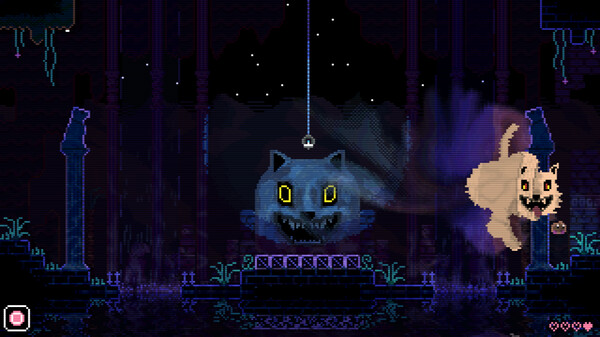 The key art for the descent into the well — Steam store
First Impressions
The top helpful positives place the same words almost verbatim: 'the best metroidvania,' 'a masterclass in non-traditional level design,' 'made for people who love video games.' One reviewer even praises the file size — 'just 35MB,' 'runs on anything.' What gets described first is not difficulty but the feel of touching this world.
The other constant is a warning: do not get spoiled. Several positives insist you dive in blind, because figuring it out yourself is the reward. One writes that the moment you think you have it all, you learn you were only on the first layer — telling you the game has layers while withholding what they are.
To me that 'no spoilers' framing is itself the achievement. The reward here is not a tool or a number but the noticing itself, so handing over knowledge early erases it. As TUNIC did with its secret manual and Fez with its cipher, Animal Well puts withheld information at the center of play.
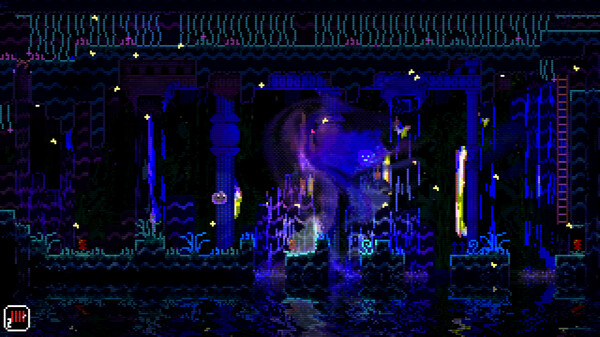 Advancing through the dim labyrinth, lantern in hand — Steam store
The World
What the pool most agrees on is atmosphere. 'Beautiful,' 'unsettling,' 'oddly charming' — a dim pixel-rendered well bottom, large creatures watching you, restrained sound. The store says the game focuses on 'tension and suspense rather than action' and that 'you are disempowered,' and reviewers' impressions trace that claim almost exactly.
I read that disempowerment as subtracting a verb. Your character cannot fight — no sword, no gun. You walk, climb, and hold up tools. Remove the verb 'attack,' and weight shifts onto the verbs that remain: observe, flee, exploit the environment. When positives say 'atmosphere over action,' they mean the feel this narrowed verb set produces.
The negatives dismiss the same world as 'just sightseeing.' One detailed pan writes that it is undeniably beautiful but the journey there is boring, with no narrative and almost no lore. A world built on tension reads as a blank to anyone who cannot lock into that tension. Less a flaw than a design that demands enough observation resolution to make atmosphere a reward.
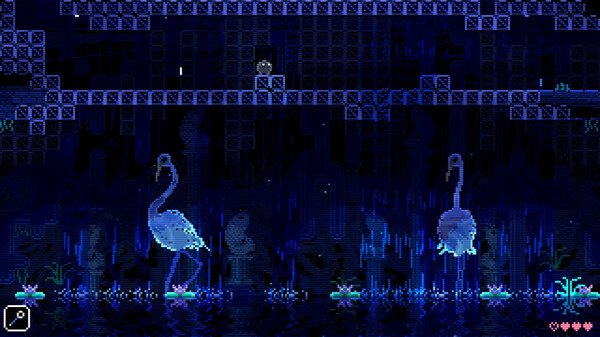 The unsettling, beautiful pixel-rendered well — Steam store
Putting the Mechanics into Words
The core, positives repeat, is a set of multi-use tools. Gadgets like a flute or a bubble wand serve for movement, for stalling enemies, and for exposing hidden doors alike. The store advertises that 'all items have multiple uses' and that enemies, environment and items 'interact in systemic ways,' and the positives back this: item variety keeps it fresh to the end.
This is exactly what Puzzlebyrinth calls verb reuse. The toolset is not large, but one tool means something different per context and combines into unexpected solutions — a small combinatorial explosion. The developer's line, 'learn how innocuous details become meaningful,' lands on the positive side as the pleasure of learning the world's grammar.
The negatives read the same tools backwards. One detailed pan writes that this is 'ten keys to one lock; as long as you hold the right key, you already know how to open it,' and another adds that they hunted for the advertised taxing puzzles but it was mostly a question of whether you had the right tool. Some note tools used in 'only two to five rooms.' I read this as a choice about whether solution quality sits in combination or in observation. Animal Well tilts the puzzle verb from manipulation toward noticing: not finding the key to a lock, but seeing that a lock is there. Those who take the bet feel their resolution climbing; those who do not are left with busywork.
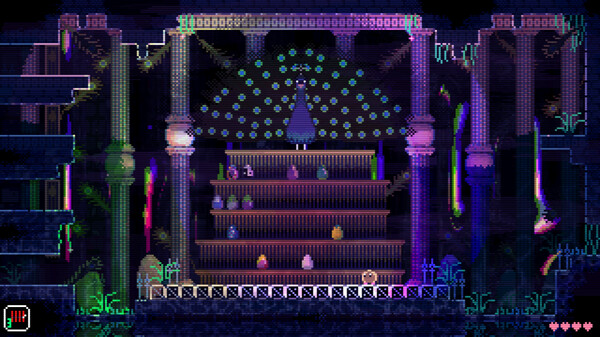 Solving with multi-use tools — Steam store
Design Craft
What makes this game special is how deep the layers run past the credits. The main game takes a few hours; beyond a second ending wait sixteen 'secret bunnies,' solved with flute melodies, UV light, and connect-the-dots puzzles. The store said 'the main game is just the beginning' and that players 'will be discovering hidden puzzles for years.' This is a rare case where that kind of claim came literally true rather than as hype.
The centerpiece, reviews and community records agree, is a community-scale puzzle around the Bunny Mural. Collect 32 eggs and you receive one random piece of a 50-piece mural. The whole reportedly can never be completed alone; volunteers on Discord pooled their fragments — plus a key fragment held by the developer — to crack it. The same thing that once happened to Fez's cipher, decoded by collective effort, is here designed in from the start.
I would call this grafting a communal zone onto the far side of the learning curve. Puzzles usually close inside one head. Animal Well deliberately makes information insufficient — an application of subtraction — leaving a remainder no individual can solve and handing it to the community. Its 'for years' reach is measured not in one player's hours but in a group's decoding speed. The price debate reduces to the same reach: negatives say '$24.99 is steep for an 8-hour main game,' defenders answer '40-50 hours if you go deep.' The same tag means different things by how far down you descend.
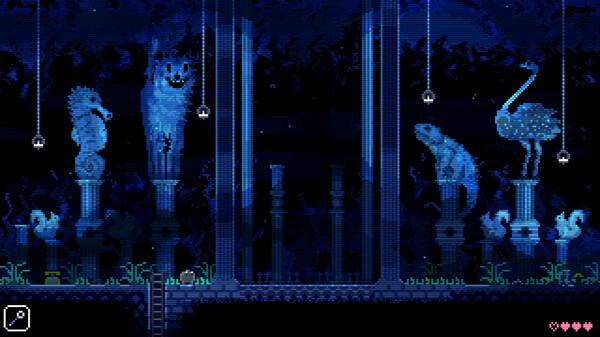 Secret layers waiting past the ending — Steam store
Sources
This piece was written by reading the user reviews on the Steam store page as of 2026-07-08. No review text is quoted directly; typical claims are reconstructed.
- Steam: ANIMAL WELL (Overwhelmingly Positive, 95% of 12,558 English reviews; across all 23,580: 22,594 positive / 986 negative; last 30 days 92% of 196, 'Very Positive')
- Read via the Steam review pages: the top weekly-helpful positives, a detailed negative on the metroidvania design, and recent reviews; plus community and guide records on the post-game secrets (secret bunnies / the Bunny Mural ARG)
- Press: quoted on the store, Eurogamer and Destructoid (10/10), the Thinky Games feature on the game's 'invisible layers,' and Metacritic 90
Closing
Steam reads 95% positive; my design-critique score is 8.7. I trim slightly from the near-perfect critic line (Metacritic 90) because the main game's puzzles do not bite as hard as the atmosphere implies, and the deepest pleasure lives with the community rather than the individual. That is not a flaw but a statement of where the game placed its bet.
The internals show that 95% is carried heavily by people who can turn observation into reward. Whether spotting a hole in a wall feels like 'cleverness' or 'busywork' is the dividing line. The developer disempowered the hero, made the tools polysemous, and entrusted the deepest layer to a community. The material for judging whether it is for you sits right there in the 986 negatives and 22,594 positives. Reported clear times run 6-8 hours for the main game and past 20 for the deep dive.
The pool's near-unanimous verdict is plain: drop your preconceptions and descend with your own eyes. Inverted: if stopping to study one picture on a wall stirs nothing in you, this well is too deep. The value of this game is set by how far you can raise your observation resolution — and the split measures that for you. Anyone who found the observation puzzles of The Witness rewarding will almost certainly descend just fine.
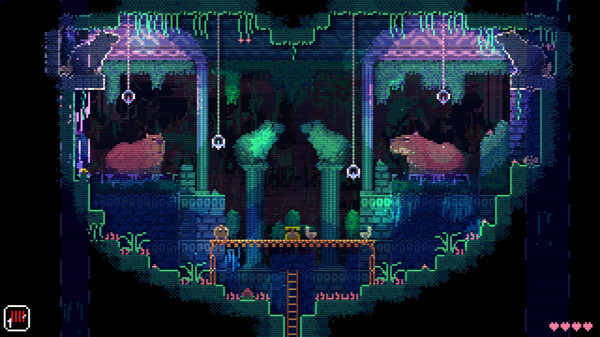 The dense, interlocking labyrinth — Steam store
Where are you with this game?
Press one and the game goes on your shelf. You can see it on your account page.
Reactions (no login)
Anonymous • one of each per visitor per day
Read next

Related reviews
Riven
Cyan Worlds' own ground-up 3D remake of the 1997 classic — a first-person puzzle adventure with no hints and no highlighting, where you walk a collapsing island and read its water, machines and D'ni number system to unlock its secrets.
Isles of Sea and Sky
A memory-less castaway pushes blocks — and only pushes them — through traps and portals across an open ocean of islands. Each island twists one mechanic while a wordless myth unfolds, growing a bottomless labyrinth from one verb. From Cicada Games.
Portal: Revolution
A free unofficial Portal 2 expansion set in the gap in that game's story, adding some forty new test chambers and hardware such as a laser-redirecting cube. It opens with only one portal available and walks you through the facility between the chambers.


