REVIEW · 2017-12-20
Bridge Constructor Portal
Two grammars grafted together, and only the constraints fell off — reading between 90% of 2,505 and a 6.4 out of ten
First Impressions
I have not played this one. I am reading what its 2,505 reviews actually graded. The numbers first: 2,505 reviews on Steam at 90% positive, labelled Very Positive (snapshot of 2026-08-31). The last thirty days sit at 91% of 45. SteamDB's all-language count is about 7,000 reviews at 88.8%.
On Metacritic, though, the PC user score is 6.4 from 73 ratings, against a critic score of 77 from 29 reviews. A thumb says 90%. A ten-point scale says 6.4.
Read the helpful reviews and the gap explains itself. The two sides are describing different games. The positive column counts GLaDOS, turrets and the Companion Cube. The negative column counts the missing budget, the missing structural limits, and the fact that you cannot place a portal yourself.
This piece follows that split. The conclusion up front: the game grafts two famous grammars together, keeps the surface of both, and drops the constraints of both.
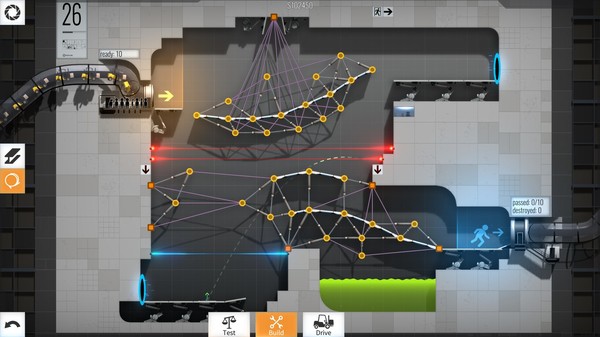
 The 1st image in the Steam store gallery (Steam store screenshot)
Putting the Mechanics into Words
Set the two grammars side by side. Portal's grammar is built on the player cutting two holes in a wall. The verb belongs to the player, and the chamber is a place to practise it. Bridge Constructor's grammar runs the other way: the only verb is adding one more beam, and what tightens the board is budget and structural load.
This game imports neither grammar whole. The portals are placed for you in each chamber and cannot be moved. That single point is the one the top negative reviews return to most. A portal you cannot move is not Portal's verb. It is Bridge Constructor's terrain.
And the building constraints? Also loose. No budget, no material fatigue, only two kinds of part — a complaint that appears not just in the negative column but inside Japanese-language reviews that recommend the game. With unlimited resources, a bridge stops being a question of building cheaply.
Count what is left and it is thin. The verbs in the player's hands are: place a point, stretch a line, get the angle right. As the piece on subtractive design argued, taking verbs away is not itself a fault. The problem is that you cannot see what was kept in exchange.
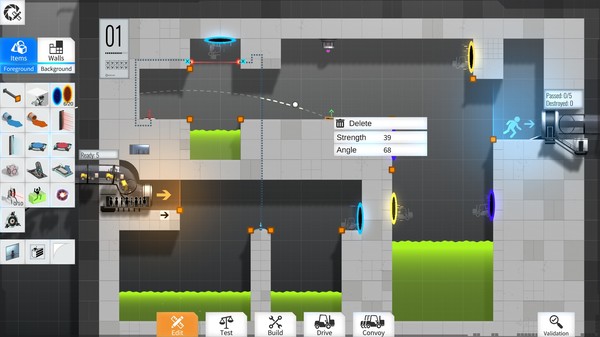
 The 2nd image in the Steam store gallery (Steam store screenshot)
The Texture of Difficulty
Where the difficulty sits follows from that. The negative vocabulary clumps into one word cluster: angle, fine-tuning, trial and error, pixel-perfect. One of the most-upvoted says there is only one solution per chamber, and the work is nudging the angle until you land on it.
What is interesting is that the same words appear inside recommendations. Several top Japanese reviews say the early chambers are fun and the later ones become repetitive fine-tuning — chores, in effect. People with twenty hours logged call half of those hours chores and still give a thumbs up.
This is the physical version of the problem in designing luck out of a puzzle. You know the shape of the answer. What you do not know is how narrow the tolerance around that shape is. The difficulty is not in thinking. It is in hitting.
Even the estimate is split. One Japanese review calls it the hardest game in the series. English reviewers complain that the tutorials hold your hand and that Portal's learn-by-doing is gone. In the terms of how to cut a learning curve, the teaching steps are fine and shallow, and then one step near the top is suddenly tall.
 The 3rd image in the Steam store gallery (Steam store screenshot)
Place in the Lineage
Place it in a lineage and both neighbours come into focus. On one side is Poly Bridge, where there is a budget, beams snap, and failure is the show. On the other is Portal 2, where the portal belongs to the player.
This game sits between them and inherits neither constraint. So the negative column complains in two native tongues. Read as a bridge game, it has no budget. Read as Portal, it will not let you aim. These are not two complaints. They are two sides of one graft.
Borrowing the framing from the reading of Caillois on mixing: the question when you combine is not whether the ingredients suit each other, but whose discipline survives the mixing. Here neither did.
That also settles the thumb-versus-ten-point gap. The binary asks whether this was Portal. The ten-point scale asks how good a bridge puzzle it is. 90% and 6.4 do not contradict each other. They answer different questions.
 The 4th image in the Steam store gallery (Steam store screenshot)
Design Craft
In fairness, some of it works. The surface fidelity is real. Valve supplied the art and the lore, and GLaDOS is reportedly voiced by Ellen McLain herself. Most of the ten most-helpful positive reviews name that as the reason they bought it.
There is craft in the structure too. Each chamber has a two-tier goal: get one vehicle across to advance, get the whole convoy across for the better mark. Skill difference is converted into goal height rather than into a wall. Nobody is stopped, and the strong player still has homework.
It is also generous about reaching people. Japanese reviews keep noting the low system requirements and the patient tutorials. Within two months it had spread from phones to consoles, and it was reported to have passed 500,000 copies by August 2018. That patience, though, points the opposite way from how Portal teaches.
 The 5th image in the Steam store gallery (Steam store screenshot)
Sources
This article is based on the Steam user reviews and related data as of 2026-08-31. Review text is not quoted directly; recurring claims are reconstructed.
・Steam: Bridge Constructor Portal (2,505 reviews at 90% positive, labelled Very Positive; last 30 days 91% of 45 / 2026-08-31 snapshot)
・Read: top 10 helpful positive, top 10 helpful negative, 8 most recent, and the top 10 Japanese-language reviews
・SteamDB: Bridge Constructor Portal (all languages, about 7,000 reviews at 88.8% positive)
・Metacritic: Bridge Constructor Portal (PC 77 from 29 critics, user score 6.4 from 73; iOS 86 from 5, PS4 78 from 7, Xbox One 78 from 9, Switch 71 from 10)
・Wikipedia: Bridge Constructor Portal (source for the Valve collaboration, console release dates and sales figure)
・Images are taken in order from the Steam store screenshot gallery. The image CDN was not reachable from this session, so captions state gallery position only.
Closing
I give it 6.8. Lower than Steam's 90%, a little above Metacritic's 6.4. The reason is the one above: nothing constraining survived on either side of the graft, and as a design judgement I mark that down.
That does not make the 90% wrong. What was promised is delivered: sixty test chambers, the real voice, and, at the moment, a one-dollar price. The last thirty days recovering to 91% of 45 probably says more about that price than about the chambers.
Who it suits is clear enough. If you want to breathe a little more of Portal's air, it works. If you want to optimise a bridge, it does not. The first group came to buy a surface, and the surface is honestly sold.
One design note to leave behind. When two games are mixed, the constraints are the first thing to fall away, because constraints wear the face of inconvenience. And constraints are usually what made either game good.
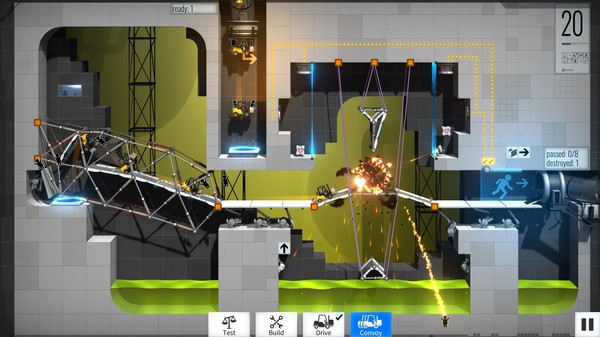 The 6th image in the Steam store gallery (Steam store screenshot)
Reactions (no login)
Anonymous • one of each per visitor per day
Read next
Related reviews
Opus Magnum
A 2D puzzle where, in an alchemist's workshop, you combine rotating and extending arms with tracks to ferry and bond atoms into potions and metals. The board and part count are unlimited, so the contest is less about clearing than about how elegantly, quickly, and compactly you build — Zachtronics' signature work.
SUPERHOT
A first-person shooter built from white rooms and red figures, where the world's time advances only as far as you move. You take your weapons from the enemies who drop them, and a single hit ends the level. Grown by SUPERHOT Team out of a game-jam prototype.
Mini Metro
A 2D minimalist puzzler in which you draw subway lines between circle, triangle and square stations in a growing city, allocating the carriages and tunnels handed to you each week, and keep the city moving until the platforms overflow. From New Zealand's Dinosaur Polo Club, grown out of a game-jam prototype.


