REVIEW · 2018-10-23
Do Not Feed the Monkeys
The watcher, watched
First Impressions
You spy on strangers through surveillance cameras - that is Do Not Feed the Monkeys. As the newest member of 'The Primate Observation Club,' you watch 'monkeys' in their 'cages' and pick clues out of their rooms and conversations. Developed by Spain's Fictiorama Studios, published by Alawar, released October 2018. I wrote this by reading the Steam user reviews stacked up as of 2026-07-11: Very Positive, about 91% across all languages (10,225 Steam purchasers).
Line up the helpful positive reviews and the words rhyme: unique, fresh, original, and always the names Papers, Please and Orwell. A guilty subject - voyeurism - wrapped in pixel art and dark humor and loaded with moral dilemmas: that sits at the center of most recommendations. Random camera draws and multiple endings make 'highly replayable' just as recurring.
The most-upvoted negative review reads the same design from the other side: 'the idea is strong, but the pressure quickly turns to frustration - small mistakes snowball and recovery feels limited,' ending on 'more exhausting than engaging.' The store's breezy voyeur banner and the helpful reviews plainly disagree. I read that split not as a fight but as a question of design range.
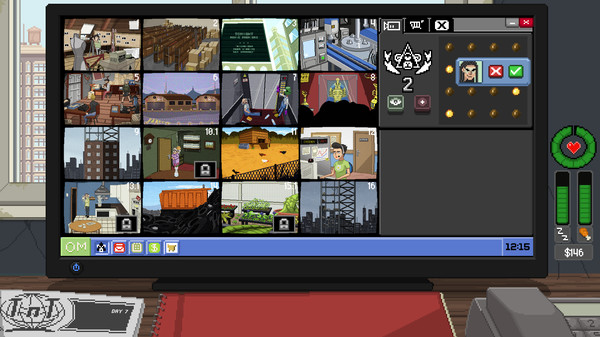 Peering at the world from a one-room apartment — Steam store
Putting the Mechanics into Words
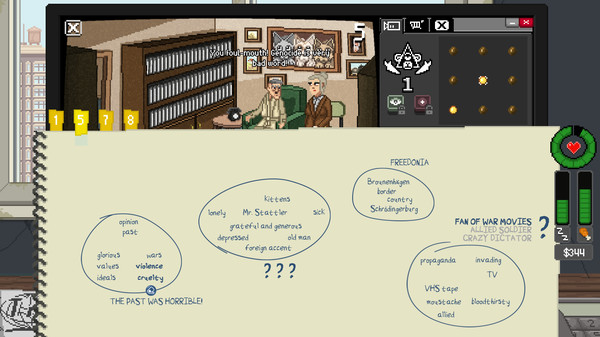
The loop reviewers describe: switch between cameras on your PC, click the elements that glow yellow - a spoken line, a prop - to jot them in your notepad. Link the fragments into a conclusion, run a phone number or address through a search engine, and you close in on who someone is. The verb set is startlingly small - watch, note, search - which in Puzzlebyrinth's terms narrows observation to a single verb. The 'gather clues and deduce' summary reviewers repeat is just that grammar.
But a second, forbidden verb sits on the board: interfere. 'Do not feed the monkeys' is the club's first rule, and reviewers laugh in unison that 'everyone feeds them anyway.' Blackmail with a secret, mail a stranger painkillers, or turn them in - the watching verb flips into a moral choice, and that flip is the design's core. It is structurally close to how Papers, Please loaded ethics onto the dull verb of checking papers.
Then daily life piles on: rent, food, sleep, and a deadline to buy new cages. Many reviewers groan that 'you can't watch everything' - but that is deliberate subtraction. The more cameras you own, the thinner your attention, forcing you to choose which stories to chase and which to drop. The combinatorial blow-up happens in time and attention, not on a board. Turning observation into a scarce resource is, I would argue, the game's best invention.
 Clicking the glowing clues and banking them in a notepad — Steam store
The World
Another thing the reviews keep praising is the air of the place. A one-room apartment the size of a bathroom, a CRT-like screen, lo-fi pixel art that many call 'purposefully low-res.' The watched lives run from comical to tragic to lurid, and the Steam tags read Dark Humor and Dystopian. Because the observational resolution is deliberately coarse, there is room for imagination to build a story from fragments - that is how I read it.
Reviewers keep pulling in the real world. One quips that you play this voyeur game 'to escape a dystopia where democracies fall to corporations and climate looms'; another finds the screen unnervingly close to peering into rooms over video calls during lockdown. Is the watcher also being watched? That nesting - flagged by the reviews reaching for Hitchcock's Rear Window - retunes an old anxiety in present-day terms.
 Coarse pixels leave room for the imagination — Steam store
The Texture of Difficulty
On difficulty the split speaks the same fact with opposite signs. One review warns the 'learning curve is steep - you will fail once before you finish'; another says 'two hours once you know it, with time to spare.' The trick is that the hardness lives in logistics, not wits. The deduction is solved in a few observations; what is hard is juggling rent, cages, food and sleep inside a 16-day deadline. Reviewers put a single run at roughly two to five hours.
The most-upvoted negative review names the texture of that: it 'leans on trial-and-error and repetition rather than learning and discovery.' Failing early without knowing the rules, then restarting, recurs in recent reviews too. But the design leaves exits - an 'easy' mode slows the stat drain, and per-day rewind works as a pseudo-save. Veteran reviewers point to that rewind to argue the time-pressure complaint is one you can soften yourself.
So the split is not better-versus-worse. Strip out the deadline and the money and voyeurism becomes mere watching; by squeezing time and cash, the design gives observation the tension of triage. Whether you read that as immersion or exhaustion tracks almost exactly onto how you feel about resource management as a genre. The recurring wish for a no-timer mode is proof the game stitches the pleasure of watching to the load of managing - and the seam is what decides who it is for.
 The deadline and the money give watching its tension — Steam store
The Reviews I Read
I wrote this by reading the Steam store's user reviews as of 2026-07-11, reconstructing typical claims rather than quoting review text directly.
・Steam: Do Not Feed the Monkeys (Very Positive; ~91% across all languages - 10,225 Steam purchasers, 11,740 of 12,545 total positive; English 91% of 2,283, recent 95% of 111)
・Read the most-helpful positive and negative reviews (all-time) and several recent ones via WebFetch; confirmed developer, engine (Unity) and assets on the SteamDB app page
・Referenced Papers, Please and Orwell, which reviewers name as touchstones, plus Kotaku and Rock Paper Shotgun coverage
Closing
What comes through the review pool is a voyeur simulator that narrows observation to one verb and stitches time-and-money management onto it. From the minimal watch-note-search, moral choices and the tension of triage rise up. 'Unique' recurs as praise because that stitch has few precedents.
Steam's overall sits around 91% across all languages. From a design view I would put it at 8.0 - a touch under the aggregate. The credit is for turning observation into a resource, the dark-humored little stories, and the replayability of random casting; the mark-down is that the most-stressful (not most-clever) moments lean on logistical grind over insight, and the range clearly sorts out anyone who dislikes resource management. That friction the enthusiastic majority forgives, I price in as a design cost.
So the audience is clear. If you enjoy peering into strangers' lives, building stories from fragments, and making moral calls under a money-and-time vise, it is a singular thing. If you would rather savor the stories at your own pace, unhurried, it is outside the range (a 2024 sequel, 2099, keeps the same time-management core). Set beside Papers, Please, which also piles ethics on one verb, or Her Story, which builds narrative from searched fragments, this little peephole's design stands out all the more.
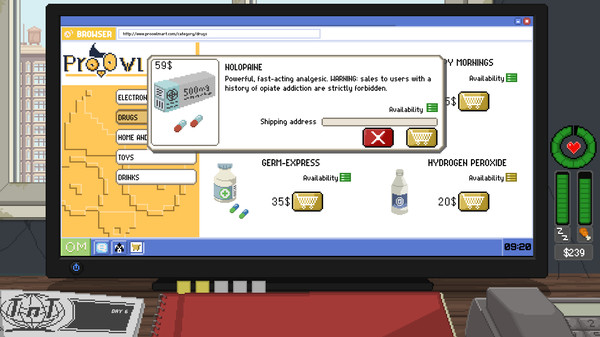 One small peephole holds watching, managing and ethics at once — Steam store
Where are you with this game?
Press one and the game goes on your shelf. You can see it on your account page.
Reactions (no login)
Anonymous • one of each per visitor per day
Read next

Related reviews
The Room Three
A first-person escape puzzler set in a mansion on a remote island, where you peer through a lens at the boxes and mechanisms left by the Craftsman, uncovering hidden layers one at a time. The third Room game expands the series from a single box to a whole estate, built on one tactile verb and an eyepiece that multiplies what you can observe.
Orwell: Keeping an Eye On You
An adventure in which you operate a state surveillance system, assembling citizen profiles from fragments lifted out of social posts, news articles, private messages and tapped calls, and deciding who gets flagged. Osmotic Studios' five-episode surveillance drama, where submitting or withholding a fragment is your only move.
Wilmot's Warehouse
A 2D organisation puzzle: push the delivered goods into your warehouse and file them however you decide. No rule governs the shelves, and when the service hatch opens you retrieve orders from memory alone. By Richard Hogg and Ricky Haggett, who previously made Hohokum, with 200 kinds of pictorial tile piling up.


