REVIEW · 2022-08-03
Last Call BBS
Zachtronics' last retro PC, loaded with eight thinking puzzles
Introduction
Last Call BBS, billed as the last game from Zachtronics and released on August 3, 2022, is a collection that packs eight thinking puzzles onto one fictional retro PC. You boot a '90s machine called the Z5 Powerlance, dial into a BBS, and download the games one at a time. Inside sit small works from different lineages: the logic puzzle Dungeons & Diagrams, circuit design in ChipWizard Professional, the falling-block HACK*MATCH, the cellular-automata X'BPGH, and three solitaires.
I write this from the Steam review pool. The label is 'Very Positive,' 94% of 1,196 Steam-purchaser reviews (snapshot 2026-07-18); across all languages and sources it is 1,431 positive to 124 negative of 1,555. On the number alone it is an unqualified hit. But because the form is an eight-game bundle, the substance is a rave with disagreement folded inside - everyone reorders which titles count as the keepers.
So I read this not as the experience of solving each puzzle, but as how the pool ranks the eight and what it calls a hit or a miss, translated through Puzzlebyrinth's design vocabulary.
 Last Call BBS header art — Steam store
First Impressions
The recurring words in the top helpful positive reviews are 'greatest hits,' 'tribute,' and 'leaving on a high note.' Everyone knows the context - Zachtronics winding down - and reads the catalogue as a farewell. The press shares the vocabulary; Siliconera called it a greatest-hits collection and a send-off and scored it an 8. Users and critics barely diverge, which keeps the first impression uncomplicated.
So most reviewers read this as a catalogue rather than a single game. Restated from the design side: anthology works tend to be judged by their maximum, not their average. If even one of the eight lands deeply, the rest can be thin and the verdict still settles on 'worth it.' The 94% is less an average of eight scores than a tally of votes for each player's single favorite.
 Key art gathering the eight-game catalogue — Steam store
The World as On-Ramp
What nearly every positive review mentions first is the wrapper, not the games. The modem sounds, the download cooldown, the short notes the previous owner - The Barkeep - leaves on the HandyMate, the aura of a fictional maker called Sawayama Corporation. The typical line is that it feels less like buying a collection and more like finding an old computer, and the pool praises that texture almost unanimously.
As design this is the interesting part. The download cooldown is a deliberately inconvenient on-ramp that keeps you from opening all eight at once - a subtraction of options that holds your hand on one game. And each game's rules arrive as letters from the former owner rather than a dry tutorial screen, dissolving the learning cost into the fiction and quietly raising the resolution of the onboarding. Even the negative side leaves the wrapper alone.
 The retro desktop and BBS connection screen — Steam store
The Verbs of the Eight
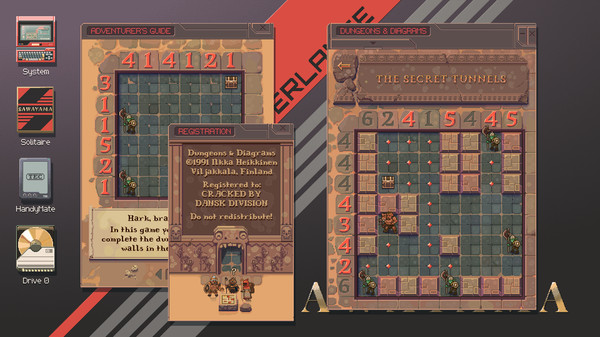
The pool's near-unanimous keeper is Dungeons & Diagrams: a logic puzzle, part Minesweeper and part Picross, where row and column numbers pin down the walls of a dungeon to a single solution. Next in line come the falling-block HACK*MATCH - lifted from EXAPUNKS - and the circuit-building ChipWizard Professional. The three solitaires, by contrast, get filed as palate cleansers.
From the design side the eight differ sharply in the grain of their verbs. Dungeons & Diagrams runs on essentially two - place a wall, clear a wall - and everything else is elimination logic, an extremely subtracted grammar. 20th Century Food Court, ChipWizard, and X'BPGH instead use the Zachtronics staple 'assemble and run,' where combinatorial explosion arrives the moment you lay parts down. The bundle's true nature is that spread in verb grain, and the game a reviewer calls a hit usually matches the verb grain they already like.
 A Dungeons & Diagrams board - walls fixed by logic — Steam store
The Texture of Difficulty
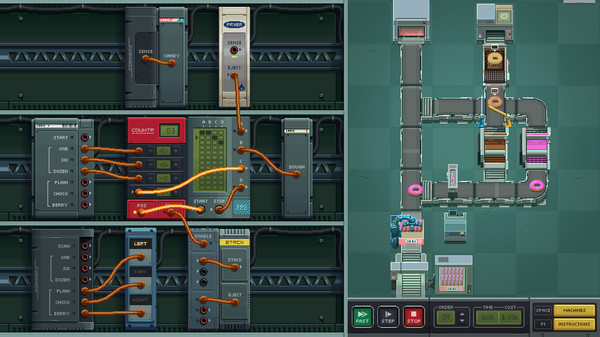
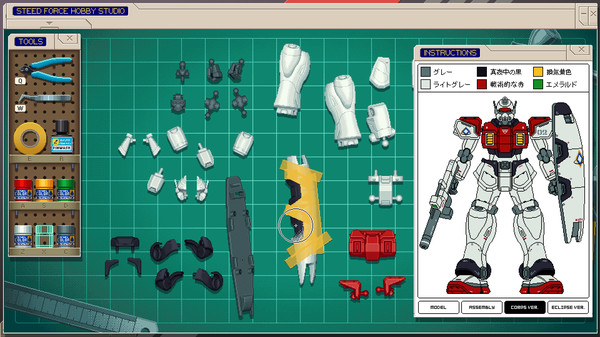
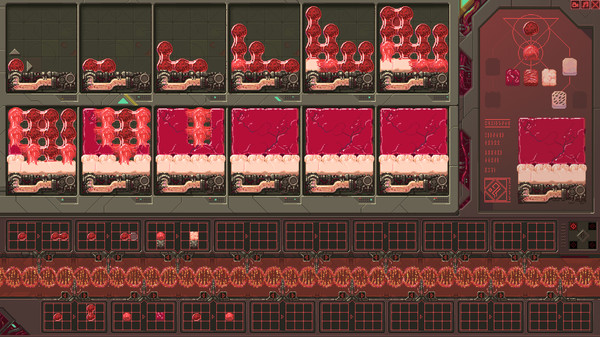
The split between 'too hard' and 'just right' concentrates on three of the eight: ChipWizard, X'BPGH, and 20th Century Food Court. The negative side keeps coming back to thin tutorials that force trial-and-error, and to 'unfair.' Meanwhile the solitaires and Steed Force (model-kit assembly) are spoken of warmly as low-stress refuges for when you're stuck. Even within a single title, the difficulty verdict cleaves in two.
Collect where reviewers got stuck and the difficulty sorts into three kinds. First, logic difficulty - fixing a single answer from given information, as in Dungeons & Diagrams. Second, design difficulty - hunting an efficient machine inside a combinatorial explosion, as in the automation games. Third, learning difficulty - where the rules are barely verbalized and the resolution of observation is left to the player, as in X'BPGH and Food Court. Most of what the negatives call 'unfair' is that third kind, which is less a rejection of difficulty than a complaint about the design of the learning curve.
This is not a place to stoke a fight. A build that withholds explanation and trusts discovery reads as a virtue to players who dislike hand-holding and as neglect to those who don't. The question is not which side is right but the reach of the design - who this catalogue is for. With eight on offer, a difficulty that fits your resolution is usually in there somewhere.
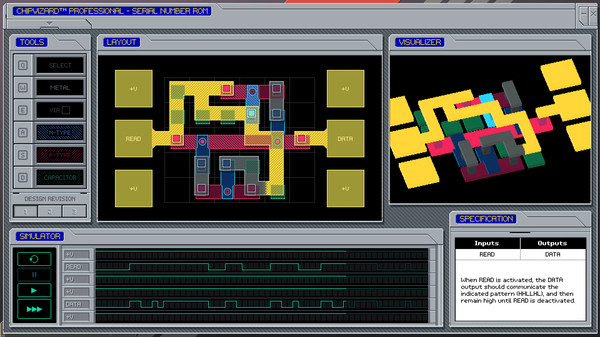 The ChipWizard Professional circuit-design screen — Steam store
Sources
This piece was written by reading the user reviews on the Steam store page as of 2026-07-18. No review text is quoted directly; typical claims are reconstructed.
- Steam: Last Call BBS (Very Positive, 94% of 1,196 Steam-purchaser reviews; overall 1,431 positive / 124 negative of 1,555)
- Read via WebFetch: the top helpful positive reviews, representative negative complaints, and several recent reviews
- Press: Siliconera (8/10), plus indiegamereviewer and others
Closing
Set beside a work that polished a single game deeply - Opus Magnum - Last Call BBS spreads its density unevenly because it is a catalogue. When some reviewers call it a pile of prototypes or 'leftovers,' they mean that density gap. But that is less a flaw than a property the catalogue form took on. Touching all eight runs roughly 15-25 hours, and Dungeons & Diagrams and HACK*MATCH are effectively endless.
Against Steam's 94%, I give it 8.5 from the design side. What keeps it off a perfect mark is that the eight learning curves aren't tuned to the same standard, and the third kind of difficulty - learning difficulty - is left unattended in places. Even so I agree with the pool's consensus that Dungeons & Diagrams alone earns the price. The catalogue's maximum is that high.
It is not for players who want to be led by the hand. But for anyone who wants the moment when a bottomless logic rises out of a few verbs - in at least one game tuned to their taste - Zachtronics' final catalogue is an easy recommendation. It reads like eight bottles lined up at a bar near closing time, one of which is bound to be your drink.
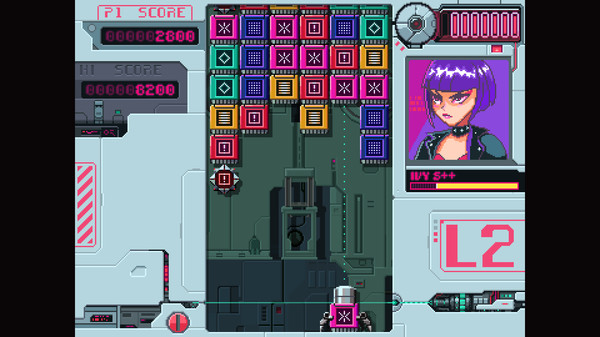 Last Call BBS library art — Steam store
Reactions (no login)
Anonymous • one of each per visitor per day
Read next
Related reviews
EXAPUNKS
A hacking puzzler set in a 1997 cyberpunk world: you write pseudo-assembly for tiny programs called EXAs and send them through the networks of banks and universities. With a printable underground zine as its manual, it pulls bottomless depth from a few verbs — a Zachtronics game.
Infinifactory
A first-person 3D puzzle where you build factories from blocks and conveyors to assemble whatever your alien captors order. SpaceChem made three-dimensional: a tiny verb set opening onto bottomless optimisation, from Zachtronics.
14 Minesweeper Variants
A pure-logic puzzle collection that rewrites the rules of classic Minesweeper in fourteen ways (and then some), stripping out luck and guessing so that swapping a single line of the rules opens up endlessly different deductions. From Artless Games and Alith Games.


