REVIEW · 2019-11-19
MOLEK-SYNTEZ
A manual-free synthesis puzzler — reading the caveats inside a Very Positive verdict
First Impressions
In a cold 2092 apartment in Cluj-Napoca, Romania, you smoke a cigarette and program a home-built synthesizer to make small pharmacological molecules — a game Zachtronics made and published in 2019. I write this not from playing it but from the Steam review pool. The label is 'Very Positive': 91% of 517 purchaser reviews (snapshot 2026-07-12; 83% of all 687). The number is high, yet it is an unusual kind of praise.
The helpful positives almost all open the same way: 'if you know Zachtronics, you know what you're in for.' A cross between Opus Magnum and SpaceChem with TIS-100's palette, histograms, optimization, a 'good kind of pain.' For them the game is a known brand and a continuation of a known pleasure.
The negatives and the qualified positives keep returning to: no tutorial, repetitive, 'not the best entry point,' and 'it lacks the magic of their best.' My job is not to stage a fight but to translate why the same design reads two opposite ways.
 Key art for MOLEK-SYNTEZ — Steam store
The World
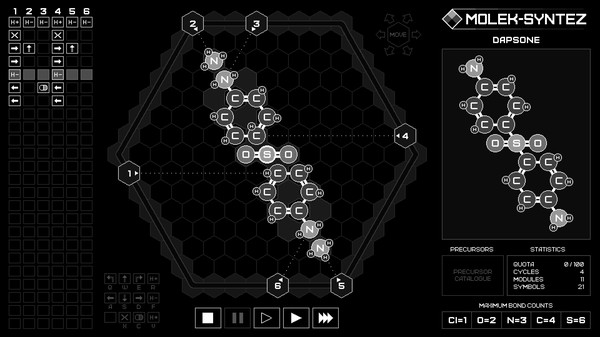
The first thing reviewers agree on is the strange presentation: a cold 2092 apartment, a cigarette, and a monochrome computer screen where you cook drugs. The UI is grayscale in the TIS-100 mold, and one reviewer calls it 'appealingly ugly.' There is nothing flashy about it.
Tellingly, even the harshest negative review praises the ambient music — 'some of the best in any Zachtronics game; you need calm to think.' So the world and the sound sit outside the fault line, one of the few things nearly everyone shares.
To me this austerity is a design statement, not decoration. A screen with no flashy rewards and no story hand-holding says: here, thinking is the only entertainment. Zachtronics' insistence that you raise your own resolution is at its most exposed.
 The 2092 Romanian apartment setting — Steam store
Putting the Mechanics into Words
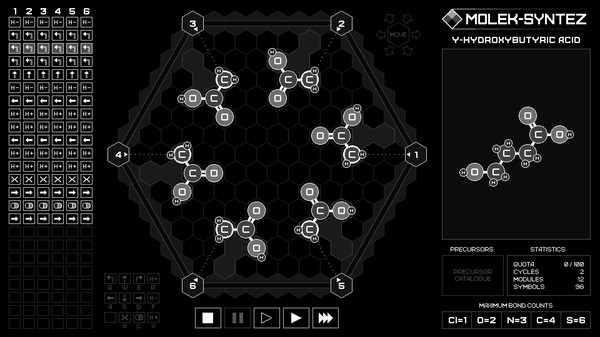
The recurring gloss is 'Opus Magnum crossed with SpaceChem.' You build molecules from industrial stock like benzene and acetone. Several reviewers name the key difference from Opus Magnum precisely: you do not place arms inside the board, you operate only from the perimeter of a finite arena — and that one rule spikes the difficulty.
In Puzzlebyrinth terms the verb is subtracted down to 'throw hydrogen, trigger a reaction.' But the finite, edge-only grammar pulls deep combinatorial explosion from few verbs. As one reviewer notes, optimizing for each of the three metrics yields wildly different solutions — the core of Zachtronics design.
The same mechanics read as 'limited and repetitive' on the negative side. The sharp complaint: any solution can be brute-forced into an ugly one, so the 'I solved it' triumph of SpaceChem is thinner here. A subtracted verb looks shallow to some and pure to others. That is where the fork begins.
 Operating a finite board from its edges — Steam store
The Texture of Difficulty
This is where opinion splits hardest, and it is about the kind of difficulty. Two stuck points recur. The synthesis logic itself is mostly called a 'good kind of pain.' The other is the entrance: no one tells you what to do.
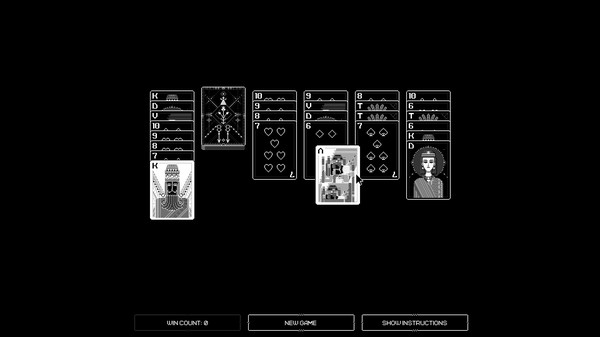
'No tutorial, no PDF, just floundering' shows up even as a caveat inside positive reviews. A reviewer who majored in chemistry still calls the opening 'jarring.' The same absence of explanation reads as 'the joy of discovery' to one player and 'unkind neglect' to another.
To me this is a step at the entrance of the learning curve, not raw difficulty. Zachtronics removes the handrail on purpose and makes you rebuild the grammar yourself. Veterans of TIS-100 and SpaceChem know the ritual; anyone who picked this as their first is left outside the line. 'Not the best entry point' is not a flaw but a matter of range.
 Facing an unexplained screen alone — Steam store
Sources
This piece was written by reading the user reviews on the Steam store page as of 2026-07-12. No review text is quoted directly; typical claims are reconstructed.
- Steam: MOLEK-SYNTEZ (Very Positive, 91% of 517 purchaser reviews; 83% of all 687)
- Read via WebFetch: the top helpful positive and negative reviews; the aggregate is confirmed steady at 'Very Positive' (88-91%) on SteamDB.
- Reference: Zachtronics official page
Closing
Steam reads 91% positive; my design-critique score is 8.0, and the two do not diverge much. The synthesis verb is clear and the finite board tames its combinatorial explosion well. Marks come off for the two things the pool keeps naming: solutions that can be brute-forced ugly, and a handrail removed too far at the entrance.
The pool's near-unanimous verdict is 'buy it if you already love Zach; otherwise start with Opus Magnum.' Fair advice. This is not an entrance but another dialect for people who already speak the language. Reviews put a clear at about 8-10 hours, though optimization can stretch it into the dozens. The split itself tells you whose shelf this belongs on.
 MOLEK-SYNTEZ — Steam store
Where are you with this game?
Press one and the game goes on your shelf. You can see it on your account page.
Reactions (no login)
Anonymous • one of each per visitor per day
Read next
Related reviews
EXAPUNKS
A hacking puzzler set in a 1997 cyberpunk world: you write pseudo-assembly for tiny programs called EXAs and send them through the networks of banks and universities. With a printable underground zine as its manual, it pulls bottomless depth from a few verbs — a Zachtronics game.
Opus Magnum
A 2D puzzle where, in an alchemist's workshop, you combine rotating and extending arms with tracks to ferry and bond atoms into potions and metals. The board and part count are unlimited, so the contest is less about clearing than about how elegantly, quickly, and compactly you build — Zachtronics' signature work.
Eliza
A visual novel about a woman who returns to work as the human voice of an AI counseling app, reading its scripted lines aloud to clients. Written by Matthew Seiji Burns and made by Zachtronics, the studio behind Opus Magnum, it ships with a kabufuda solitaire game on the side.


