REVIEW · 2023-09-01
Void Stranger
How lifting the floor folds a whole labyrinth into one puzzle
Introduction
You carry one floor tile with a rod and set it down elsewhere. With little more than that verb, you descend a 2D Sokoban labyrinth. System Erasure self-published it on September 1, 2023 (the same studio made the shmup ZeroRanger).
I write this not as a play diary but from the Steam review pool. The label is "Very Positive" — 3,043 of 3,332 reviews across all languages, 91% (91% of 2,625 in English, ~90% in the last 30 days, snapshot 2026-06-18). On paper, an easy win. Read the substance, though, and praise and complaint keep pointing at the same spot.
The recurring phrase among helpful positives is "go in blind" and "it rewired my brain." Among the critical and qualified reviews it is "abrasive," "hostile," "progress loss." The same device is a blessing to one camp and a punishment to the other. I will read that overlap in design terms.
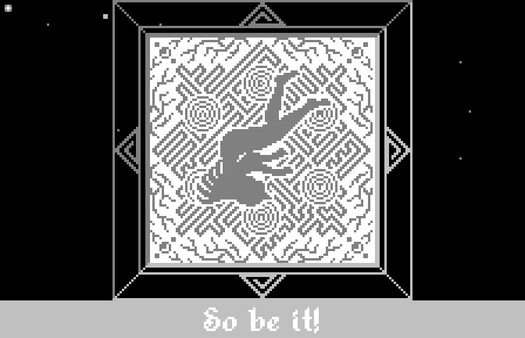 A room in Void Stranger — Steam screenshot
First Impressions
The first impression reviewers most often record: the opening few dozen rooms are a gentle Sokoban. Walk, push a box or boulder, lift a tile, set it down. Many admit they relaxed here and called it tame.
Then the floor literally drops out — several reviewers swear the game appears to end once. The "go in blind" advice from the helpful positives is a code word guarding this drop. What they withhold is not a walkthrough; it is the experience of a first impression betrayed.
The store page coaxes you gently — "it autosaves, take it easy," "get some rest," "ask someone." Yet the same list promises "several stages of frustration" and "a long road." That gentle tone wrapped around ominous words is, I would argue, the first trailer for how the reviews split.
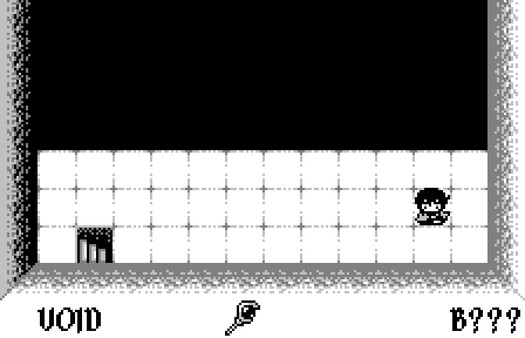 It opens as a plain Sokoban: walk, push, deliver — Steam screenshot
Putting the Mechanics into Words
In one line: the verb set is startlingly small. Walk, push, and use the rod to lift one floor tile and place it elsewhere. The positives' favorite line — "the rules take a minute, the depth never bottoms out" — is what we call subtraction of verbs: not adding systems, but wringing combinatorial explosion from minimal grammar.
Lifting the floor matters because the floor is both terrain and resource — a bridge over a pit, a lid on an enemy, a wall that cuts off retreat. Where Patrick's Parabox detonated on the single word "recursion," this one detonates on "you can carry the terrain."
And the reviews keep drifting outside the room — "remember the icon from 75 stages ago," "keep graph paper." The thing to be solved expands from a single puzzle to observation and memory spanning the whole labyrinth. VaporLens tallies "deep, layered puzzle design" as the top praise. Read accurately, this is a meta-puzzle wearing a Sokoban skin.
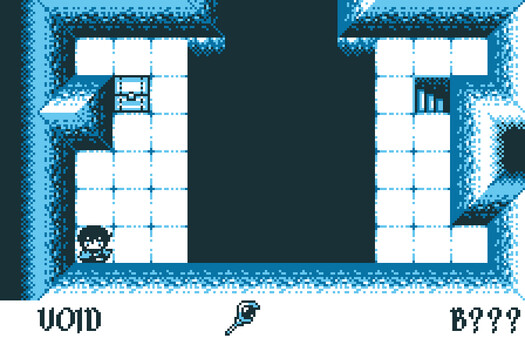 Lift a floor tile, set it elsewhere — the verbs stay few — Steam screenshot
The Texture of Difficulty
Difficulty is the loudest argument here. "Balls hard," "hardcore," "filtered" show up on both sides alike. I want to gather the spots where reviewers say they stalled and split the difficulty into three textures.
First, pure combinatorial difficulty — rotating the board in your head; almost everyone praises this. Second, observation-resolution difficulty — the lock that opens only with knowledge ("did you notice that icon?"). Third, friction difficulty — a single misinput rolling back hours, the endless backtracking through the same rooms.
The split lives in that third texture. Positives swallow even the friction as story, as Sisyphean labor. Critics carve it out as "wasted time," "unfair." Neither is a misreading. The author chose friction as a theme; whether it reads as pleasure or pain is a question of design reach — who it was aimed at. I label the difficulty "brutal," but the felt texture differs per player.
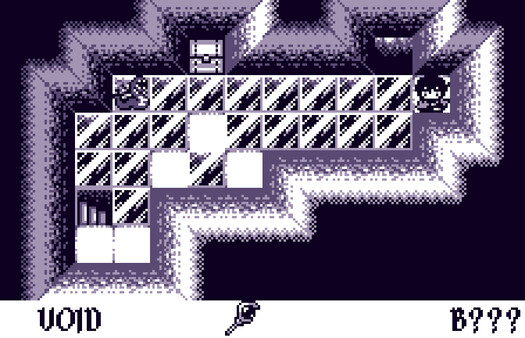 One misstep rolls you back — friction as both theme and cost — Steam screenshot
Place in the Lineage
To explain the game, reviewers almost always reach for another. The most frequent is "Outer Wilds as a Sokoban" (Outer Wilds), then Tunic, La-Mulana, and Lucas Pope (Obra Dinn). The comparisons cut across genres, which is telling.
The common thread is plain: progress is gated not by reflex or move count but by what the player knows and has not overlooked. Observation resolution is the key. This game grafts that "knowledge is the key" structure onto Sokoban grammar — so purists see "too much story," story fans see "too hard a Sokoban."
Recent reviews show a shift, too. 2025 video essays (Super Eyepatch Wolf and others) pulled in newcomers; recent posts often open with "came here from a YouTuber." Some regulars even steer beginners to the studio's ZeroRanger first. Discovery moved from word of mouth to video, nudging the sentiment slightly warmer.
 What gates you is knowledge, not move count — observation is the key — Steam screenshot
Sources
This piece was written by reading the Steam user reviews as of 2026-06-18 — a reading of reviews, not a play diary.
· Steam: Void Stranger (91% of 3,332 all-language reviews positive / "Very Positive" / 2,625 in English)
· Read via WebFetch: top 10 helpful positives, top 5 critical/qualified, top 5 recent
· Cross-checked with VaporLens review aggregation and Raijin stats
Closing
In closing: Void Stranger is a rare game that folds an entire labyrinth into one puzzle with the smallest set of verbs. Grafting knowledge-gating onto Sokoban grammar and making observation resolution the final key, it sits — like Stephen's Sausage Roll — on the side where height of difficulty matches depth of experience.
My score departs a little from Steam's 91%. On design grounds I give it 8.6. The deduction is clear: the observational and combinatorial difficulty is a virtue, but the friction that rolls back progress, however justified as theme, is not a cost everyone should pay. When reviews repeat "not for everyone," I take that as a statement of reach, not a confession of failure.
For: those who love doors that open with knowledge and do not mind graph paper. Not for: those who want the snap of a solution in a short sitting. Maybe the truest summary is the one-line review — "a perfect example of why games shouldn't be made for everyone." I would only add one line beneath it: the line that marks design reach.
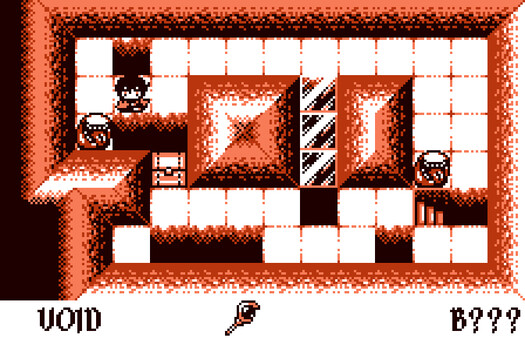 The labyrinth itself folds into a single puzzle — Steam screenshot
Where are you with this game?
Press one and the game goes on your shelf. You can see it on your account page.
Reactions (no login)
Anonymous • one of each per visitor per day
Read next
Related reviews
Paquerette Down the Bunburrows
A 2D puzzle game about cornering rabbits down in a warren. The bunnies flee by fixed rules, so you close their escape routes in advance with traps, a pickaxe and carrots. Five themed depths, over a hundred bunnies and a stack of secrets underneath, made by Bunstack.
Can of Wormholes
A grid-based sokoban where you steer a worm that crawls Snake-style-head forward, tail shrinking-to fill target holes with a body of the exact right shape and length. A handful of verbs (push, grow, slice) hide layers of interactions that fire only under precise conditions. By munted finger.
Bombe
A logic puzzle where you do not clear the Minesweeper board yourself: you write rules that act on the numbered regions, and a checker verifies them. Rules that pass are applied automatically to every board from then on, leaving only the situations no rule has reached. A solo project by Charlie Brej.


