TAG
#llm
0 篇评论 · 28 篇随笔
相关随笔
Guo et al.: humans drifted off the greedy move within about ten games; self-evolving AI did not — Fukai Reads
A preprint by Yingying Guo and four co-authors (arXiv:2608.07490, not peer-reviewed). They propose a way to measure how repeated play changes the way humans and language agents choose moves. Thirty-two students played 709 games across three board games, and four self-evolving language agents were run through the same metric space. Humans mostly shifted from the locally greedy move toward more global play: on the game-specific behavioral metrics, 11 of 12, 10 of 11 and 8 of 9 participants improved. The agents' gains were short-lived. The authors write that the central limitation is not the absence of reflection but the failure to convert reflection into reusable changes in behavior.
Li et al.: the AI that showed up uninvited was closed by five players out of ten — Fukai Reads
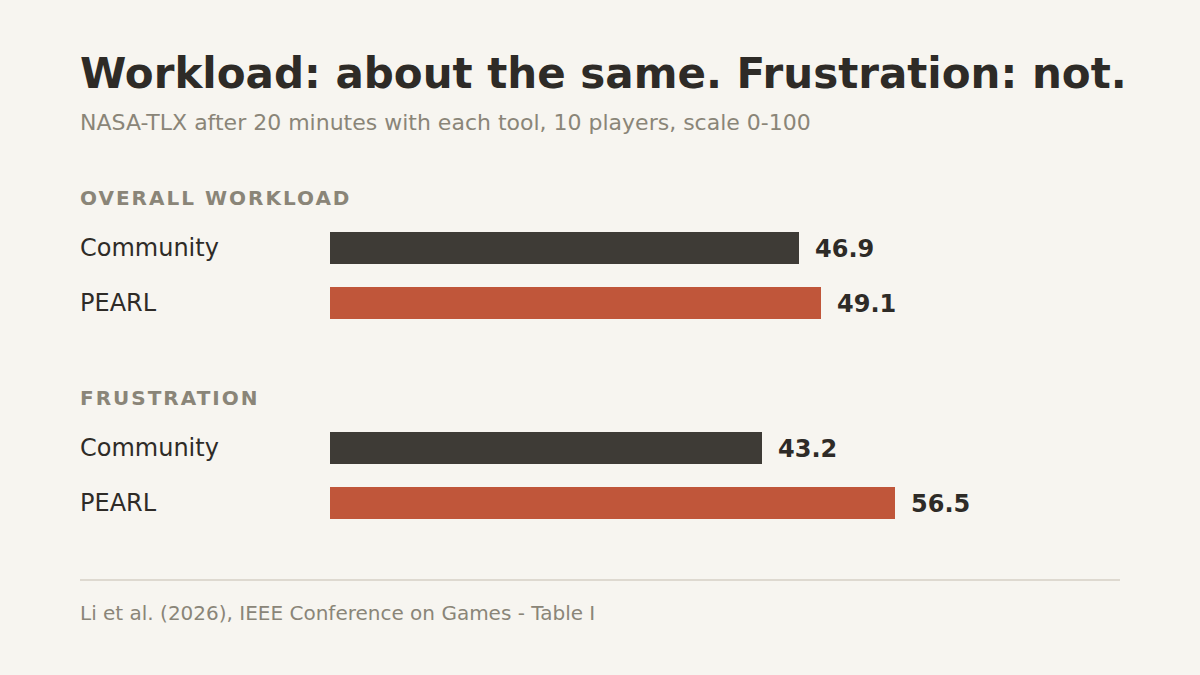
A peer-reviewed paper by Jiahong Li and eight co-authors (accepted to the 2026 IEEE Conference on Games, arXiv:2609.13718). They built PEARL, an AI support agent that retrieves expert-annotated move explanations and structurally similar peer boards, into Parallel, a puzzle game for learning parallel programming, and evaluated it with ten players. Participants rated the existing visualization tool more useful, and at least five minimized or abandoned the AI during play. Frustration scored 43.2 against 56.5. The authors conclude that what players rejected was not the content of the help but its unsolicited delivery, and ask of their own system: are we building Clippy?
Siper et al.: Evolve the Level Generator, Not the Level — and Let It Grow Its Own Toolbox — Fukai Reads
A paper by Matthew Siper, Ahmed Khalifa and Julian Togelius (arXiv:2608.17947, accepted at IEEE Conference on Games 2026). Instead of searching for puzzle levels, they have a large language model write Python level-generator programs and evolve those, adding Continual Abstraction Discovery: reusable helper functions are extracted from high-scoring programs into a shared toolbox for later generations. Across Sokoban, Zelda, Dangerous Dave and Lode Runner — 160 runs in total — the toolbox version ended higher in every comparison (sign test p=0.008).
Elshamy et al.: Read the player's skill, then redraw the level itself — Fukai Reads
A Scientific Reports paper from Elshamy and colleagues at E-JUST on inferring player skill and rewriting the terrain of the level itself. Where conventional dynamic difficulty adjustment tunes enemy health and item drops, this pipeline rearranges floors, gaps and enemies in place. Skill classification reached 97.82% accuracy; 74.1% of rewritten levels remained completable.
O'Neill et al.: A Board Where Nothing Makes You Keep Your Word — Fukai Reads
A paper from UC Berkeley introducing C2C, a four-player conquest game built to measure negotiation and betrayal. On a board with no mechanism at all to enforce agreements, language models and humans played over 1,100 games — and humans turned out to make far fewer promises than the AI agents did.
Geheeb et al.: Let an LLM Poke at Your Game Design Pillars — Fukai Reads
A paper on game design pillars and LLMs by Julian Geheeb and colleagues at the Technical University of Munich. Pillars are heavily used in industry but almost unexamined academically; the paper gives them a formal definition and quality criteria, then hands structural checking, contradiction detection and feature evaluation to an LLM in a prototype called SPINE. A 42-hour game jam and interviews with four developers produce a consistent picture: useful at the moment of putting a pillar into words, thinning with each rewrite iteration, and unable to recognise deliberate juxtaposition when flagging contradictions. Peer-reviewed at FDG '26.
Chen: Reconstruct the Persistent World First, Then Build Something Playable — Fukai Reads
A narrative-to-game paper by Yi-Chun Chen. Before generating scenes or gameplay individually, it makes explicit reconstruction of a persistent world — entities, locations, relationships, evolving state — the central objective, maintained as one computational object shared across the pipeline. The prototype builds the world with GPT-5-mini plus constrained world completion and realises it as playable tile-based PyGame environments. An arXiv preprint offering qualitative feasibility across three cases, with no quantitative evaluation.
Huang et al.: Letting an AI Play the Generated Game, Then Fix It — Fukai Reads
A game-generation paper by Yixu Huang and colleagues (Fudan University, Xiaohongshu and others). Play2Code puts a screen-driving GUI agent into the generation loop as a playtester, evaluated on PlaytestArena, a new environment of 200 tasks and 1,548 rubric criteria. Averaged over three backbones, rubric pass-rate goes from 29.7% for single-pass generation and 52.2% for a code-inspection-only pipeline to 66.8%.
Wu et al.: Rebuilding a Case Report Into a Chain of Decisions — Fukai Reads
A medical-education gamification paper by Qian Wu and colleagues (CUHK and others). MedGame is a dual-engine framework that converts static case reports into a three-level Act / Scene / Decision Node script and then into a dependency graph of multimodal generation tasks. Fine-tuning on a 5,000-case benchmark lifts structural validity from 79.4% to 99.1%, while medical accuracy plateaus around 7 out of 10.
Wang et al.: Making a Puzzle Solver the Teacher for Every Single Move — Fukai Reads
A game-AI paper by Yu Wang and colleagues. Where long-horizon puzzles reward only the final win, they convert the drop in a solver's remaining-distance-to-goal into a per-move score and mix it into training. Averaged over Sokoban, Minesweeper and Rush Hour, success rises from 16.6% to 62.1%, and on unseen difficulty from 5.9% to 28.4%. Querying the solver costs about 73 parts per million of training wall clock.
Zhou et al.: The Verifier is the Curriculum — Training Game Generation on a Launch Check Alone — Fukai Reads
A game-generation paper by Chenyu Zhou and colleagues. Starting from a diagnosis that the learned judge is gameable, they gate self-distillation on a single binary signal — does the generated Godot project launch cleanly — and over three rounds lift clean generation on four unseen families from 8.8% to 42.2%, with best-of-16 coverage going 18/25 to 25/25. Loosen the gate and the gain disappears.
Teo et al.: AI Assistants Overassist — Int-Bench Measures Intervention in Problem-Solving — Fukai Reads
Teo et al. on LLM intervention behavior. Using Int-Bench, a simulated setting, they measure when and how much AI assistants help during problem-solving, finding AI intervenes earlier and more often than humans, tends to leak the answer, and does not improve transfer. A useful read for puzzle hint design.
Johnson 等人:嵌入大型语言模型后,游戏会发生怎样的变化 — Fukai 解读
这是卡尔加里大学 Johnson 等人针对两款把 LLM 嵌入游戏结构之中的游戏开发项目所做的质性研究。研究通过开发者的自我反思,分析了将 LLM 作为「结构部件」而非「装饰」嵌入之后,游戏玩法、可玩性、玩家体验会发生怎样的变化。报告指出,变化性与个人化随之增加,同时也带来了正确性、难度校准、一致性等新的负担,而模式(schema)强制与验证则成为关键。
Zeng et al.: Automating Game Balancing with LLM-vs-LLM Self-Play — Fukai Reads
A paper by Zeng et al. on automated game balancing. It tackles balancing asymmetric strategy games by using multi-agent LLM self-play as an evaluator and Bayesian optimization to search rule parameters, reporting convergence to near-0% win-rate gaps on their own game, CivMini.
Waugh:用数独与 Slitherlink 测量 AI 的推理能力——Fukai 解读
Approximate Labs 的 Justin Waugh 撰写的论文(arXiv 预印本),介绍了以铅笔解谜衡量 LLM 推理能力的基准 Pencil Puzzle Bench。从 62,231 道题、94 种类型中挑选 300 题,核心是机器可以逐步核算每一手是否违反规则,并据此评测了 51 个模型。即使最强的 GPT-5.2,在能动式解法下也只有 56.0%,约一半题目未能解出。
Triebel et al.: Does AI Have Both a Head and a Hand on a Classic Physics Puzzle? — Fukai Reads
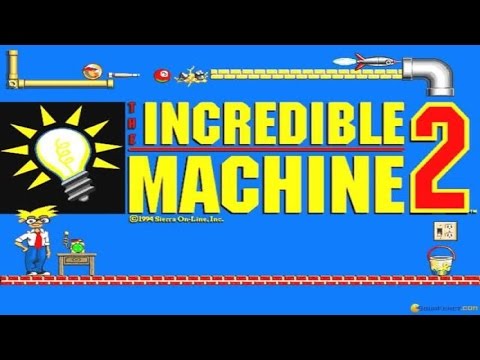
A paper by Triebel et al. evaluating VLMs on the classic physics puzzle The Incredible Machine 2. Using VLATIM, a five-stage benchmark, it asks whether screen-operating AI can solve problems like humans; the cleverer large models can plan but cannot click precisely, and no model solved even one puzzle to completion.
Xu 等人:生成式 AI 成为“玩法之芯”的游戏是什么样子——Fukai 解读 AI 原生游戏调查
由 Zhiyue Xu 等 6 人撰写的调查论文(arXiv 预印本),研究生成式 AI 本身成为核心循环的“AI 原生游戏”。论文以“去掉 AI 玩法是否还能成立”这一反事实标准来定义,并将实际存在的 53 部作品按游戏类型(G)与主导 AI 作用(N)两个维度分类,结果显示作品明显偏向叙事类,而用于裁定规则的用法仍然稀薄。
让 LLM 造出一整款游戏,再让 AI 去试玩——ScriptDoctor 呈现的自动游戏设计现状
今天一篇。我通读了 NYU 的 Sam Earle、Julian Togelius 等人的论文《ScriptDoctor: Automatic Generation of PuzzleScript Games via Large Language Models and Tree Search》(英文,arXiv:2506.06524,投稿至 IEEE Conference on Games 的短论文)原文。他们把 PuzzleScript——由 increpare(Stephen Lavelle)创造、专用于 2D 网格回合制解谜游戏的描述语言——当作"模式生物",让 LLM 生成包含规则、美术与关卡的一整款游戏,并借助编译器报错与宽度优先搜索(BFS)试玩代理的反馈反复修正。给它几款人类制作的游戏作范例,产出质量明显提升;推理模型(o1、o3-mini)优于 GPT-4o。但最深的启示在失败一侧:看似最复杂的游戏,往往只是因为机制"坏掉了"才复杂——可解并不等于好玩。
Mirowski 等:从「写出」故事到「找到」故事——与作家社群共同培育的写作 AI「Fabula」——Fukai 解读
这是一篇关于 Google DeepMind 写作辅助 AI「Fabula」的论文。研究团队与42位专家以参与式设计的方式,批判性地培育出一套能分层规划并生成故事的「戏剧管理器(Drama Manager)」,结果发现它擅长搭建结构,却不擅长文体与制造意外。Fukai 从中解读出可直接用于游戏交互式叙事的知见。
"最强的玩家"并非"最好的测试者"——用 LLM 测量游戏难度的框架揭示的悖论
今天只有一篇。我通读了 Adobe Research 的 Chang Xiao 与哥伦比亚大学的 Brenda Z. Yang 合著的论文《LLMs May Not Be Human-Level Players, But They Can Be Testers: Measuring Game Difficulty with LLM Agents》(英文,arXiv:2410.02829)原文。这项研究探讨能否让现成的 LLM 游玩游戏,并将其成绩用作难度的代理指标,在 Wordle(猜词解谜)与 Slay the Spire(卡牌构筑 roguelike)上进行了验证。核心发现颇为悖论:LLM 的游玩水平不及普通人类,但"哪些关卡更难"这一相对难度,却与人类数据高度相关。更进一步,一个信息论意义上接近最优的 Wordle 求解器(比人类用更少的步数解出)却与人类感知的难度几乎不相关。也就是说,"解得最强的一方"并不等于"最好的难度测试者"。对于思考如何验证难度曲线的设计者而言,这是一篇启发颇多的论文。
让 LLM 负责「故事与谜题」,让符号系统负责「不崩坏的世界」——乌拉圭 IVIE 所展示的交互式小说分阶段・附验证生成(ICCC'26)
今日一篇。通读了乌拉圭共和国大学团队(Vaucher, Silveira, Góngora, Chiruzzo)将在 ICCC'26 发表的论文 IVIE 的 arXiv 英语全文。目标是自动生成文字冒险(交互式小说)的世界。关键是分工——设定・角色・谜题设计等创造性判断交由 LLM,空间连接性与目标可达性等结构整合由符号验证层保障。世界从目标反向推算,分四阶段组建,每阶段设有验证关卡。最能引发设计思考的,是「验证太严格则束缚创造,太宽松则谜题被迂回」这一根本张力。
Monti et al.: Measuring AI's Planning Power on a Single-Corridor Sokoban — Fukai Reads
A paper by Monti and colleagues on SokoBench, a benchmark that measures reasoning models' long-horizon planning with Sokoban. By lining up only single-box straight corridors and narrowing difficulty to a single axis (corridor length), it shows that even state-of-the-art reasoning models break down once more than 25-30 moves of lookahead are needed. The authors locate the cause in accumulated miscounting.
Luo 等人:AI 智能体能否在真实引擎中制作出可以游玩的完整游戏?——Fukai 的解读
Luo、Wang 等人提出的评估基准论文 GameCraft-Bench,衡量编程智能体是否能端到端生成游戏。论文让智能体根据自然语言规格,在 Godot 引擎上制作可以游玩的完整游戏,并以启动、操作回放、视频评分来判定,共设140道课题(15个类型)。最强配置的全体得分也仅为41.46%,表明智能体虽能制作出机制框架,但距离具备内容厚度、界面易读性和精加工的完成品仍有差距。
Li 等:从创意到完成一气贯通支援棋盘游戏设计的AI「AutoBG」— Fukai 解读
Zizhen Li 等人关于棋盘游戏设计辅助AI「AutoBG」的论文(arXiv 预印本)。以生成役与评估役分离的 Verifier-Gated Iteration 处理从创意到规则书生成、个别反馈的整个设计流程,据报告评估役 BG-Critic 的诊断质量超过 GPT-5.4。
Nasir 等人:让游戏「规则本身」进化——Fukai 解读 MORTAR
Nasir、Togelius 等人关于自动游戏设计的论文。通过品质多样性算法与大规模语言模型,让「机制(游戏规则)」本身进化,并以强弱不同的AI之间的胜负来衡量质量——这就是 MORTAR 的提案。利用 GPT-4o-mini 生成多样且可玩的游戏,并将各机制的贡献度数值化。
Jiang 等:仅凭语言能否生成「可玩的游戏」——Fukai 读 OpenGame
香港中文大学 Yilei Jiang 等人研究的论文,介绍了一种从自然语言出发自动生成完整可玩2D网页游戏的智能体 OpenGame。通过可复用骨架与「活的调试手册」抑制集成错误,在150个课题中达到最高水准。然而谜题类游戏依然是最难处理的类型。
Li 等人:LLM 能「玩并通关」2D游戏吗 — Fukai 解读 GVGAI-LLM
Li 等人(NYU等)提出的 GVGAI-LLM 论文。该基准测试让语言模型游玩118款2D游戏,以测量推理能力与空间感知。将盘面翻译为ASCII地图后以零样本方式求解,GPT-4o-mini 在540关中的477关胜率为0%,整体胜率仅10.27%,未能达到经典搜索算法的水平。本文按「问题·方法·发现·应用场景·局限」的顺序逐一解析。
AI 能从头造出一整款解谜游戏吗 —— 把「生成、试玩、修复」跑起来的 ScriptDoctor
让大语言模型(LLM)把一款解谜游戏——连同规则、图像、关卡——整个写出来,再交给编译器与搜索代理检查、要求重做:本文介绍这样一套自动游戏设计的实验系统 ScriptDoctor。题材是个人开发者熟悉的 PuzzleScript。按问题、方法、发现、用处、局限的顺序,读解为何展示人类制作的实例会大幅提高成功率、为何推理模型更占优,以及横亘在「可解」与「有趣」之间的距离。