REVIEW · 2013-06-03
Gunpoint
Ein Stealth-Puzzle ums Umverdrahten – so gebaut, dass man nie stecken bleibt
Introduction
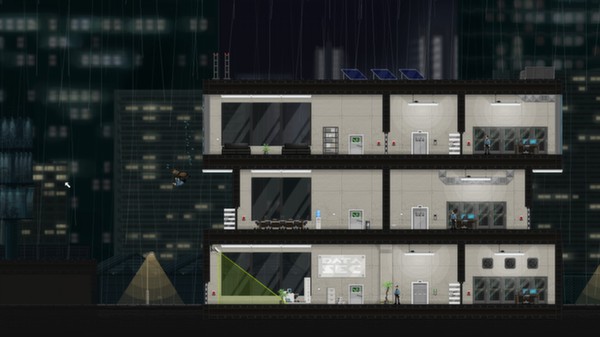
A 2D stealth-puzzle where you rewire a building's wiring to trap its guards. You play a freelance spy breaking into high-security offices to steal data. The core tool is the Crosslink: click and drag to reroute the electrics — wire a lightswitch to a trapdoor, say. Released in 2013, reportedly made almost single-handedly by Tom Francis (developer and publisher: Suspicious Developments).
My material is the pool of 10,000-plus Steam reviews. The label is the top tier, 'Overwhelmingly Positive' — 12,969 of 13,300 all-language reviews are positive (~97%, snapshot 2026-07-17). English alone is 97% of 8,224, and even the last 30 days sit at 90%. Thirteen years on, the number won't move.
Critics agree: Metacritic 83, IGN 9.0, Destructoid 9.5. So this isn't a piece that weighs a split. It reads a near-consensus — what the pool praises again and again, and where the thin sliver of complaint gathers — and translates that into Puzzlebyrinth's design vocabulary.
 Gunpoint key art — Steam store
First Impressions
Line up the top helpful reviews and the words rhyme: clever, smart, stylish, funny, and 'jazz and noir.' Most are grabbed first by the mood — a dim pixel-art detective story and a jazzy soundtrack — before they ever mention design.
The emblem of this pool is one long-running top review: 'First ten minutes: funny. Fourth hour:' — then a single breathless sentence chaining a lightswitch to a socket to an elevator to a knocked-out guard. What it conveys isn't a walkthrough but the high of a circuit assembling in your head.
And most positives add one reservation at the end: 'didn't want it to end,' 'wish there was more,' 'Gunpoint 2 plz.' Less a complaint than reluctance to leave. The only real talking point — its brevity — shows up in the margins of the praise itself.
 Gunpoint key art — Steam store
Putting the Mechanics into Words
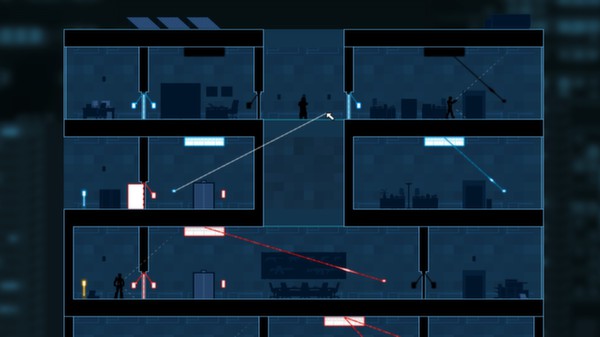
What every positive names is one device: the Crosslink. Press a button and the room's wiring lights up as lines; drag with the mouse to reroute — switch to door, a guard's gun to another gun, alarm to lightbulb. There is one verb, 'connect.' In our terms, the verb has been subtracted to a single move.
One verb, but the connections explode. One reviewer writes of 'thousands of ways to solve each level.' Linking device to device turns each room into a small circuit diagram and folds the guards' paths into it — a combinatorial blowup. Like Papers, Please from the same 2013, it's one author mining a single small system deeply.
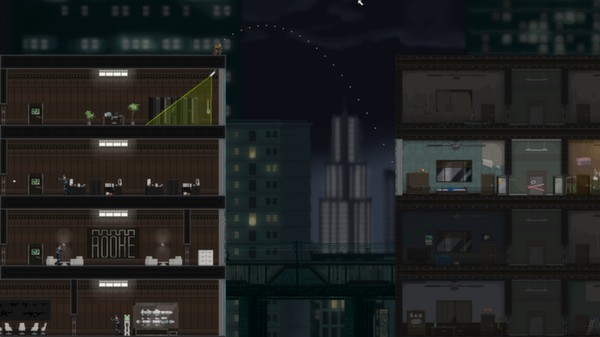
The pool also repeats the tension that 'everyone dies in one hit, you included,' softened by a generous rewind to autosaves from the last ~90 seconds. Sneak or slaughter, lethal or not — each reviewer's route differs. The same wiring becomes a different story per player: a design of high observational resolution.
 Gunpoint — Steam screenshot
Design Craft
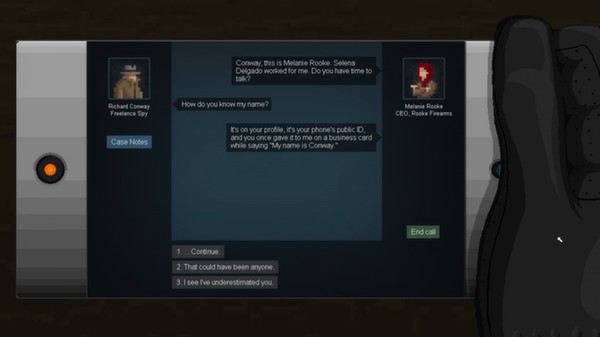
The most useful line, for a design critic, is one reviewer's: the mechanics are 'balanced between being clever and keeping the player moving forward — something puzzle games too often lose.' That's the crux. Most puzzles build friction by getting you stuck; Gunpoint sets 'never stuck' as the goal.
The means is the learning curve. Each mission adds exactly one new gadget or wireable object, testing last level's trick in the next. When reviewers say they were 'always doing something useful,' it's because the standing-still time has been deliberately trimmed, propped up by instant rewind.
It cuts both ways. Prioritising flow keeps the raw difficulty low — the hardest rooms are optional, the main path glides. Hardcore puzzlers find it light. But the overwhelming majority read that smoothness as the virtue. Flow over difficulty: a clearly bounded authorial choice.
 Gunpoint — Steam screenshot
Pacing
The one gathered complaint is length. 'Short' sits right in the user tags, and reviews put the main path at 3-4 hours; HowLongToBeat-style notes land near 3 for the story. The word 'short' recurs even in the positive reviews.
But 'short' cuts two ways. One is affection inverted — 'didn't want it to end.' The other is a price note — 'short for $10.' Several pair the two: 'no complaints at the sale price,' 'at $10 it's lean, no fat.'
And an antidote ships from day one: a level editor and Steam Workshop. Many reviews say to run the campaign a few times, then dive into community levels; one claims hundreds of hours there. The author ends the campaign short and hands the extension to the player. Length is a boundary, not a bug.
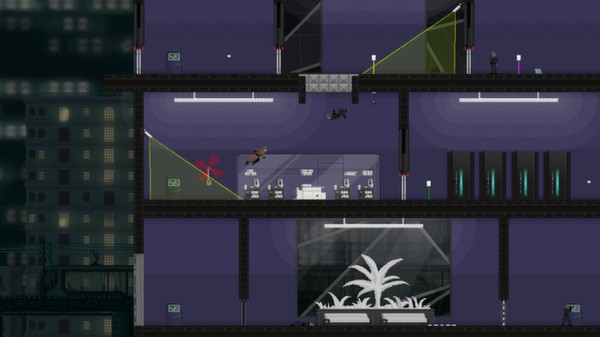 Gunpoint key art — Steam store
Sources
Written by reading the Steam store user reviews as of 2026-07-17. No review text is quoted directly; typical claims are reconstructed.
- Steam: Gunpoint (Overwhelmingly Positive; 12,969 of 13,300 all-language reviews positive ~ 97%; English 97% of 8,224)
- Read via WebFetch: the top 10 helpful positives, price/length-caveat reviews, and several recent ones; aggregates cross-checked against Steambase monthly data
- Press: Metacritic 83, IGN 9.0, Destructoid 9.5, Polygon 9.0
Closing
Steam reads 97% positive; my design-critique score is 8.5. The percentage is a 'would you recommend' vote, not a measure of polish, so they're different rulers — but they don't clash much. The marks come off in essentially one place: the short campaign and the shallow puzzle depth tied to it.
It's a touch light for anyone who wants to sit and struggle. But for anyone who wants to assemble clever tricks in a smooth, funny flow, it's close to ideal — readers who like the same dry British wit of The Sexy Brutale. The pool's near-unanimous verdict: 'short, but not a wasted second.' And then, so often: 'make a sequel.' That reluctance to leave is the surest proof the design worked.
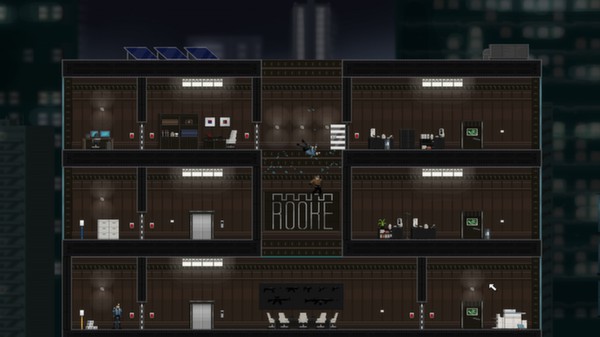 Gunpoint key art — Steam store
Reactions (no login)
Anonymous • one of each per visitor per day
次に読む

関連レビュー
Contrast
3D の街の光源を動かして壁に落ちる影を変形させ、その影の中へ 2D のシルエットとして滑り込んで足場を渡る、パズル・プラットフォーマー。少女ディディの想像上の友人ドーンとなり、ヴォードヴィルと film noir が漂う 1920 年代風の街の物語を、光と影という一つの動詞で解いていく。Compulsion Games の 2013 年作。
Brothers - A Tale of Two Sons
病の父を救う「生命の水」を求めて、兄と弟が旅に出る。左スティックで兄、右スティックで弟を同時に動かし、二人の体格と得意を組み合わせて谷や水路や巨人の骨を越えていく。台詞はすべて架空の言語。Josef Fares が監督し、Starbreeze Studios が2013年に発表した無言のパズル・アドベンチャー。
Magrunner: Dark Pulse
磁力を操る Magtech グローブで、同色は引き合い異色は反発するキューブや台座を組み合わせ、40 以上のテストルームを抜けていく一人称パズル。Portal の文法を下敷きに、クトゥルフ神話の悪夢を研究施設へ流し込んだ Frogwares の 2013 年作。


