REVIEW · 2022-11-03
The Entropy Centre
Zeit-zurückspulende Testkammern an Bord einer sterbenden Raumstation
First Impressions
I write this not as a log of my own playthrough but from the pool of user reviews stacked up on Steam. The Entropy Centre is a first-person puzzler made by the UK's Stubby Games and published by Playstack in November 2022. Aboard a ruined space station, you descend through cube-based test chambers with ASTRA, an AI companion gun that rewinds an object through time.
The label reads 'Very Positive': 88% of 2,015 English reviews, 3,268 across all languages, and 3,881 positive of 4,344 across all review types (snapshot 2026-06-22). The last 30 days hold steady at 86% of 37. That number isn't lukewarm; it's clearly high. What's interesting is how cleanly opinion splits inside that high score.
Open the reviews and both camps draw the exact same reference line — Portal. The helpful positives say it 'scratches the Portal itch'; the negative side dismisses it as a 'drawn-out Portal fan game.' I'll read this from that fault line, alongside other Portal-shadowed pieces like ChromaGun and The Turing Test.
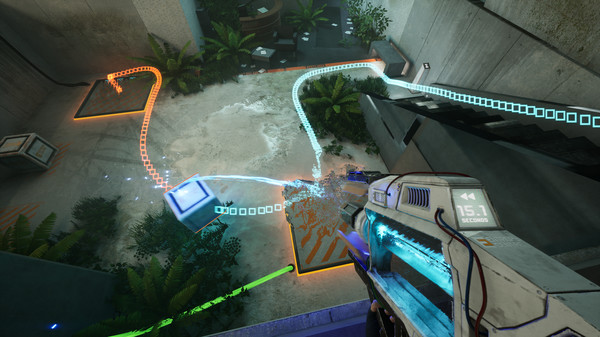 Key art for The Entropy Centre — Steam store
Putting the Mechanics into Words
The positives keep explaining the game the same way: 'picture the goal first, then build backward to it.' ASTRA rewinds one object's last ~38 seconds — that's the whole kit. Place a cube on a pad and a door opens; cubes also become jump pads and bridges. When reviewers say they 'felt like a genius,' they mean the instant a rewind trail has carried everything to where it needed to be.
In Puzzlebyrinth's terms this is a one-verb design. What's unusual is that the single verb reverses the direction of causality, so the grammar of a solution is not 'place' but 'work backward.' You fix the end state and reason out the starting layout in reverse — the observation resolution being tested sits in a future that hasn't happened yet, not in the board in front of you.
For all that satisfaction, the design keeps its combinatorial explosion fairly tame. As Game Informer (8/10) notes, the rewind mechanic itself restricts the space of possible solutions. The chapter-by-chapter rollout of one new cube type is careful teaching, but that care stacks rather than branches: late puzzles add objects without forking the path.
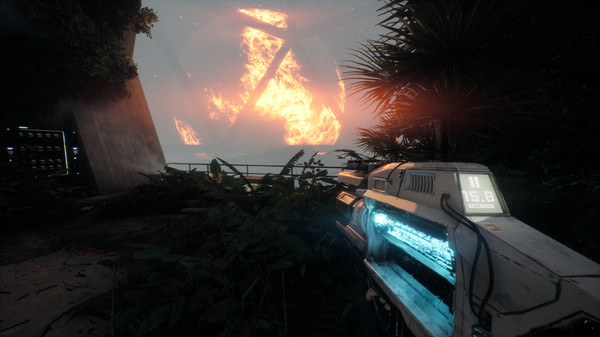 A test chamber where rewinds assemble cause and effect — Steam store
The Feel of the Story
The fiercest friction here isn't the puzzles but the volume of talk. The positive side adores ASTRA, the companion gun: an emoji-faced, cheerfully rule-bound AI that 'steals the show,' is 'adorable,' with facility emails that stay light yet land the occasional weight. The negative side reaches for the opposite words — 'dialogue written like a message board,' 'the cat jokes fall flat,' 'more yapping and waiting than actual play.'
What's worth noting is that both are pointing at the same thing: a chatty AI and a lot of text. One camp reads it as charm, the other as padding. That's less a quality dispute than a question of design reach. Stubby Games chose to fill the gaps between puzzles with a talkative personality; how much you take to that banter decides whether the same design is a hit or a miss for you.
Several reviews also flag a mismatch of pace between story and play. The narrative pushes apocalyptic urgency while the puzzles ask you to stop and reason backward at length — urgency in the writing, deliberation in the play, a temperature gap that tears at the experience late on. It sits in the story-rich lineage of The Turing Test, but where that one filled the silences with speculation, this one fills them with the warmth of a personality.
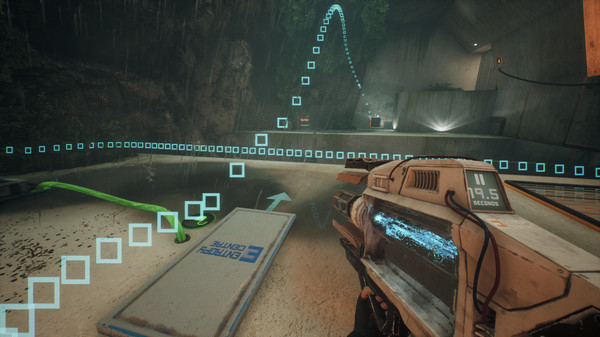 ASTRA, the companion AI, and the facility — Steam store
The Texture of Difficulty
Steam's tags include 'Difficult,' yet the core negative line is 'I was rarely stumped.' That contradiction disappears the moment you treat difficulty as one thing. From the pool, the 'difficulty' reviewers point at splits into three kinds.
First, conceptual difficulty — the early friction of learning the backward grammar, exactly where positives delight that their 'brain bends a new way.' Second, execution friction — cubes glitching into walls mid-rewind and forcing a restart, a bug-driven annoyance Game Informer flags too. That difficulty comes from the controls, not the thinking. Third, fatigue from length: chapter after chapter piling on same-element puzzles until the third act drags.
What divides opinion isn't depth but that third kind. Because the combinatorial explosion never fully arrives, late difficulty trends 'longer' rather than 'deeper.' Chase and stealth beats are grafted on near the end, dropping a foreign body into the quiet backward grammar. The difficulty itself is middling; it's the texture shifting chapter by chapter that becomes the fault line.
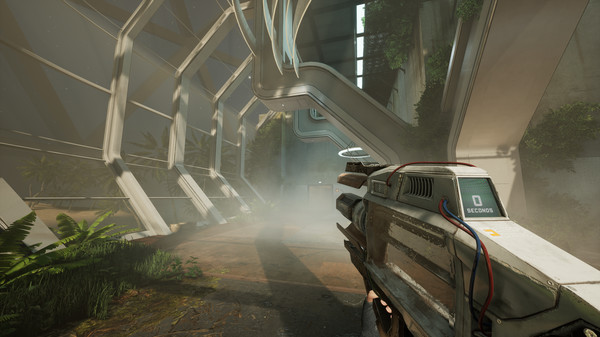 Earth seen from the facility — length and vista, late game — Steam store
Sources
This piece was written by reading the user reviews on the Steam store page as of 2026-06-22. No review text is quoted directly; typical claims are reconstructed.
- Steam: The Entropy Centre (Very Positive — 88% of 2,015 English reviews; 3,268 all languages; 3,881 positive of 4,344 across all types)
- Read via WebFetch: helpful positives, representative negative complaints, and several recent reviews, tallying recurring words and axes of judgment
- Press: Game Informer (8/10) and scores/notes from other outlets
Closing
Steam reads 88% positive; my design-critique score is 7.8, and the two don't diverge much. The one verb — working backward — is lucid and genuinely opens a new way of thinking. The marks come off for two things: the verb never reaches a real combinatorial explosion, so the back half pads itself with length; and the twitch beats grafted on near the end muddy an otherwise pure grammar. My reasons largely overlap with Game Informer's 8.
The pool's shared advice is plain: 'buy it if you have a Portal itch, but let the talkative story wash over you.' Roughly twelve hours, the pleasure of the rewind, a chatty companion, a dragging third act — how you price those four decides your verdict. Outside its reach for anyone wanting pure, quiet logic; well worth it for anyone who wants the Portal gap filled with story and all. The split itself tells you who the game is for.
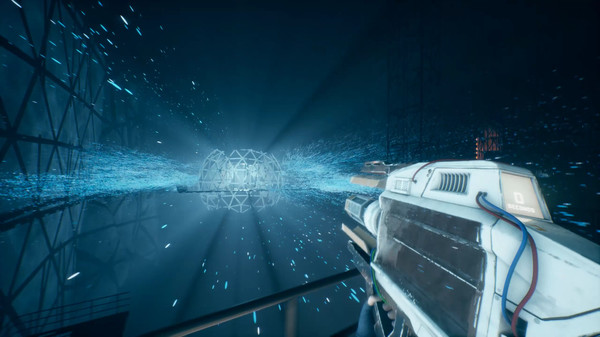 The Entropy Centre — Steam store
Where are you with this game?
Press one and the game goes on your shelf. You can see it on your account page.
Reactions (no login)
Anonymous • one of each per visitor per day
Read next
Related reviews
Portal Reloaded
Ein kostenloser Community-Mod auf Basis von Portal 2. Neben den blauen und orangen Raumportalen kann man nun ein grünes Zeitportal schießen, das zur selben Anlage 20 Jahre später führt, und löst so 25 Testkammern, indem man zwischen Gegenwart und Zukunft hin- und herwechselt. Veröffentlicht 2021 vom Solo-Entwickler PORTANIS, 2023 um 20 Koop-Level erweitert.
Hyperbolica
Ein nichteuklidisches Erkundungsadventure aus der Egoperspektive: Man durchläuft eine Stadt, die aus hyperbolischem Raum, in dem sich Parallelen nicht schneiden, und sphärischem Raum, in dem entfernte Dinge größer wirken, besteht, spricht mit den Bewohnern und erwirbt durch Rennen, Skifahren und Schneeballschlachten ein körperliches Gefühl für diese Welt. Ein Werk von CodeParade, der auch die Rendering-Pipeline im Alleingang aufgebaut hat.
GNOSIA
Ein Solo-„Werwolf"-Spiel, bei dem man allein durch Gespräche und Abstimmungen die ins Raumschiff eingeschleuste „Gnosia" aufspürt. Bis zu 15 Besatzungsmitglieder erhalten in jeder Runde neu verteilte Rollen, während man in einer Zeitschleife dieselbe Reise immer wieder durchlebt — ein Adventure von Petit Depotto.


