REVIEW · 2024-11-12
The Rise of the Golden Idol
Eine Lektüre der Rezensionen, die ständig am ersten Teil gemessen werden
First Impressions
I wrote this by reading the pile of user reviews on Steam. You click through a frozen crime scene, pull words from testimony and evidence, and drop them into blanks to fix who did what, why, and in what order. Color Gray Games made it and Playstack released it in November 2024 — a 1970s deduction adventure of twenty linked cases.
The numbers run high: 95% of 2,389 English reviews positive (Overwhelmingly Positive), 3,522 all-language (Very Positive), Metacritic 78 and OpenCritic 85 'Mighty' (2026-06-29 snapshot). Yet the last 30 days dipped to 75% of 82 — Mostly Positive. That gap between lifetime and recent is not unrelated to the comparison habit I'll get to.
The first thing the review pool reveals is that its most frequent proper noun isn't the studio or the genre — it's the first game, The Case of the Golden Idol. Praise and complaint both ride that single line. This is a sequel that gets read through its predecessor, so I'll read the comparison itself.
 A sequel set in the 1970s; the review pool's recurring reference point is the original — Steam store
The Feel of the Story
Across the positive reviews the recurring praise is that the story isn't delivered to you — it assembles. You're flooded with facts, you reorder them in your head, and a throughline stands up. One review calls it 'a massage for your brain' and contrasts the self-paced format with watching a film. In Puzzlebyrinth terms it speaks straight to observation resolution: seeing fragments and rebuilding the whole.
The negative side keeps pointing at the same object and calling it 'lighter' than the first game. Cases are smaller and more numerous, the Idol is sidelined, and the 1970s setting barely bites until the end. Learn bird names, decode a strange dance, reconstruct a photoshoot — reviewers read these as padding that adds little to the throughline, and call the finale anticlimactic.
My read: both describe the same facts on different axes. The first game's gravity was the unknown itself — what is the Idol? The sequel starts after that answer, so it must relocate its gravity to the cross-chapter meta-cases. Positive players take that linkage as the payoff; negative players say it arrives late. It's not story quality but where the gravity sits. As a sibling in deduction-as-storytelling, Return of the Obra Dinn makes a useful contrast.
 Cross-chapter meta-cases become the story's new center of gravity — Steam store
Putting the Mechanics into Words
The core is the first game's verb: place a word in a blank. You harvest words from evidence and fill ad-lib sentences to fix the case. The sequel layers per-case sections on top — name people, order events, arrange fingerprints and portraits into hierarchies — and adds an end-of-chapter 'storyboard' meta-puzzle binding four or five cases. Positive reviewers welcome the wider palette.
The complaints cluster on handling. The original's fixed two-screen view became movable pop-out windows. More flexible, but the windows are big and many, so you overlay and dismiss them and forever fight for space. And because used words no longer vanish, the word box never shrinks and you keep re-hunting through clutter.
There's a design trade here. In the first game, a correctly placed word left the board — progress made visible, and a subtraction that tidied the screen. The sequel spends that subtraction to buy window freedom. 'Freer' versus 'messier' is just how much each reviewer misses the vanishing. One verb (place), but the grammar and screen manners around it split the experience. The Roottrees are Dead reads in the same vocabulary.
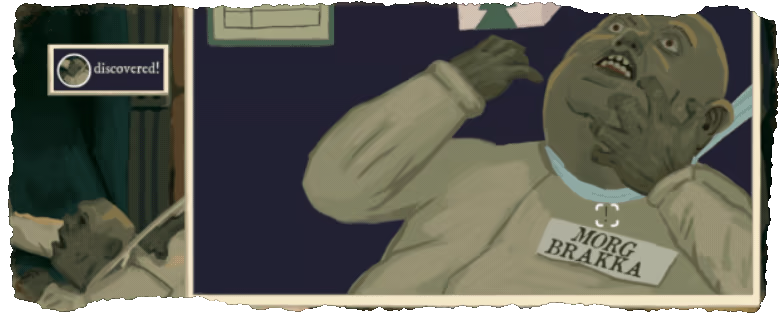 Movable windows and an end-of-chapter meta-puzzle; freedom bought by dropping the vanishing words — Steam store
The Texture of Difficulty
Verdicts on difficulty split. Some call it easier than the first game because the cases are smaller; many still report getting stuck late. But the most repeated concrete complaint isn't logic, it's phrasing: you know the answer yet can't word it the exact way the game wants. One review was rejected for writing 'Y or X' instead of 'X or Y'. In German, grammar errors in the translation made correct answers unbuildable and stalled the deduction outright.
I'd sort that 'stuck' by kind: (a) a real gap where you missed an observation; (b) a parser refusing a correct meaning on grammar; (c) a translation that diverges from the original. Only (a) is the designed difficulty; (b) and (c) are friction outside the deduction. When a reviewer says they spent more time formatting than solving, their observation resolution won — the notation's grammar tripped them.
The critic-versus-user temperature gap reads as the same friction seen from different seats. At Metacritic 78 and OpenCritic 85, critics rate it a confident refinement and aren't very hung up on the predecessor; Steam regulars, especially those who loved the first game, keep measuring the sequel by it. The recent dip to 75% rests on only 82 reviews, so I won't over-read it — but the measuring stick is still in hand.
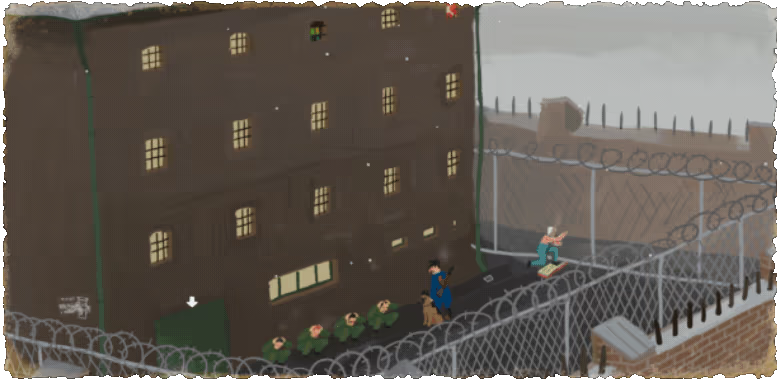 You can see the answer yet fail the wording — difficulty drifts from logic to notation — Steam store
Design Craft
The striking thing in the negative reviews is how many grant it's a good game and still vote no. One notes that Steam asks not 'is it good?' but 'do you recommend it?', concedes the quality, and signs off: 'I recommend the first one.' It reads as regret, not anger.
That's a question of design scope, not a defect. Players who came for the deduction stay satisfied — the fill-in pleasure persists even when cases shrink. Players who came for the first game's heavy air and meta-narrative read the same changes as loss. The sequel faced the hard problem of following a game that sold the unknown; the new Idol power (rewriting memory) and the end-of-chapter meta-puzzles are its attempts at an answer. Positive players accept them as new gravity; negative players say they land late.
So I won't stoke the split into a fight. Color Gray spent its complexity budget on 'smaller and many' rather than 'bigger and one.' The first game's deeper dig I leave to the The Case of the Golden Idol piece; the sequel's choice is best read not as decline but as a redrawn scope of who it's for.
 The 'good but not recommended' vote points at design scope, not a flaw — Steam store
Reviews Consulted
This piece was written by reading the user reviews on the Steam store page as of 2026-06-29. No review text is quoted directly; typical claims are reconstructed.
- Steam: The Rise of the Golden Idol (English 95% of 2,389 — Overwhelmingly Positive; 3,522 all-language — Very Positive; last 30 days 75% of 82 — Mostly Positive)
- Read via WebFetch: the top ~10 helpful positive reviews, ~10 helpful negative reviews, and several more recent ones
- Press: Metacritic (78) and OpenCritic (85, Mighty)
Closing
Layered into one image, the review pool reads as a vote on a sequel that polished the interface, multiplied the cases, and spent less on atmosphere. The core verb — telling a story through fill-in deduction — is intact; the grammar, window manners, and distribution of narrative gravity around it were rebuilt. The split is whether you read that rebuild as refinement or as loss.
Steam's English 95% is a strong yes to 'do you recommend it?'; the recent 75% and Metacritic's 78 are more reserved. From a design view I give it 8.0. It sits below the first game's 8.5 because parser friction and some padding shave the experience's peak — but the deductive core is sound, so it can't sit low. For atmosphere-first players, the original; for the pleasure of a story assembling itself from blanks, this sequel.
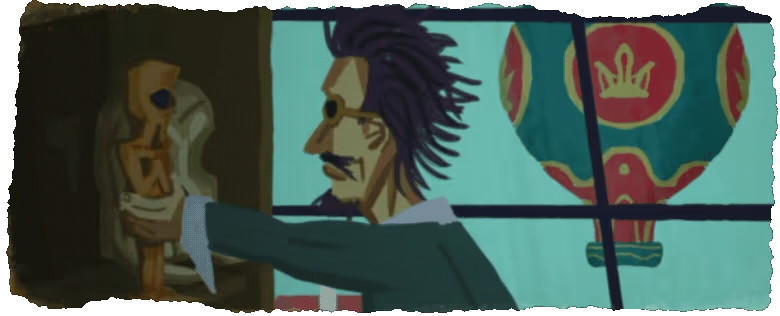 The core verb is intact; how you judge the rebuilt grammar and gravity is the split — Steam store
Where are you with this game?
Press one and the game goes on your shelf. You can see it on your account page.
Reactions (no login)
Anonymous • one of each per visitor per day
Read next

Related reviews
The Case of the Golden Idol
Ein Deduktionsspiel: Untersuche erstarrte Tatort-Tableaus, sammle Wörter aus den Indizien und fülle Lücken, um jeden Mord eines Kriminalfalls im 18. Jahrhundert zu rekonstruieren.
Duck Detective: The Secret Salami
Ein 2.5D-Beobachtungs- und Deduktionsabenteuer, in dem ein abgehalfterter Enten-Detektiv Beweise mit der Lupe prüft und gesammelte Wörter in Lückensätze einsetzt, um den Fall eines gestohlenen Mittagessens zu lösen. Happy Broccoli Games macht den Golden-Idol-Stil leicht, voll vertont und wortspielreich.
The Roottrees are Dead
1998, eine gestürzte reiche Familie. Durch das frühe Internet einer Einwahl-Verbindung und durch Bücher und Artikel stöbernd, verfolgt man die Blutsverwandtschaft dieser Sippe und füllt die Lücken eines Stammbaums — ein Ich-Perspektive-Denkrätsel. Das kostenlose Browserspiel aus dem Global Game Jam wurde von Evil Trout Inc. neu aufgebaut.


