TAG
#deduction
27 reviews · 7 essays
Related essays
Love Letter (2012) — One of Sixteen Cards, Removed Before Anyone Looks
Seiji Kanai's Love Letter (2012) begins by removing one of its sixteen cards without anyone seeing it. Only fifteen ever reach the table. Discards sit face up where anyone can count them, and yet one card is structurally unknowable. This piece takes apart that subtraction — incomplete information without a random number generator — plus why the deck size was decided by demo tables abroad, and why the Countess's compulsory rule is, at a physical table, only a conscience.
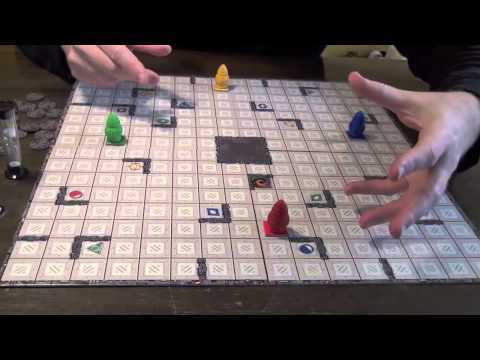
Ricochet Robots (1999) — Instead of Turn Order, a Number Said Out Loud
Alex Randolph's Ricochet Robots (1999) has no turn order. There is one board, and everyone solves it at the same time. Whoever finds a route says a number out loud, and the right to demonstrate goes to the lowest bid. The sliding movement ports to code almost too well; the one minute of sand does not. Reading the rulebook closely, here is what disappears and what survives — including the tie-breaking rule the publishers still have not agreed on.
Mastermind (1970) — A Telecoms Engineer's Four Colors, Later Reborn as Fallout's Hacking Screen
In 1970, Israeli telecommunications engineer Mordecai Meirowitz devised Mastermind, a game that reveals only a count of hits and near-misses from four hidden color pegs. Rejected by major toy companies, it was released by Invicta Plastics in 1971 and sold over 30 million sets within the decade. In 1976 Donald Knuth showed it could be solved in five moves or fewer, and in 2007 a Bethesda programmer built it directly into Fallout 3's hacking minigame. This piece traces how a half-century-old constraint — telling the player only a number, never the answer — still shapes puzzle design in the age of Wordle.
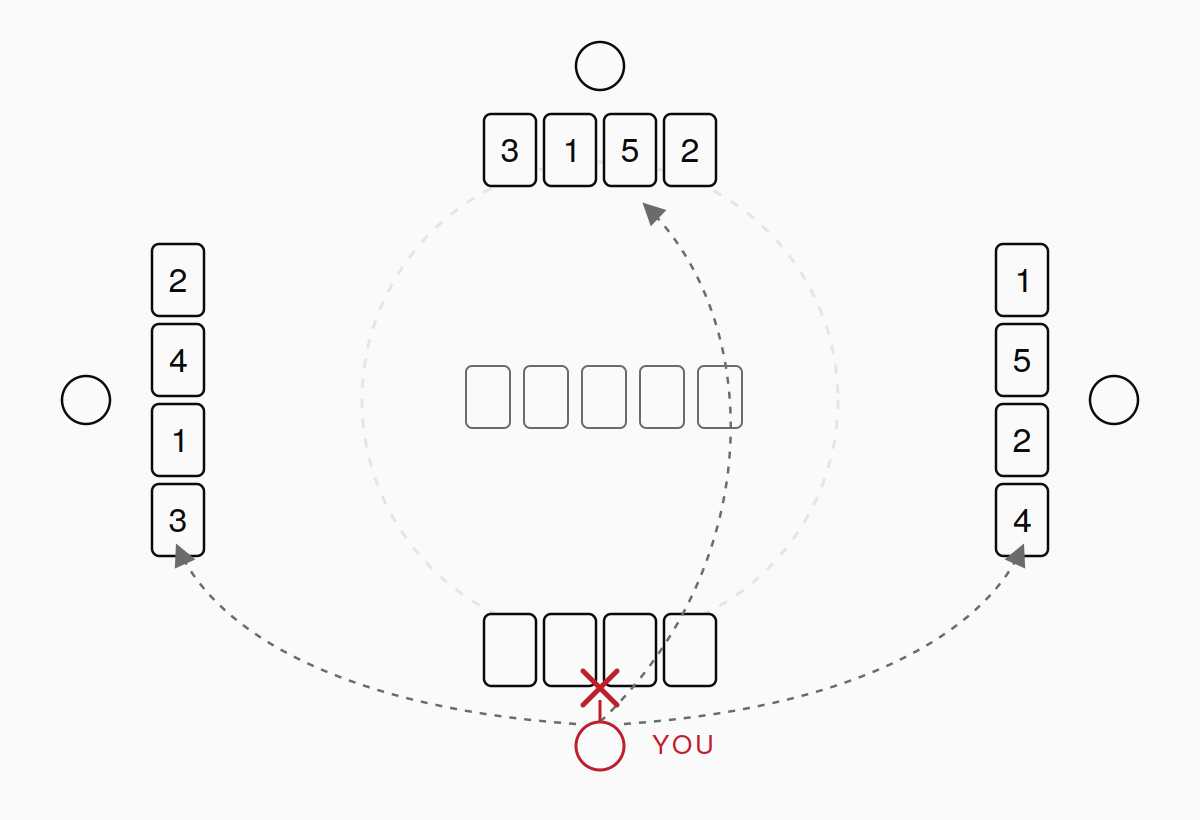
Hanabi (2010) — The Rule That Matters Most Is the One the Rulebook Never Made
In Hanabi you hold your hand facing away from yourself, and a hint may name only one colour or one number. Yet the official rulebook hands the rule that matters most — what you are allowed to say — straight to the table. That is the first thing to vanish in code, and it is why an AI that scores 24 with a copy of itself scores almost zero beside a differently-trained partner.
In-Game Notebook Design — Where Should a Deduction Puzzle Keep Its Memory? (from Obra Dinn to Chants of Sennaar)
The difficulty of a deduction puzzle changes with where the player's memory lives. From La-Mulana and Her Story, which pushed notes onto real paper, to Obra Dinn's self-filling logbook and the hypothesis slots of Golden Idol and Chants of Sennaar, this essay rereads the in-game notebook as a design device.
Walking and Deducing — The Boundary from Gone Home to Return of the Obra Dinn
The 'walk and read' experience Gone Home and Firewatch refined, versus the 'actively deduce' experience of Return of the Obra Dinn and The Case of the Golden Idol. Where is the line between them? A designer's reading of the fault line between walking simulators and deduction puzzles, with Her Story and Outer Wilds in between.
Soundtrack: The Case of the Golden Idol — grey music for frozen time
The OST Kyle Misko wrote in wartime Lviv for The Case of the Golden Idol: cold 18th-century England fused with new-age ambient, looping beside a frozen crime scene and never rushing your deduction. On the design of music that refuses to react — and what a composer can steal from it.




Related reviews
Wilmot Works It Out
A puzzle-building game: open the weekly package, pull out square pieces, assemble the pictures, and hang the finished ones on your walls. Each package mixes pieces from several pictures, so sorting comes before building. The sequel to Wilmot’s Warehouse, from Hollow Ponds and Richard Hogg.
puzzleobservationlogicHypnospace Outlaw
An observation adventure set in 1999. You patrol Hypnospace — a virtual internet people browse in their sleep — as a volunteer Enforcer, wandering personal homepages and digging out rule violations and hidden pages with nothing but a weak search box and thin clues. Designed by Jay Tholen at Tendershoot.
observationnarrative-puzzlesimulationCypher
A first-person puzzle game about cryptography. You walk white exhibition rooms and decode the ciphertexts hung on their walls, from simple substitution through polyalphabetic ciphers to machine ciphers. A solo work by Matthew Brown of the Hexcells trilogy, and it assumes you have paper and a pencil.
puzzlelogic-deductionminimalistZero Escape: The Nonary Games
Two Spike Chunsoft mystery adventures in one package: nine people are locked inside a facility and must pass through numbered doors to get out. It bundles the DS-born Nine Hours, Nine Persons, Nine Doors with its sequel Virtue's Last Reward, alternating first-person escape-room sections with branching novel sections.
mysteryadventurenarrative-puzzlePhoenix Wright: Ace Attorney Trilogy
A courtroom adventure in which you play defense attorney Phoenix Wright, matching one line of testimony against one piece of evidence to break a lie. Capcom's collection gathers all fourteen episodes of the three games first released between 2001 and 2004, with the art redrawn frame by frame.
mysteryvisual-noveldeductionContradiction: Spot the Liar!
A live-action (FMV) murder mystery in which Detective Inspector Frederick Jenks spends one evening - 5pm to midnight - reopening a drowning in the small English village of Edenton. You interview the residents, collect what they say, then pair two statements that clash and confront the liar to unlock the next thread. Designed and scored by Tim Follin for Baggy Cat.
mysteryfmvdeductionSherlock Holmes: Crimes and Punishments
A third-person detective adventure set in Victorian London: walk the scene, lift clues from it, then wire them together on a board called the Deduction Space until a conclusion forms. Each of six standalone cases supports several conclusions, and you also decide whether to hand the person you name to the law or let them go. Made by Frogwares.
deductioninvestigationnarrative-puzzleScene Investigators
A first-person deduction game: walk reconstructed crime scenes, work out what happened from the evidence alone, and type your answers into an exam terminal. No hints, no confirmation. From EQ Studios, makers of The Painscreek Killings, built on their stated 70/30 principle.
deductionobservationinvestigationUnheard - Voices of Crime
A deduction adventure played over a top-down floor plan: you move between rooms and scrub a recording of the day back and forth, listening. There are no subtitles — you name the figures and answer the case questions using only what you heard. From NExT Studios.
mysteryobservationpuzzleStrange Antiquities
A 2D identification-and-deduction puzzler in which you mind an occult antiques shop in the lakeside town of Undermere, probing unlabelled objects by colour, touch, scent and inner perception, cross-referencing illustrated tomes, and handing each customer the item their trouble calls for — where what you hand over decides the town's fate.
puzzlemysteryTangle Tower
A hand-drawn, fully voiced detective adventure: a painter's murder in a strange mansion, solved by interrogating suspects, pairing the clues you gather, and cracking the puzzles hidden through the tower. SFB Games' 2019 follow-up to Detective Grimoire.
puzzlemysteryadventureThe Shapeshifting Detective
A murder-mystery FMV in which a detective can shapeshift into anyone they've met to draw out secrets no one would tell a cop. The killer is picked at random each new game, and 1,600+ live-action clips branch on your choices — from D'Avekki Studios, makers of The Infectious Madness of Doctor Dekker.
mysteryfmvadventureSquareCells
A tiny logic puzzle that crosses Picross with Minesweeper: fill or break each square in a hidden grid using only the surrounding clues, where a number in a cell tells you how many cells it connects to. No guessing — every solution is reachable by pure deduction. By Matthew Brown, creator of Hexcells.
puzzlelogicnonogram-like14 Minesweeper Variants
A pure-logic puzzle collection that rewrites the rules of classic Minesweeper in fourteen ways (and then some), stripping out luck and guessing so that swapping a single line of the rules opens up endlessly different deductions. From Artless Games and Alith Games.
puzzlelogicminesweeper-likeChinatown Detective Agency
A cybernoir point-and-click set in near-future Singapore, where you run a detective agency and crack international cases by researching real facts in a browser outside the game. General Interactive Co.'s experiment hands the last step of every clue to the live web.
deductionobservationmysteryDuck Detective: The Secret Salami
A 2.5D observation-and-deduction adventure where a down-on-his-luck duck detective peers at evidence and slots words into fill-in-the-blank sentences to crack the case of a stolen lunch. Happy Broccoli Games takes the Golden Idol style and makes it light, fully voiced, and pun-heavy.
deductionobservationnarrative-puzzleDo Not Feed the Monkeys
A digital voyeur simulator: watch strangers - 'monkeys' - through surveillance cameras, pick clues from their rooms and talk, and pin down who they are with a notepad and a search engine. Blackmail, help, or look away, all while juggling rent, food and sleep. A game by Fictiorama Studios.
observationdeductionsimulationMurder by Numbers
A 2D visual-novel-meets-picross set in 1996 Los Angeles, where out-of-work actress Honor and a discarded robot named SCOUT solve nonogram puzzles to uncover clues and chase a murder case. Published by The Irregular Corporation, with music by Ace Attorney composer Masakazu Sugimori and character art by Hatoful Boyfriend's Hato Moa.
puzzlelogicmysteryLucifer Within Us
An isometric detective game where you scrub testimony timelines and jab at contradictions to solve murders, piecing together motive, means, and opportunity in a daemon-haunted theocracy — from Kitfox Games.
mysteryobservationnarrative-puzzleShadows of Doubt
A first-person detective sim set in a procedurally generated 1980s noir city. Gather fingerprints, CCTV, receipts and call logs, pin them to an evidence board, and name the killer out of a fully simulated crowd — every citizen with a name, a job and a life of their own. From ColePowered Games.
mysteryimmersive-simfirst-personThe Rise of the Golden Idol
A 2D deduction adventure where you click through frozen crime scenes and drop harvested words into blanks to reconstruct who did what, why, and in what order. A standalone sequel to The Case of the Golden Idol, set across twenty linked cases in the 1970s.
deductionobservationnarrative-puzzleBotany Manor
A first-person puzzle set in an 1890s English manor, where you play retired botanist Arabella Greene and deduce each forgotten plant's ideal growing conditions from letters, posters, and clippings to coax it into bloom. Reading clues and binding them to a herbarium page is the core verb.
puzzlefirst-personTametsi
A 2D deduction puzzle where you flag hidden mines using only each tile's adjacency clues. It strips the luck from Minesweeper and layers colours, row/column totals and non-square tilings across 100-plus boards hand-built by Grip Top Games.
puzzlelogicStrange Horticulture
A 2D occult deduction puzzle in which you identify each plant that arrives at your counter by matching it against an almanac and the clues you gather, then use its effects to answer customers and steer the story. Made by the UK’s Bad Viking, it unravels foggy Undermere’s mysteries with a cat and a single book.
puzzlemysteryThe Roottrees are Dead
A first-person deduction puzzle: scour the early, dial-up-era Internet plus books and articles to establish who is truly blood-related to a crashed dynasty, filling in the blanks of their family tree. Evil Trout Inc.'s reworking of a free Global Game Jam browser game.
deductionobservationnarrative-puzzleHexcells Infinite
A Minesweeper-lineage logic puzzle: find the hidden blue cells on a hex grid using only adjacency counts, line hints and consecutive/non-consecutive markers — pure deduction, no guessing. Matthew Brown's third entry layers an endless puzzle generator over 36 hand-made boards.
puzzlelogic-deductionminimalistThe Case of the Golden Idol
A deduction game: examine frozen crime-scene tableaus, gather words from the evidence, and fill in the blanks to reconstruct each murder across an 18th-century mystery.
deductionobservationnarrative-puzzle


