HISTORY · 2026-09-14
Mastermind (1970) — A Telecoms Engineer's Four Colors, Later Reborn as Fallout's Hacking Screen
From a postal engineer moving a paper guessing game onto wooden pegs, to the hacking screen in Fallout 3
Introduction — A Job Guessing What's on the Other End of the Line
This is an invention born in 1970. Its maker was Mordecai Meirowitz, an Israeli telecommunications engineer. Alongside his work handling phone lines at the post office, he rebuilt an old paper-and-pencil guessing game using colored wooden pegs.
It grew out of a game called Bulls and Cows, a paper game of guessing a sequence of digits whose origins are said to reach back over a century. Meirowitz moved it onto a board you could touch: four holes, six colors of peg.
No major toy company would take it on. The one that finally showed interest was Invicta Plastics, a small toy firm in Leicester, England. Founder Edward Jones-Fenleigh refined the design, and in 1971 it was released as "Mastermind."
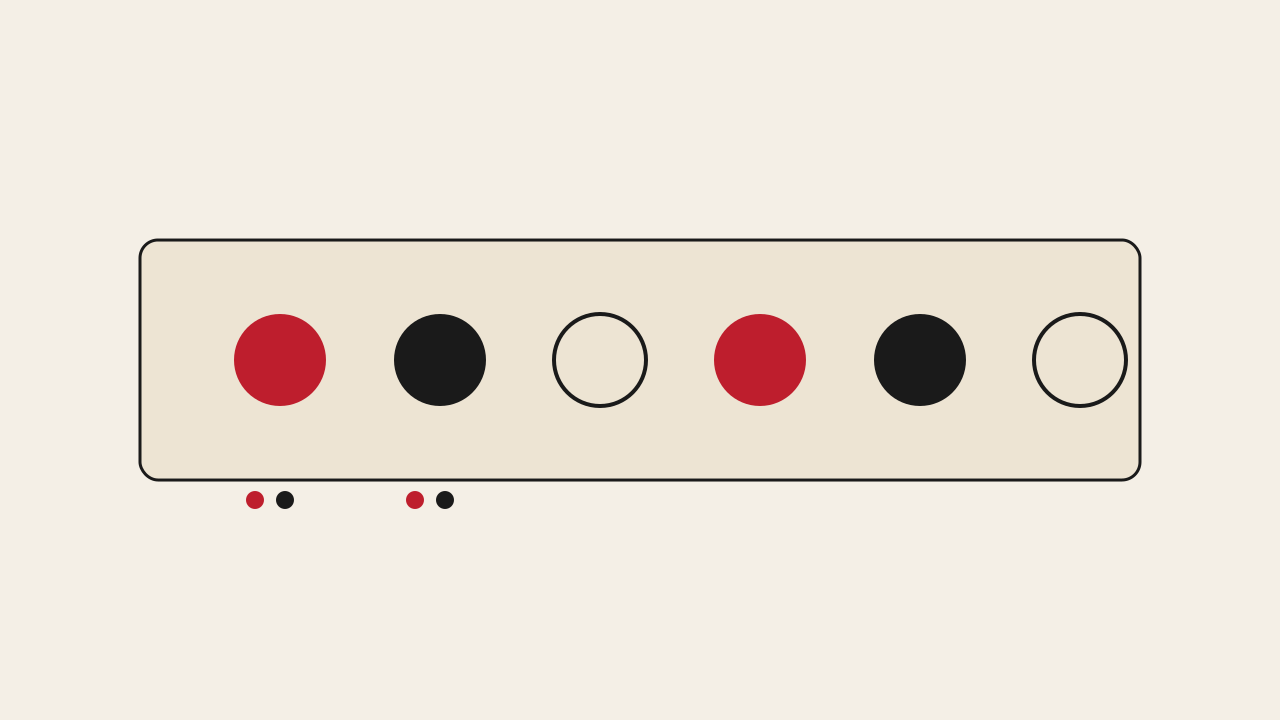 Four color pegs, and the scoring pegs that reveal only hits and near-misses (illustration, AI-generated)
Context — Bulls and Cows Inside the Titan
Around 1970, computers were still locked away in university computing rooms. At Cambridge, a student named Frank King had already ported Bulls and Cows onto the Titan mainframe in 1968, calling his version "MOO."
What's striking is the story that Cambridge's computing centre sharpened its defenses against unauthorized access partly because of students tampering with MOO's leaderboard — lessons later said to have informed IBM's own thinking. A puzzle's side game became a training ground for computer security.
In the decade Invicta's version launched, home games still lived in a world of paper and plastic. Mastermind sold over 30 million sets within the 1970s alone, and later tallies put the cumulative total above 50 million across 80 countries — sometimes called the best-selling new game of the decade.
 A university computing room and a living-room toy box, both housing the same act of deduction (illustration, AI-generated)
Mechanics — A Constraint That Reveals Only Numbers
The rules are simple. One side hides a sequence of four colors; the other guesses a sequence in return. The answer comes back not as colored pegs but as small red-and-white scoring pegs: red for right color in the right spot, white for right color in the wrong spot.
This constraint — revealing only a count of hits and near-misses, never the hidden sequence itself — is the heart of the game. All you can see is a number describing how close your own guess came, and from that alone you narrow down the possibilities.
In 1976, computer scientist Donald Knuth solved the game mathematically, showing that an optimal strategy can crack any sequence in five moves or fewer. In 1993, Koyama and Lai tightened that further, to an average of 4.34 moves. A toy became a board for theory as well as play.
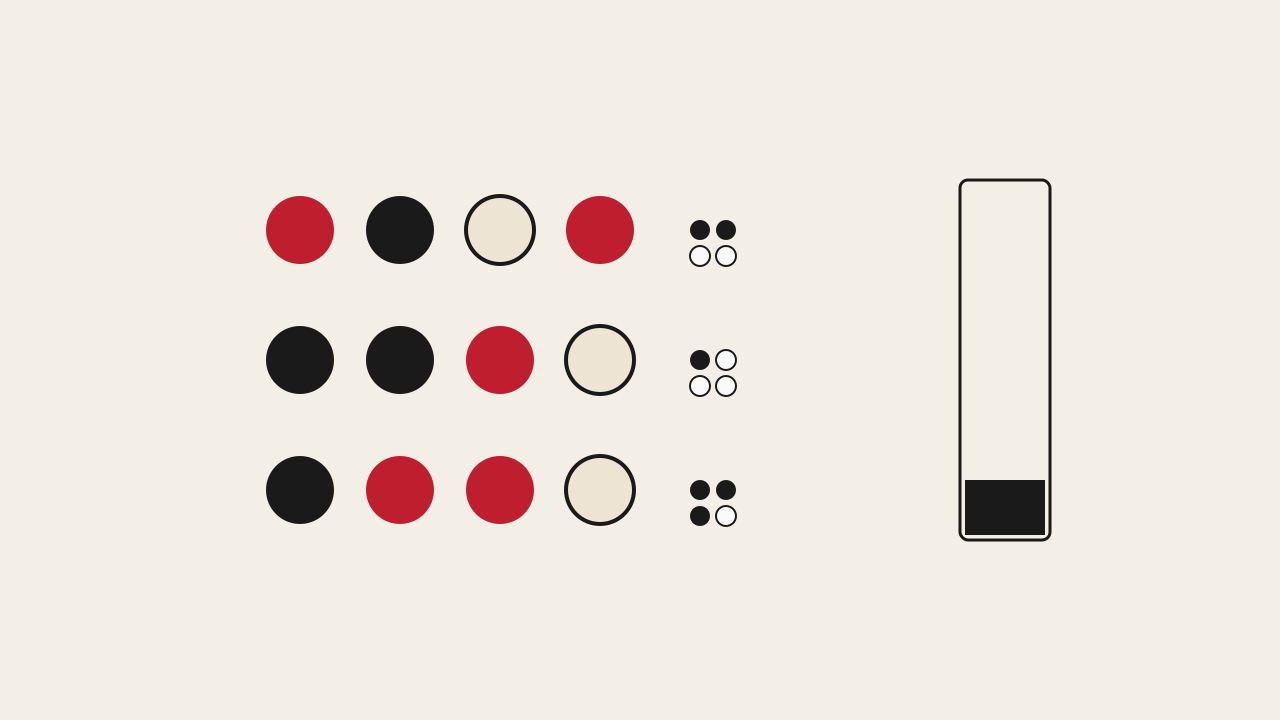 Each guess narrows the field, using nothing but red and white pegs (illustration, AI-generated)
Legacy — The Day It Became Fallout's Hacking Screen
This skeleton of deduction survived changes of color and country. In Japan it spread both as "Mastermind" via Kawada and Hasbro Japan, and under the name "Hit and Blow" (taken from its own scoring terms); Fuji TV's number-guessing show Numer0n sits in this same lineage.
The crossing into digital games left a clearer paper trail. In 2007, Bethesda programmer Dan Teitel, tasked with building the hacking minigame for Fallout 3, later recalled that the original concept — scrolling letters vanishing on a countdown — was "tedious and obtrusive." A colleague showed him Mastermind, and it became the solution outright. Variations on the same mechanism later turned up in Neverwinter Nights and Sleeping Dogs.
The resemblance keeps recurring. Wordle, the word-guessing game that spread in 2021, is often compared to Mastermind — though Wordle is the gentler of the two, since it reveals letter position outright, where Mastermind reveals only color. The constraint set by four wooden pegs half a century ago — tell the player only a count, never the answer — still shapes how puzzle designers work today.
 From wooden pegs on a board to a hacking screen on a monitor (illustration, AI-generated)
Sources
Sources consulted for this article:
・Wikipedia: Mastermind (board game)
・Wikipedia: Mordecai Meirowitz
・Wikipedia (Japanese): Mastermind
・VICE: The Mysterious Origins of Mastermind, the Codebreaking Board Game
・Smithsonian National Museum of American History: Invicta Electronic Master Mind
Closing — Guessing the Unseen, From Numbers Alone
Meirowitz was an engineer of phone lines — a man whose job was to handle what lay on the other end of a wire without seeing it directly. That the game he made became one of narrowing down an unseen answer using nothing but numbers may not be entirely a coincidence.
The four color pegs a postal engineer devised traveled from a 1970s living room to a Cambridge mainframe to a ruined terminal in Fallout. That much the record shows; which screen it travels to next, no one has written yet.
 Four pegs alone, quietly telling fifty years of lineage (illustration, AI-generated)
Reactions (no login)
Anonymous • one of each per visitor per day
関連シリーズ
Puzzle Incident History第36回 / 全40回
Read next

Related reviews
Phoenix Wright: Ace Attorney Trilogy
Ein Gerichtsabenteuer, in dem man als Verteidiger Phoenix Wright eine Zeile einer Zeugenaussage gegen ein Beweisstück hält, um eine Lüge zu brechen. Capcoms Sammlung vereint alle vierzehn Episoden der drei zwischen 2001 und 2004 erschienenen Spiele, mit Bild für Bild neu gezeichneter Grafik.
Contradiction: Spot the Liar!
Ein Live-Action-Mystery (FMV), in dem Kriminalinspektor Frederick Jenks an einem einzigen Abend — von 17 Uhr bis Mitternacht — einen Ertrinkungsfall im kleinen englischen Dorf Edenton neu aufrollt. Man befragt die Bewohner, sammelt ihre Aussagen, wählt dann zwei widersprüchliche Aussagen aus, stellt die lügende Person damit zur Rede und öffnet so den nächsten Erzählstrang. Design und Musik stammen von Komponist Tim Follin für Baggy Cat.
Wilmot Works It Out
Ein Puzzlespiel: Aus dem wöchentlichen Paket quadratische Teile herausnehmen, Bilder zusammensetzen und die fertigen Bilder an die Wand hängen. Da jedes Paket Teile mehrerer Bilder gemischt enthält, muss man vor dem Zusammensetzen erst sortieren. Die Fortsetzung zu Wilmot's Warehouse von Hollow Ponds und Richard Hogg.


