REVIEW · 2024-09-26
Shadows of Doubt
Prozedurale Detektiv-Sim: ein geteiltes Urteil gelesen
Introduction
You land in a procedurally generated, hyper-industrialised 1980s noir city as a private eye. When a murder hits, you gather fingerprints, CCTV, receipts, call logs and public records, pin them to an evidence board, link the threads, and name one citizen as the killer. Every resident has a name, a job, a flat and a routine, and lives on with or without you. Made by the UK's ColePowered Games, published by Fireshine Games; Early Access 2023, 1.0 in September 2024.
I write this from the Steam review pool. English reviews are Very Positive, 81% of 10,711 (snapshot 2026-07-02); across all languages about 82% of 17,445, though the last 30 days dip to 71%. A high overall score, but the split — and how it shifts over time — is where the interest lies.
Most reviews are written as stories, not scores. 'Let me tell you about my first solved murder,' several begin. What makes people narrate a case? I'll read that narration in Puzzlebyrinth's design terms.
 Shadows of Doubt — Steam store
First Impressions
Line up the helpful positives and they share a shape: each recounts one murder like a novel's synopsis — vent into the neighbour's flat, cut the cameras, match a receipt's timestamp to CCTV, name the killer. One calls it 'a tiny Columbo simulator.' The common note is the thrill of a system spitting out a story that is theirs alone.
The negative side keeps returning to broken, buggy, repetitive, and the dry line that 'it only delivers on the procedural.' Updates that softlocked progress; victims that feel mass-produced. Many wish for a neutral verdict — torn between a concept they love and an execution that won't cooperate.
What interests me is how often praise and complaint point at the same thing. One reviewer's 'endless stories' is another's 'they're all the same.' My job isn't to stage a fight but to translate where the two fork into design terms.
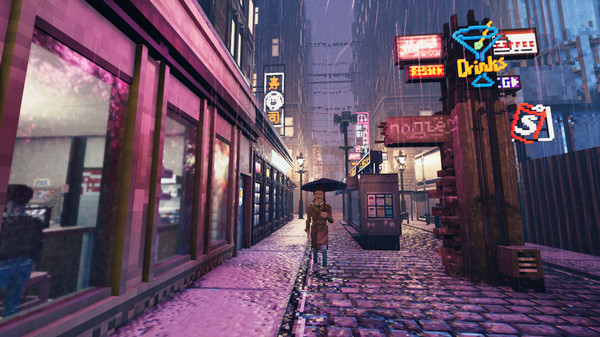 Tailing one of the crowd — Steam store
Putting the Mechanics into Words
What positives savour is the moment the evidence connects. A suspect profile only 4% filled — grey eyes, a name starting with Z — and from there you thread cameras, calls and receipts, crossing names off one by one. In Puzzlebyrinth terms, this is raising observation resolution: from a smudge to a single citizen in the crowd. The board's strings are that resolution made visible.
But the verb count here is high — lockpicking, hacking, tailing, bribing, records, vents. This is the opposite of Baba Is You or Sokobond, where the verb is subtracted to one. It is maximalism, not subtraction. The freedom positives praise and the 'unfocused' negatives lament are two faces of that same breadth. Where Return of the Obra Dinn authored its deduction grammar tightly, this hands the grammar to the city's sheer volume.
And the negatives land a real hit: 'once you understand the mechanics, every case is the same.' Learn the CCTV-timestamp shortcut and the grammar thins to one path; the only thing that changes case to case is the killer's name. That is the sharpest contrast with authored design like The Case of the Golden Idol, which keeps updating its grammar.
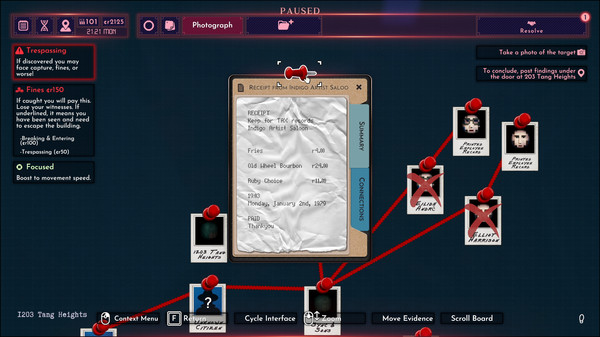 Stringing the evidence board — Steam store
The World
Near-unanimously, reviews grant the city its conviction: voxel rain-alleys, neon and jazz, a diner at 3am. 'All you need is the noir filter and some crime jazz,' one recent review shrugs — and that captures the hook. A living city where everyone has a room, a job and a life is praised even in the negative reviews.
But that city stands on combinatorial explosion. Procedural generation multiplies cases, citizens and floorplans without limit. The positives' 'never the same board twice' and the negatives' 'they all feel alike' are two faces of the same explosion: infinite variation, unpruned by an author, tends to converge on an average.
The developer calls the city 'your oyster.' The helpful reviews half agree and half hold back — the freedom is real, but events dense enough to deserve it are not everywhere. The gap between the world's breadth and its density is the soil the split grows from.
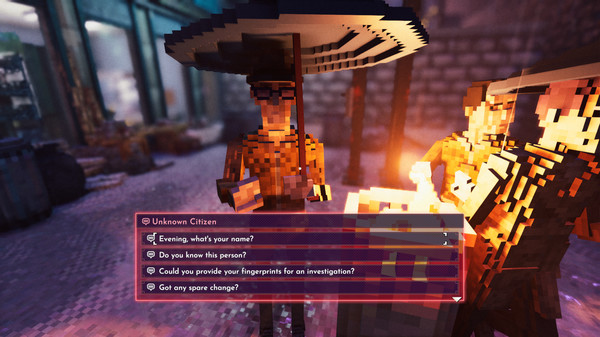 A voxel-built noir city — Steam store
The Texture of Difficulty
'Difficulty' differs wildly per reviewer. On the very same first murder, one draws a 'professional' kill with no CCTV or prints and praises the bite; another gets so much evidence it ends in minutes and calls it thin. That is not skill — it is the seed the generator dealt. Difficulty is left to generation's luck, not an author's hand: the first reason opinions split.
Second, the learning curve falls asleep. Positives narrate their first solve like a life event; run the same steps a few times and, as negatives put it, 'understood equals done.' Authored mysteries add new grammar per level to keep lifting the curve; a generator is structurally bad at that. A steep rise, then a flat — that shape shows up as the gap between older and recent reviews.
And the bugs matter. 'Used to love it; updates broke it,' say long-time players among the helpful negatives. When difficulty turns unfair, it is a defect, not a design — worth recording fairly. As I noted in walking sims vs deduction, a detective game's difficulty lives in how information is served; by outsourcing that to generation, this game bets even that quality on luck.
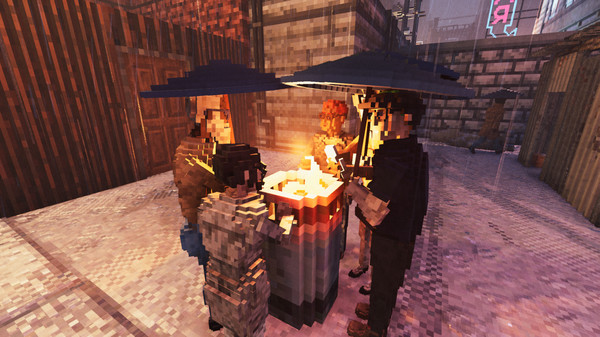 Evidence swings with the seed — Steam store
Sources
This piece was written by reading the user reviews on the Steam store page as of 2026-07-02. No review text is quoted directly; typical claims are reconstructed.
- Steam: Shadows of Doubt (Very Positive; 81% of 10,711 English reviews, ~82% across all languages, 71% in the last 30 days)
- Read via appreviews: the top ~10 helpful positive reviews, ~10 helpful negative, and several recent reviews
- Press: PC Gamer and GamesRadar+, both roughly 'limitless potential, not yet finished'
Closing
Steam's English score is 81%; my design-critique score is 7.5. The feel of raising observation resolution is hard to replace at this price, and that is where the credit sits. The marks come off for a maximalism that thinned the deduction grammar to one path, and for leaving difficulty and case density to the luck of combinatorial explosion. Dropping the author's pruning shows up as the late-game flat.
The recurring recent verdict is 'buy it on sale and wait for polish,' and I am close to that. The road to your first solved case is as real as the reviews say. But if you want the weight of an authored case, that is out of reach here — a thirst filled by Obra Dinn or the Golden Idol. Generation's freedom or an author's density: the split itself maps the choice.
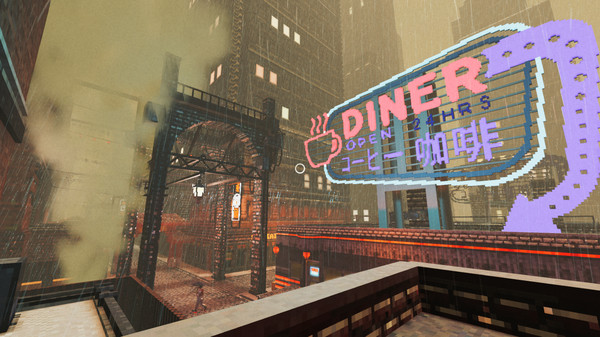 The road to your first solved case is real — Steam store
Where are you with this game?
Press one and the game goes on your shelf. You can see it on your account page.
Reactions (no login)
Anonymous • one of each per visitor per day
Read next

Related reviews
Portal: Revolution
Eine kostenlose inoffizielle Erweiterung zu Portal 2, angesiedelt in der Lücke seiner Geschichte, mit rund vierzig neuen Testkammern und neuer Hardware wie einem Würfel, der Laser umlenkt. Sie beginnt mit nur einem verfügbaren Portal und lässt einen zwischen den Kammern zu Fuß durch die Anlage gehen.
Wilmot Works It Out
Ein Puzzlespiel: Aus dem wöchentlichen Paket quadratische Teile herausnehmen, Bilder zusammensetzen und die fertigen Bilder an die Wand hängen. Da jedes Paket Teile mehrerer Bilder gemischt enthält, muss man vor dem Zusammensetzen erst sortieren. Die Fortsetzung zu Wilmot's Warehouse von Hollow Ponds und Richard Hogg.
Botany Manor
Ein Ego-Puzzle in einem englischen Herrensitz der 1890er-Jahre, in dem man die pensionierte Botanikerin Arabella Greene spielt und aus Briefen, Plakaten und Zeitungsausschnitten die idealen Wachstumsbedingungen jeder vergessenen Pflanze ableitet, um sie zum Blühen zu bringen. Hinweise lesen und einer Herbariumsseite zuordnen ist das zentrale Verb.


