ANALOG · 2026-09-15
Ricochet Robots (1999) — Instead of Turn Order, a Number Said Out Loud
One move is not one square but "until something stops you" / one board, everyone solving at once / the movement ports cleanly, the one-minute timer does not
Today's texture: flick it once, and it will not stop until it hits a wall
Today's texture: flick it once, and it will not stop until it hits a wall.
There is one board. The people solving it are everyone at the table.
Ricochet Robots has no turn order. Nobody ever hears "it's your turn now." Instead, whoever finds a route says a number out loud. The right to demonstrate goes around in order of that number, lowest first. The bid itself is the turn.
The movement rules port to code without complaint. If anything, too easily. What does not port is the bidding.
That is what I want to take apart today.
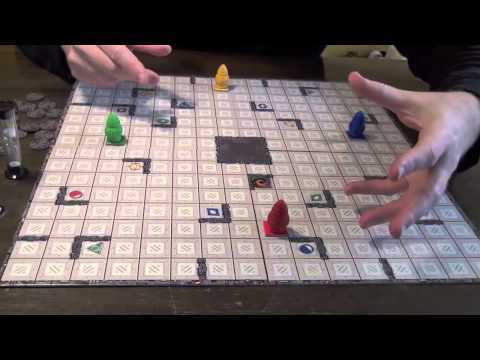 From the thumbnail of "Ricochet Robots rules explanation and overview" (BoardGameGeek, YouTube)
What, when, who — a 16×16 board and about a minute of sand
The designer is Alex Randolph. It came out in 1999 in Germany, from Hans im Glück, as Rasende Roboter.
Abacusspiele took it over later, Rio Grande Games published several English editions, and the current edition comes from Z-Man Games. It has been on sale, without a gap, for more than twenty years.
The board is assembled from double-sided tiles. Put together, it is a 16×16 grid. Four robots, one per colour. Seventeen target chips (sixteen with symbols, one multicoloured). And one sand timer, about a minute.
Player count: "two or more." No upper limit is given. Which is to say it works with a hundred people.
For the movement itself, the rulebook says it best. The robots have "no brakes." Once set in motion, a robot travels straight until it hits an obstacle. It cannot stop, and it cannot turn.
So one move is not one square. You slide until you stop, and that is one move. A wall, the edge of the board, or another robot. It keeps going until one of those arrives.
One more condition: on its way to the target, a robot has to ricochet at least once. A straight slide to the goal does not count.
I do not own a copy, so I could not weigh it. A retailer lists a shipping weight of 1600g and a box of 303×303×87mm — but that is packed weight, not the weight of what is inside.
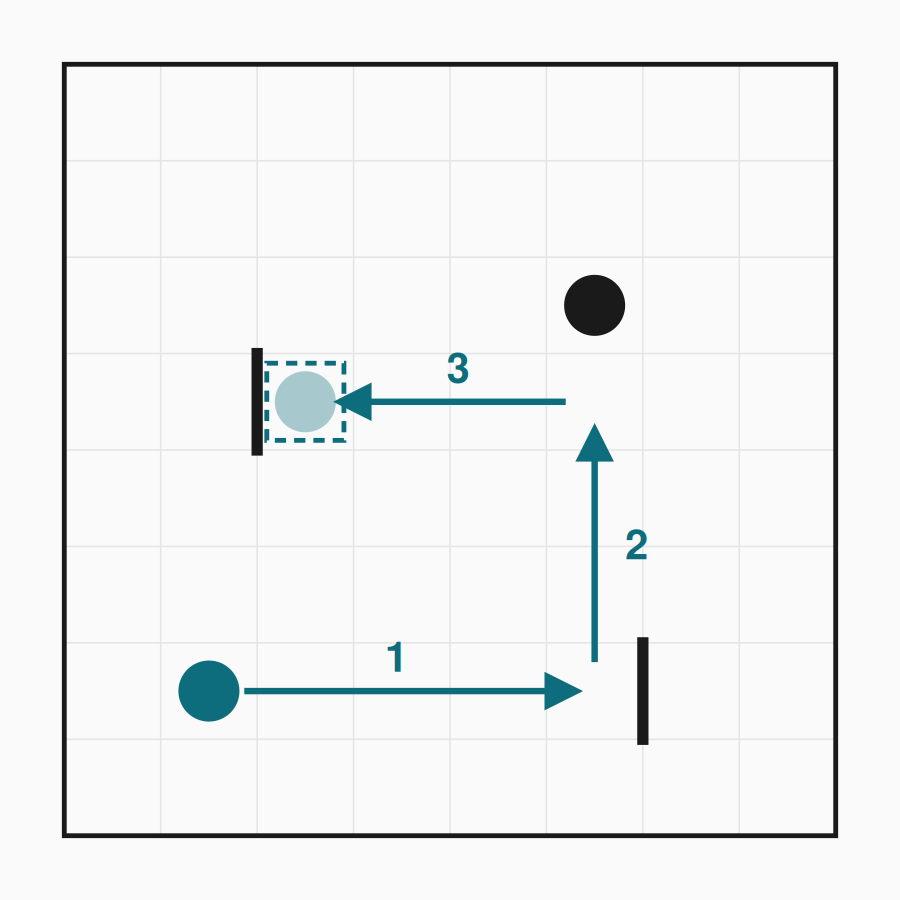 (Diagram) One move = until you stop. Turn at a wall, halt against the black robot, reach the target in three.
Why it can get away with having no turn order
The reason is simple. There is only one board, and everyone can see all of it at once.
When someone finds a route, they say only the move count. "Five." The first person to bid flips the sand timer. For the remaining minute or so, everyone else calls out their own number.
When the sand runs out, the lowest bidder demonstrates. Reach the target in exactly that many moves and the chip is yours. Fail, and the robots go back to their starting squares and the next-lowest bidder tries.
The interesting part is that a bid is not a proof. "I can do it in five" is a claim. Until a hand touches the board, nobody knows if it is true — sometimes not even the person who said it.
Undoing is easy because this is a physical object. Under each robot sits a position marker of the same colour, and it stays on the board. A failed attempt is reset in a second. Undo, implemented with four pieces of cardboard.
There is a hole, though. What happens when two people bid the same number?
The Rio Grande rulebook says the earlier bid goes first. A widely circulated English rules summary says the player with fewer chips has precedence — except under tournament rules, where the earlier bid wins. Twenty years on sale, and this is still not settled.
And if you take "fewer chips wins ties," staying quiet becomes profitable. Bid first and you flip the timer, handing everyone else a free minute. The rulebook even specifies what to do when nobody has bid after four or five minutes. The designers knew the silence could happen.
Porting it to a screen — what dies, what survives, what only code can add
What dies: simultaneity.
Alone in front of a screen, there is nobody to bid against. Saying "five" means nothing. The sand timer is pointless. Every reason to hurry disappears.
The demonstration goes with it. At the table, the bidder slides the robots themselves, in front of everyone, and everyone watches and agrees. A screen resolves the move and the verdict instantly. There is no room left for agreeing.
What survives: the movement.
Slide until blocked. Turn ninety degrees at a wall. Stop against another robot. All of that is an array and a while loop. In our own lexicon, Constrained Grid Movement is the closest entry.
"Other pieces become your obstacles" survives cleanly too. Strong players deliberately park irrelevant robots as walls. It is the same muscle Snakebird and Into the Breach build.
As a lineage, this is less like the one-square-at-a-time boards of Klotski and more like Threes!, where one push moves the whole board. A lot changes per input.
What only code can add: a guaranteed minimum.
Solvers exist. DriftingDroids (GPL-3.0) states plainly that it finds the optimal solution to every problem, using iterative deepening. So you can know a puzzle is a seven before you hand it out.
At a table, plenty of chips get resolved without anyone finding the shortest line. Digital does not allow that. It is an addition and a subtraction at once: that faint discomfort of "there is probably something shorter" goes away.
You can also stand on a floor of known difficulty. The general form of this board has been shown to be PSPACE-complete (Balanza-Martinez et al., arXiv:2402.11440, 2024). Knowing the general case is intractable, you can pick out only the easy instances to serve.
The same shape as the Hanabi piece. The board mechanism ports. What lived between people does not.
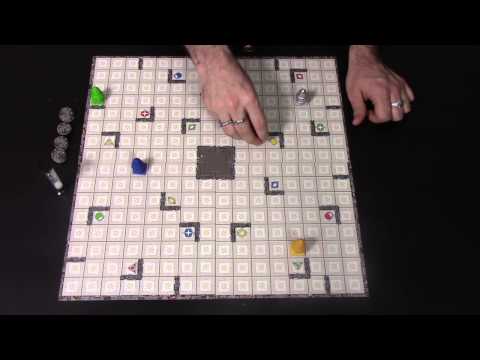 From the thumbnail of "Ricochet Robots - A Dice Cup 'How to play' video by Steve Raine" (Dice Cup, YouTube)
For makers — make them say the number before they solve it
One thing only: make the bid the turn.
In a daily puzzle it looks like this. Before submitting a solution, the player has to declare "I will solve it in N." The moment anyone declares, a deadline timer starts. After the deadline, submissions are checked in order of the declared number, lowest first.
It is not a race for speed, and not a race for correctness. You are asking people to bet on how far they can see. The same puzzle becomes a different experience.
One warning. Decide your tie-break before you write the code. That is the exact spot Ricochet Robots never settled in twenty years. On a screen it costs you one millisecond timestamp. The parts that are easier than cardboard should actually be made easy.
In closing
The board ports to code. Almost too neatly.
What does not port is the minute of sand — the one where somebody says a number and every back at the table curves forward at once.
So: in your game, would you leave this declaration to human hands?
If you would, you now have to build a place to say it aloud and a place to show the proof. If you would not, you have to decide when and how to reveal the solver's minimum. Not which is correct — which one you want people to see. Decide that first and the rest goes faster.
Sources
Wikipedia (EN) — Ricochet Robots (designer, edition history, 17 chips, Z-Man board configuration) ↗
Lireer / ricochet-robot-solver — confirms the 16×16 board and frames it as shortest-path search ↗
Gamersphere — Ricochet Robots product page (shipping weight 1600g, box 303×303×87mm) ↗
Reactions (no login)
Anonymous • one of each per visitor per day
関連シリーズ
Solved by Hand第4回 / 全5回
Read next
Related reviews
Phoenix Wright: Ace Attorney Trilogy
Ein Gerichtsabenteuer, in dem man als Verteidiger Phoenix Wright eine Zeile einer Zeugenaussage gegen ein Beweisstück hält, um eine Lüge zu brechen. Capcoms Sammlung vereint alle vierzehn Episoden der drei zwischen 2001 und 2004 erschienenen Spiele, mit Bild für Bild neu gezeichneter Grafik.
Contradiction: Spot the Liar!
Ein Live-Action-Mystery (FMV), in dem Kriminalinspektor Frederick Jenks an einem einzigen Abend — von 17 Uhr bis Mitternacht — einen Ertrinkungsfall im kleinen englischen Dorf Edenton neu aufrollt. Man befragt die Bewohner, sammelt ihre Aussagen, wählt dann zwei widersprüchliche Aussagen aus, stellt die lügende Person damit zur Rede und öffnet so den nächsten Erzählstrang. Design und Musik stammen von Komponist Tim Follin für Baggy Cat.
Evan's Remains
Plattformen, die verschwinden, sobald man sie verlässt, und Blöcke, die andere Blöcke aktivieren oder anhalten – allein aus dieser Kombination sind die Rätsel gebaut, die jeweils auf einem einzigen Bildschirm gelöst werden, während man die Geschichte von Dysis liest, einem Mädchen auf der Suche nach dem verschwundenen Jungen Evan. Ein 2D-Puzzle-Adventure von maitan69.


