ANALOG · 2026-09-12
Portal, The Board Game (2015) — When a Portal Stopped Being a Hole and Became "Adjacent"
Cardboard panels can hold no falling and no momentum / what survived is "two distant tiles, one step apart" / and that alone still breaks how you read the board
Today's texture: cardboard panels knocking against each other
Today's texture: cardboard panels knocking against each other.
Valve's Portal has a board game. It is called Portal: The Uncooperative Cake Acquisition Game, and Cryptozoic Entertainment released it on 23 September 2015.
It is uncooperative, as advertised. Two to four players fight over cake.
Only one thing interested me. That feeling of opening a hole in a wall and stepping through it — what happens to it on cardboard?
Here is the answer first. The portal stopped being a hole and became "adjacent". And that substitution is more honest than I expected.
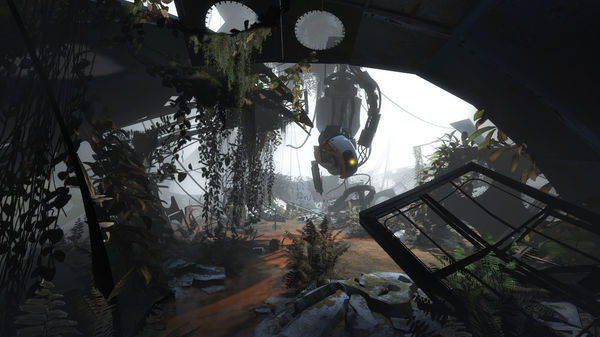 Image: Valve, Portal 2 (from the Steam screenshots)
What is in the box, and what one turn looks like
The box is 10.5 × 10.5 × 3 inches. I could not weigh it. I do not have a copy in front of me, so that is as far as the touch goes.
Inside: double-sided Test Chamber panels, Test Subject miniatures, cake-slice miniatures, Aperture cards, one Portal Gun card per player, two portal tokens, a GLaDOS token, a Turret and a Companion Cube miniature — and one Steam activation code for Portal 2 (component list, Portal Wiki ↗).
In play the panels are laid out three rows by five (rules summary, GeekDad ↗).
A turn has four steps. Optionally play one Aperture card. Move Test Subjects to an adjacent chamber. Place the GLaDOS token on a chamber at the old edge and activate it. Then flip that chamber over and set it down at the new edge.
Every Test Subject standing in an activated chamber dies.
The chambers run from one edge to the other like a conveyor belt. The board itself moves every turn. That part is a lovely piece of design.
A Test Subject can carry one cake slice. Cake left in an activated chamber goes to the incinerator. In exchange, whoever had the most Test Subjects in that chamber takes a reward. So the player who walks into the fire profits.
You win on cake still on the board at the end. The game ends when a player loses every Test Subject, or when all eight cake slices have been burned.
One aside. The game was announced for autumn 2014 at $50 (The Mary Sue, 2014 ↗). The box actually arrived a year later.
Why "adjacent" and not a hole
Portals work like this. You play an Aperture card as a Portal Gun instead of using its printed effect. That lets you reassign the two portal tokens to chambers of your choice.
The two chambers holding those tokens count as adjacent from then on. However far apart they sit, you can step between them in one move.
When a chamber is recycled and moved, its portal moves with it.
This is where the physics runs out. A cardboard panel has no up and down. It has no falling. It has no speed.
The strongest thing in digital Portal was one specific moment: the speed of your fall coming back out of the exit. A board has nowhere to store that speed.
So the design kept only what could be kept: rewriting adjacency so two distant points connect directly. Paper can do that.
One thing in the rules bothers me, though. The cost of using a portal is measured in "one Aperture card's worth of effect".
Which means the portal here is not a special mechanism. It has been demoted to one card effect among many. The headline mechanism is bought with the same currency as everything else. Hold a strong card and the portal simply goes unused. I am strict about this one.
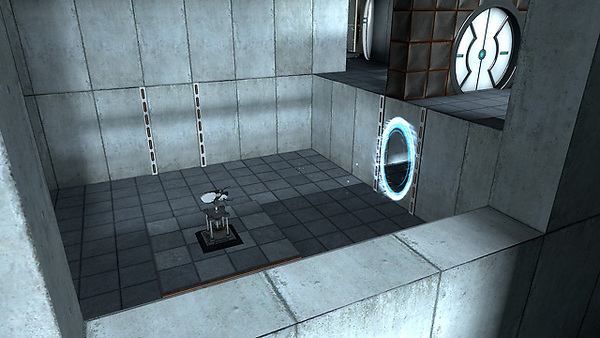 Image: Valve, Portal (from the Steam screenshots)
Translating it back — what is lost, what stays, what only a screen can add
This column normally translates from analog to digital. Here the original is digital, so I read the arrow backwards — and it lands straight back on our own workbench.
What is lost. Momentum. Continuous surfaces. Line of sight. The speed of aiming. Half the pleasure of Portal lived in the act itself: aiming at a wall you can see and opening a hole in it. On a board you do not aim. You place.
What stays. The rewriting of adjacency — and it survives astonishingly well. Make two distant cells one step apart on a grid and the reading of the shortest route falls apart. Anyone who has built a constrained grid movement puzzle can picture that collapse immediately. Our own encyclopedia entry for Portals also puts "movement itself, reinvented" at the center of its definition.
What only a screen can add. Falling, momentum, continuous surfaces, a camera, and the preview of seeing through to the other side. Lined up, that list is almost exactly the list of what the board game had to drop.
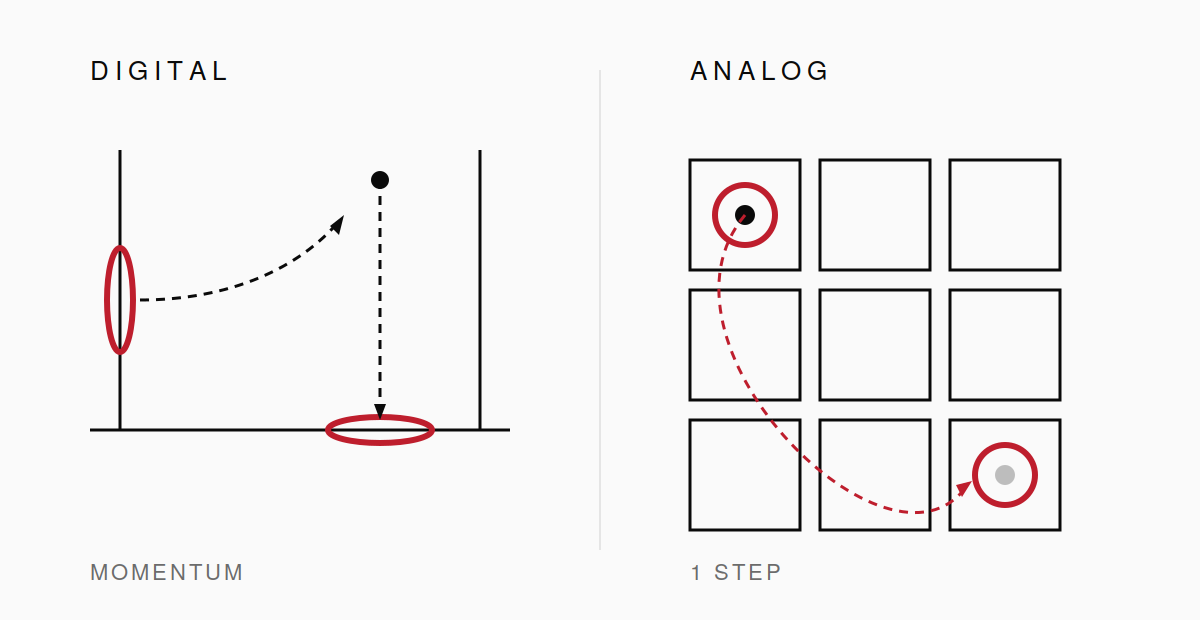 (Diagram) Left: digital carries momentum. Right: on the board, only "two distant tiles, one step apart" survives
Now the practical part.
If you are building a grid puzzle and you want portals in it, build it first with nothing but the adjacency rewrite. No falling, no momentum. If the board is not interesting under those terms, adding momentum later will not save it.
The board game has already run that experiment for you. Read it as a test result that somebody paid to produce, and it is rather generous.
There is a version that cut the other way. Bridge Constructor Portal puts momentum, not adjacency, in the lead role. Pick one side or the other and you get two different games under the same logo. Portal and Portal 2 were the rare case that held both at once.
For makers — do not price your headline mechanism like everything else
One takeaway only. Give your headline mechanism its own cost.
Here the portal trades against one Aperture card's effect. It is bought from the shared wallet. So as long as a strong card sits in hand, the headline never comes out.
The same accident happens in digital games. Put your signature ability on a shared cooldown or a shared resource and players will weigh it against everything else, every time. The moment it is weighed, it becomes one option among many.
The fix is simple. Run the headline mechanism on a separate currency: its own charge, its own button, its own action. Make it non-fungible and players stop asking whether to use it and start asking when.
I wrote about what a rulebook leaves unsaid in the Hanabi piece. This time it is the reverse: what the rulebook does say — the price tag — is what decides the game.
In closing
The epilogue is the funny part. Fans have digitized this board game as a Tabletop Simulator Workshop mod (Portal (Scripted) ↗).
A mechanism born inside Valve's screen became cardboard and then went back into a screen. Third lap. And the box shipped with a Portal 2 Steam code from the start — a return ticket, included.
I like these round trips. Each lap makes it a little clearer what can be made into an object and what cannot.
So, today's question. In your game, will you leave the decision to connect two distant points in human hands?
Do you show the hand placing the token, or do you let the solver compute the shortest path? Not which is correct — which one you want people to see. Decide that first and the building goes faster.
Sources
Portal Wiki — Portal: The Uncooperative Cake Acquisition Game (component list, outline of play) ↗
Noble Knight Games — product specs (2015, part no. CZE01823, box 10.5×10.5×3 in) ↗
Images are Steam screenshots of Valve's Portal and Portal 2, plus a diagram drawn for this article.
Note: no individually credited designer could be confirmed from public sources; all of the above treat the game as a joint Valve / Cryptozoic Entertainment production. The stated minimum age also differs between sources (12+ and 15+), so it is left out of the body text.
Reactions (no login)
Anonymous • one of each per visitor per day
関連シリーズ
Solved by Hand第3回 / 全5回
Read next
Related reviews
Evan's Remains
Plattformen, die verschwinden, sobald man sie verlässt, und Blöcke, die andere Blöcke aktivieren oder anhalten – allein aus dieser Kombination sind die Rätsel gebaut, die jeweils auf einem einzigen Bildschirm gelöst werden, während man die Geschichte von Dysis liest, einem Mädchen auf der Suche nach dem verschwundenen Jungen Evan. Ein 2D-Puzzle-Adventure von maitan69.
inbento
Ein Puzzle mit Aktionskarten: In einer 3×3-Bento-Box legt man Zutaten so an, dass die vorgegebene Vorlage entsteht. Verschieben, tauschen, kopieren, aufheben und später ablegen — mit einer festen Anzahl weniger Kartentypen löst man 127 Level. Zwischen den Kapiteln liegt eine kurze Geschichte über eine Katzenmutter und ihr Junges. Ein Werk von Afterburn, demselben Studio wie hinter Golf Peaks.
Felix The Reaper
Ein isometrisches Puzzlespiel, in dem man sonnige Stellen meidet und nur über Schatten geht, um den Tod eines Menschen zu inszenieren. Man schaltet die Sonne zwischen zwei Positionen um, um die Schatten neu zu formen, schiebt und zieht Gegenstände und bringt den unaufhörlich tanzenden Sensenmann Felix ans Ziel. Entwickelt von Kong Orange, erzählt von Patrick Stewart.


