ANALOG · 2026-09-17
Love Letter (2012) — One of Sixteen Cards, Removed Before Anyone Looks
Incomplete information by subtraction, not randomness / the discard row is the record device / only the Countess's compulsion is left to conscience
Today's texture: thin. A whole game, sixteen cards
Today's texture: thin. One whole game fits into sixteen cards.
Love Letter takes one of those sixteen and sets it aside, unseen. Nobody looks at it. It stays face down and is not used that round.
You play with the remaining fifteen. Your hand is always exactly one card.
That single removed card is the whole of today's piece. No random number generator, and yet nothing can be pinned down to the end. And everyone knows a card was taken.
 From the thumbnail of "Love Letter - How To Play" (Cardboard Crash Course, YouTube)
What the sixteen cards are, and why there are sixteen
It was released on 13 May 2012, at Game Market in Tokyo, by a one-person label called Kanai Factory. Design by Seiji Kanai, art by Noboru Sugiura.
The deck breaks down like this. Five Guards (1). Two each of Priest (2), Baron (3), Handmaid (4) and Prince (5). One each of King (6), Countess (7) and Princess (8). Sixteen in total.
A turn is short. Draw one card from the deck, discard one of your two cards face up, resolve its effect. Then it is the next player's turn.
When the deck runs out, the highest card in hand wins the round. A round win is one token, and the first player to four tokens wins the game.
Only in a two-player game are three further cards removed face up. Those three are not used. They are simply visible.
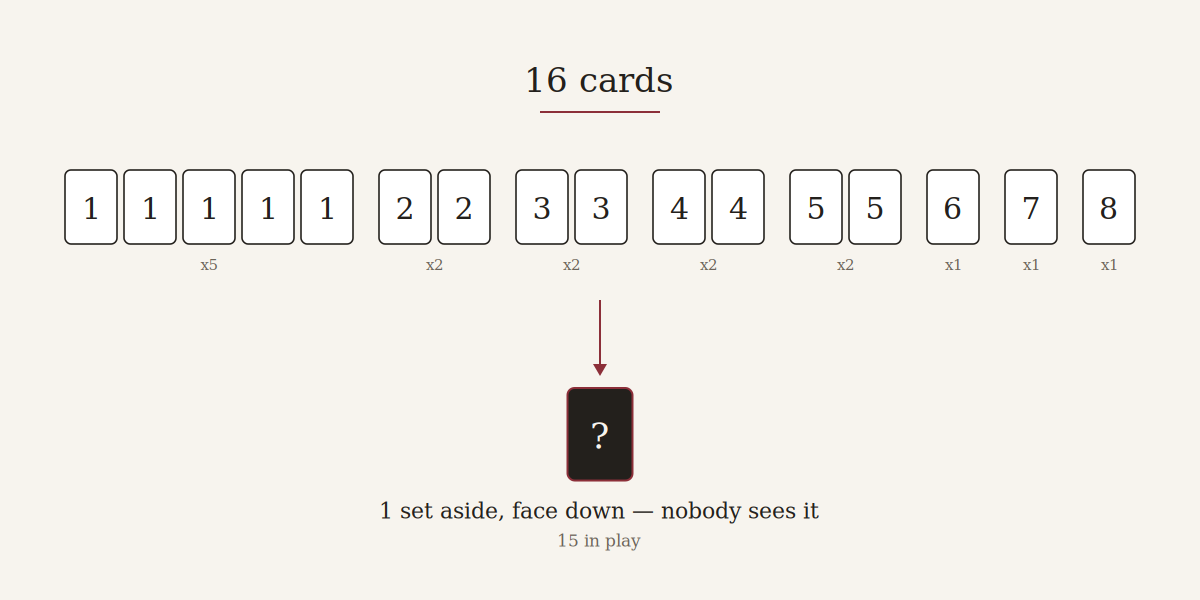 (Diagram) The 16-card deck and the one card removed unseen. Only 15 are ever in play
The Japanese retail edition came from Arclight on 31 May 2014: 2-4 players, 5-10 minutes, ages 10 and up, 1,850 yen before tax, with enough cards in one box for two simultaneous games.
What followed is remarkable. Over three million copies sold, translated into more than 28 languages. It took the grand prize at the 2012 Japan Boardgame Prize, and in 2014 it placed fourth at the Deutscher Spiele Preis — the first Japanese designer to place there.
So why sixteen? The designer's own answer is not about how the game feels.
"I am not especially fluent in English, and German is beyond me entirely. I thought a game that is easy to explain would be at a real advantage abroad" (4Gamer, December 2014).
He traces it to exhibiting at SPIEL in Germany for the first time in 2008. A game that explains quickly gets in front of more people. The card count was set by the throughput of a demo table, not by the table you play at.
I could not weigh it. I do not have a copy in front of me. One overseas edition is reported to fit its sixteen cards and thirteen wooden scoring cubes into a small red velvet bag. Let me just say it is a quantity that does not even need a box.
Why it works in paper and hands — the record lives on the table
One card in hand. So hiding it takes no skill at all. You just hold it face down between your fingers. No fanning, no shuffling your hand around so nobody reads your sorting.
Discarded cards sit face up in front of you, in the order they were played. The record lives on the table, not in anyone's head.
Which means anyone can count. There are five Guards. If three are out, two remain. Memory barely enters into it. You just move your eyes.
And still you cannot count it all. Because of that first removed card. Only fifteen ever reach the table. There is structurally no line of play that pins everything down.
This uncertainty-by-subtraction is my favourite thing in the game. No random tables, no exploiting an uneven shuffle, no sleight of hand. One card, face down, outside the game. That is the whole device.
Seeing faces matters too. When you name a number with the Guard, you are not only reading probabilities. You are watching whether the other person's hand stopped for a moment.
Now let me be hard on one clause. The Countess (7) carries a compulsion: if she is ever in your hand alongside the King (6) or the Prince (5), you must discard the Countess.
But hands are hidden. Break that rule and nobody at the table can tell. Play the King quietly to avoid risking the Princess, and nothing happens.
That is a hole in the rules. On paper it is a rule; at the table it is a conscience. I will leave it stated that plainly.
The designer himself does not claim he engineered this with confidence. "The mechanism of Love Letter was a product of luck that happened to come together — it is not that I was confident in it." He says he only felt it the day before Game Market, watching other designers react at a playtest session.
 From the thumbnail of "Interview with Seiji Kanai" (Club de Juegos Rosario, YouTube)
Porting it to code — what is lost, what survives, what can be added
What is lost: the pause in someone's hand, and the labour of counting.
Glances, phrasing, the three seconds before a declaration. Losing those is the same story as any face-to-face game.
The quieter but larger loss is the counting. A screen always lays the discard history out for you. Perfect counting by everyone becomes the default state. At the table, the gap between the player who loses track and the player who does not was itself the skill gap. That gap disappears.
What survives: the incomplete information built by subtraction.
The distribution of fifteen cards, and the one that never opens. That is just an array. Code handles it more naturally than cardboard does — move the top card into a side variable without ever reading it.
For assembling truth out of fragments, the closest entry in our encyclopedia is Deduction, with Return of the Obra Dinn and The Case of the Golden Idol as the digital exemplars. But their secret is one authored truth; this one's secret is a fresh random card every round. Same reasoning, different source.
What only digital can add: actual enforcement of a compulsory rule.
Hand the Countess to a machine and the compulsion becomes real. What was a conscience returns to being a rule. For this game, that is unambiguously an addition.
Asynchronous play is another. Take one turn, close the screen, let the opponent answer later. A 5-10 minute design can be cut even finer.
The digital version arrived on Steam on 24 October 2018, developed by Nomad Games and published by Twin Sails Interactive.
I wrote about hiding hands before, in the Hanabi piece. There, the only hand you cannot see is your own. Here, exactly one card is invisible to everyone. The hiding points the other way.
For makers: try subtraction before you reach for randomness
One thing to take away. You do not need a random number generator to create incomplete information. Remove one card from a deck small enough to count, and you are done.
Two conditions. The deck must be small. And everyone must know a card was removed.
If the deck is large, nobody notices the missing card. What cannot be counted is the same whether you hide it or not. Love Letter's fifteen sits just inside what a person can track by eye. That is why "one card unaccounted for" becomes tension.
In a puzzle of your own: leave exactly one cell of the board undisclosed to the end — and state plainly that one cell is hidden. Players will pin down everything else, then gamble only on that last square.
What matters is not how much you hid. It is that the player knows something is hidden.
In closing
One of sixteen cards, seen by nobody. That alone keeps a five-minute game unresolved to the end. Three million copies probably rest on it.
And the Countess's compulsion, left on paper, is a promise people keep. Hand it to a machine and it returns to being a rule. Not which is correct — which one you want to play.
In your game, do you leave enforcing the rules to human hands?
If you do, you are designing for a rule that can be broken. If you do not, nothing breaks — but the credit for not breaking it disappears too. Decide first, and the building goes faster.
Sources
Steam — Love Letter (developer Nomad Games, publisher Twin Sails Interactive, 24 October 2018) ↗
Reactions (no login)
Anonymous • one of each per visitor per day
関連シリーズ
Solved by Hand第5回 / 全5回
Read next
Related reviews
Phoenix Wright: Ace Attorney Trilogy
Ein Gerichtsabenteuer, in dem man als Verteidiger Phoenix Wright eine Zeile einer Zeugenaussage gegen ein Beweisstück hält, um eine Lüge zu brechen. Capcoms Sammlung vereint alle vierzehn Episoden der drei zwischen 2001 und 2004 erschienenen Spiele, mit Bild für Bild neu gezeichneter Grafik.
Contradiction: Spot the Liar!
Ein Live-Action-Mystery (FMV), in dem Kriminalinspektor Frederick Jenks an einem einzigen Abend — von 17 Uhr bis Mitternacht — einen Ertrinkungsfall im kleinen englischen Dorf Edenton neu aufrollt. Man befragt die Bewohner, sammelt ihre Aussagen, wählt dann zwei widersprüchliche Aussagen aus, stellt die lügende Person damit zur Rede und öffnet so den nächsten Erzählstrang. Design und Musik stammen von Komponist Tim Follin für Baggy Cat.
Wilmot Works It Out
Ein Puzzlespiel: Aus dem wöchentlichen Paket quadratische Teile herausnehmen, Bilder zusammensetzen und die fertigen Bilder an die Wand hängen. Da jedes Paket Teile mehrerer Bilder gemischt enthält, muss man vor dem Zusammensetzen erst sortieren. Die Fortsetzung zu Wilmot's Warehouse von Hollow Ponds und Richard Hogg.


