RETRO-REVIEW · 2026-06-26
Threes! (2014) — One Last Board That Grows by Three
Born in a night, polished over fourteen months: the origin of the merge-slide puzzle
Introduction
This is a game that appeared on the small screen of the iPhone on 6 February 2014. The developer was Sirvo, a tiny independent trio: designer Asher Vollmer, artist Greg Wohlwend, and composer Jimmy Hinson. Its name was Threes!. On a four-by-four board you slide numbered tiles and grow multiples of three. That is all there is to it.
I want to read this work not as an object of nostalgia but as a design destination. Its rule can be stated in a single sentence. And yet Apple gave it an Apple Design Award that year and named it Apple's best iPhone game of 2014. Threes! quietly proved that brevity and depth need not contradict each other.
The story does not end there. Barely a month after release, a very similar free game swept the world, and the original Threes! found itself accused of being the imitation. This essay traces that strange reversal too, and what the year 2014 left behind in the history of puzzles.
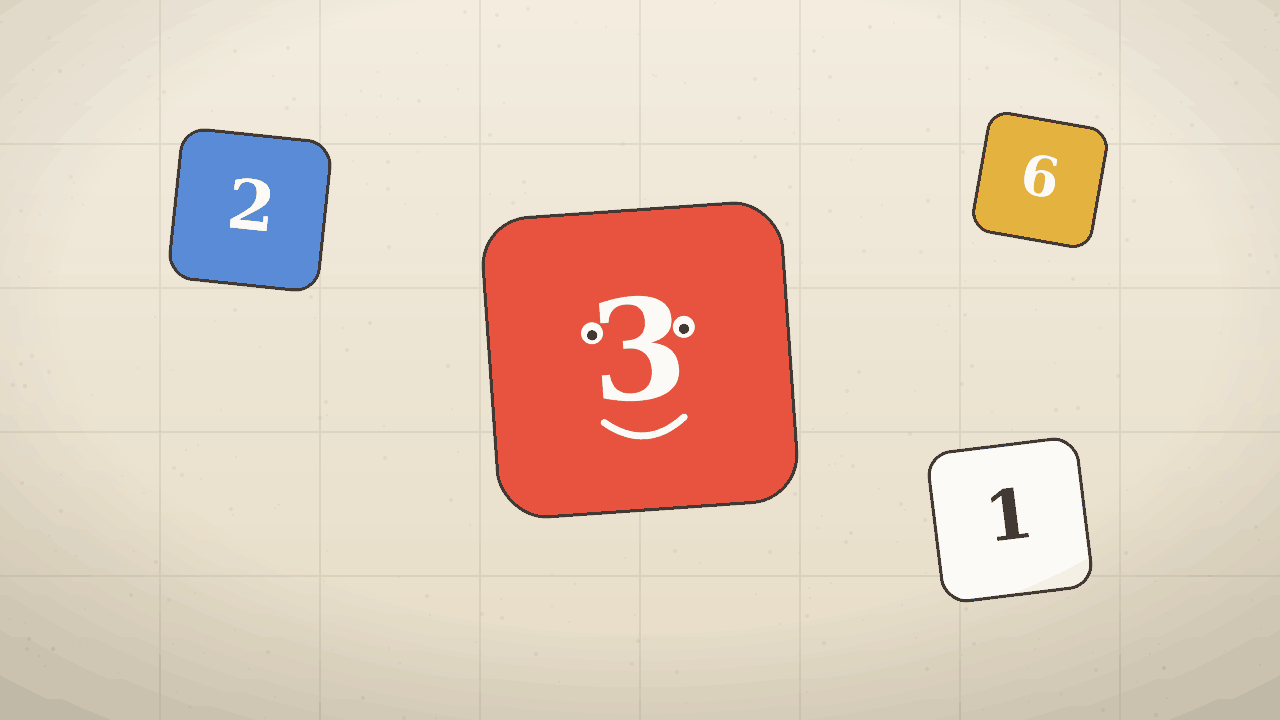
A board that grows by threes — the work's signature image (illustration, AI-generated)
The context of its time
Recall the year 2014. Smartphones were everywhere, and the App Store offered an overwhelming number of games every day. Most were free, designed to earn through ads and in-app purchases. Into this Threes! arrived as a paid, buy-once app. A single purchase bought play that was never interrupted to the end — a stance toward distribution that already looks old-fashioned today.
The prototype was reportedly built in a single night. But the three of Sirvo then spent over half a year reshaping the material. They tried visual themes such as sushi and chess and discarded them, and after fourteen months of development they returned to where they had begun: numbers. They later published this trial and error as a making-of essay running to some forty-five thousand words. Beneath a brief game lay that much hesitation.
The handheld lineage matters too. I once introduced 1995's Mario's Picross as a portable puzzle that slipped logic into idle moments. Threes! stands further along that line. One stop on the train, a few dozen seconds of waiting — it was play optimized for fragmented time, now carried by the new input of the touch screen.
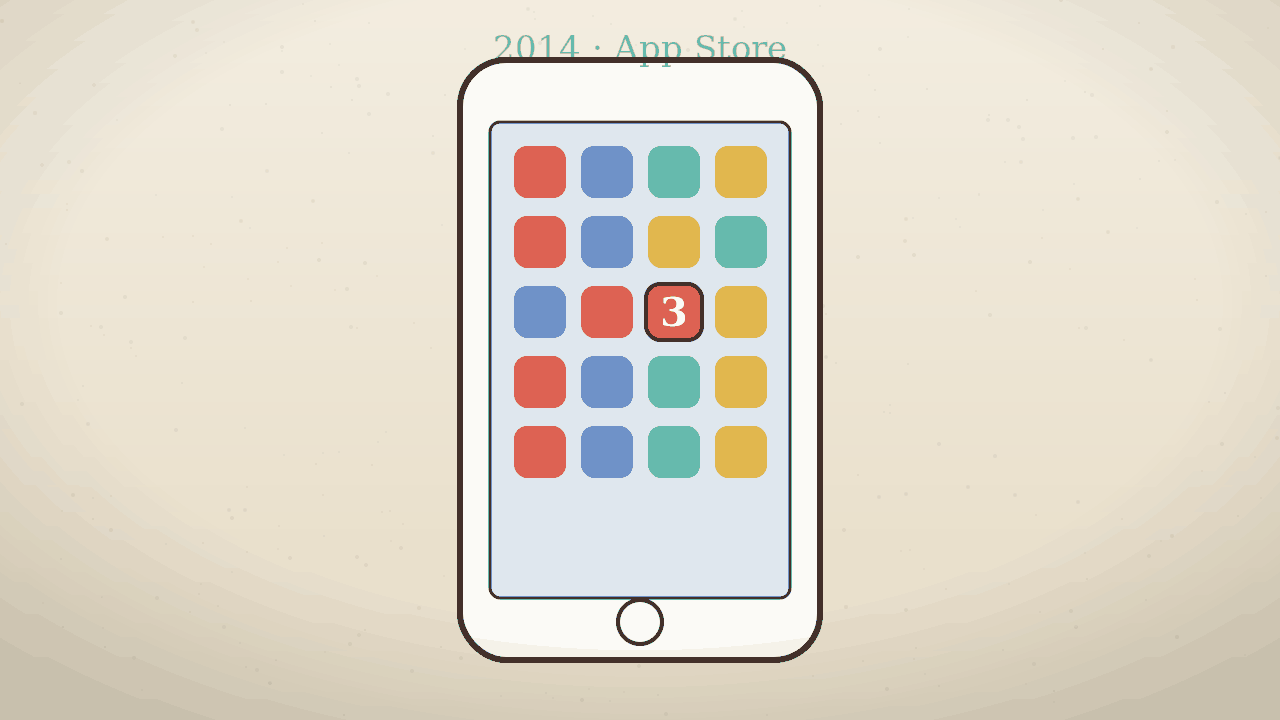
2014: play lined up on the screen in your palm — an impression of the era (illustration, AI-generated)
Mechanics
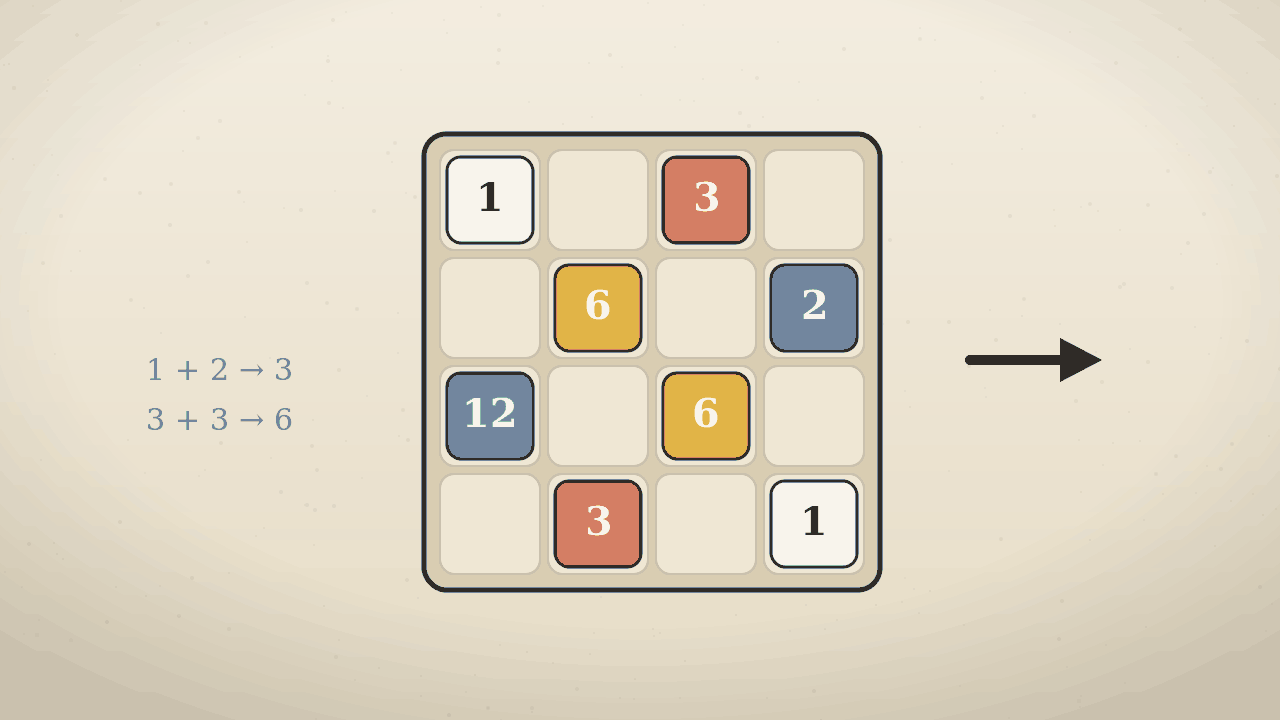
The board is four by four. Tiles bear 1, 2, and from 3 onward the multiples of three. When the player tilts the board in one direction, every tile slides one cell that way. A 1 meeting a 2 makes a 3; thereafter equals merge — 3 and 3 into 6, 6 and 6 into 12 — doubling as they go. A 1 and a 1, or a 2 and a 2, never combine. This asymmetry creates a small tension over where to place things early on.
With every move a new tile slides in from the edge of the board. So the board fills relentlessly, and the game ends the instant no direction can move. Afterward the tiles are tallied into a score. Because larger numbers leap in value, the player is asked not 'when do I fold' but 'how far can I grow this.' No retreat, no undo, only sliding forward — this one-directionality is the work's core.
What must not be overlooked is that the tiles have faces. Through Wohlwend's art the numbers acquire little expressions and personalities. Into a board of cold arithmetic they bring an attachment, a reluctance to let go — and this single thing is the texture that separates Threes! from later works of similar mechanism. The system is arithmetic, but the feel of play is closer to raising characters in a small garden.
Slide, stack, grow by threes — an impression of the play structure (illustration, AI-generated)
Lineage to the present
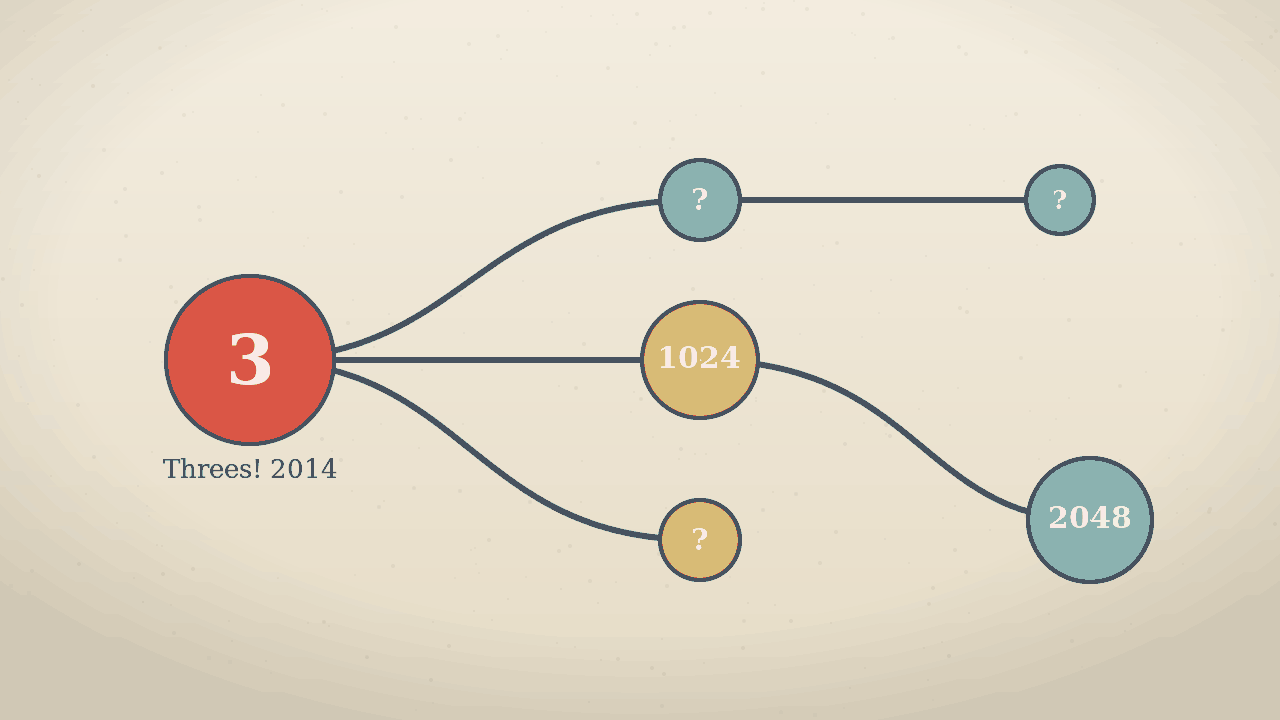
Threes! launched in February 2014. The next month, on 9 March, 2048 — made by the nineteen-year-old Gabriele Cirulli as a weekend test of his skills — was released. Free and open-source, it reportedly drew over four million visitors in a single week. Cirulli himself acknowledged that 2048 was 'conceptually similar' to Threes!, and that its direct template was Veewo Studio's 1024 — itself an imitation of Threes!. A structure of imitation stacked two steps from the original.
The irony was that 2048, spreading explosively for free, reached more eyes first, so that Threes! — over which a year and a half had been spent — was called 'a copy of 2048.' Sirvo wrote candidly about this 'cloning feeling' in their making-of essay. Cirulli, for his part, said he was unwilling to profit from a concept he had not invented, and left 2048 free. Rarely has the ethics of imitation been recorded so plainly.
Today a glance at Steam reveals countless 2048 derivatives and number-merging puzzles. Trace their source and it converges on one point: Threes! in 2014. What I can assert is only what the developers' own testimony confirms — the chain Threes! → 1024 → 2048. I refrain from declaring 'this and that are all children of Threes!' beyond that. Yet the chronology quietly tells us that it was this work that made the very vocabulary of the merge-slide puzzle current.
A lineage that begins at three and branches outward — an impression (illustration, AI-generated)
References
Sources referenced in this article:
・2048 by Gabriele Cirulli (official)
In closing
What Threes! showed historically is twofold. One is the fact that polishing a single verb — 'slide' — can raise a depth worth more than a year of labor. The other is the cold lesson of how easily digital play is duplicated, and how the original may not be remembered as the original. In the single year of 2014, that light and shadow were inscribed at once.
As one who travels back through history, let me add this. Novelty is sometimes measured not by who thought of it first, but by who polished it to the end. Threes! folded half a year of hesitation and fourteen months of carving into a brief game. Even after the imitations spread, the one thing no one could steal was the feel of those numbers with faces.
Reactions (no login)
Anonymous • one of each per visitor per day