REVIEW · 2022-01-21
Strange Horticulture
Ein okkultes Pflanzen-Rätsel, in dem das Nachschlagewerk zur Grammatik wird
Introduction
Customers bring plants to your counter, and you identify each one by leaning on your shelf stock and a single almanac. Once you know what a plant is, you use its effect — sleep, healing, poison, hallucination — to answer a request or a town mystery. A 2D occult deduction puzzle made by the small UK studio Bad Viking and published in January 2022 by Iceberg Interactive; press reports describe the team as built around two brothers.
I write this from the Steam review pool. The English label is “Overwhelmingly Positive,” 95% of 9,715 reviews (14,421 across all languages; snapshot 2026-06-25). The press agrees: Rock Paper Shotgun’s “Bestest Best,” 90 from PC Gamer, 83 on Metacritic. On the numbers, almost everyone is praising it.
But a game almost everyone praises is exactly the one worth dissecting. Read the pool, and the praise words — “cozy,” “relaxing,” “a rainy-day game” — and the minority complaints — “tedious,” “too short,” “the book feels insufficient” — turn out to touch the same single design from opposite sides. This piece reads that one point.
 Strange Horticulture — Steam store
First Impressions
The first thing helpful positive reviews write — before any genre label — is mood. Rain, lamplight, the shop cat, the tactility of turning pages. “Cozy,” “relaxing,” “chill” line up as if stamped. Recent reviews settle into refrains too: “perfect for a rainy day,” “just so cozy,” “I love the cat.” The first thing to notice as an observer is that this game’s first impression is told through texture, not through solutions or difficulty.
Under that texture sits tension. Even the positive side writes “cozy, but something is off.” The shop is safe; the requests customers bring touch disappearances, poisonings, a suspicious cult. The “Lovecraftian” reviewers keep reaching for is not hype but a structural note: a stack of calm acts — identify one plant — becomes a staircase down into the town’s dark.
In Komugi’s terms, this is a design that hands you training in observation resolution wrapped in comfort. You sink into telling leaf-shapes and smells apart, and that immersion is the same as immersion in the story. The first impression is texture because the design chose texture as its doorway.
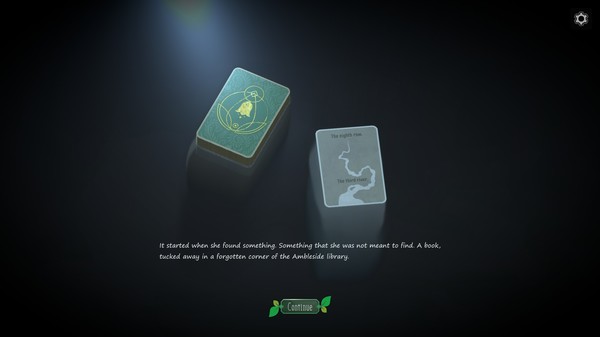 The shopfront and the cat — the texture reviewers name first — Steam store
Putting the Mechanics into Words
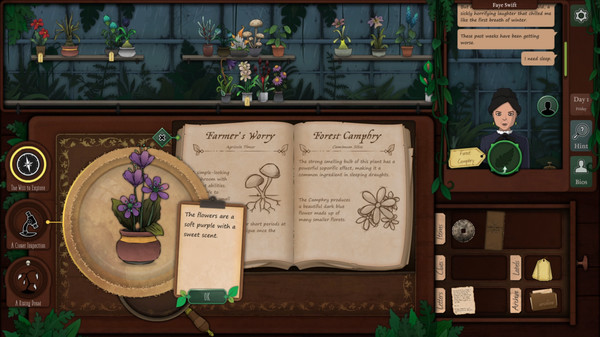
The verb of a game positive reviews sum up as “part cozy mystery, part logic puzzle” is, at bottom, one: identify. Take the clues you gather — leaves opposite, scent sweet, toxic — hold them against the almanac, and narrow which pot on your shelf matches. No shooting, pushing, jumping. You advance by observing and matching.
Here Komugi’s vocabulary bites. The almanac is this game’s grammar. Each page offers oppositions — opposite vs alternate leaves, serrated vs smooth — and a clue is the predicate that picks one. You attach a predicate (observation) to a noun (the plant) and fix one sentence through a grammar (the book). It shares a root with why Return of the Obra Dinn and The Case of the Golden Idol won people over: the pleasure of fixing one sentence from fragments.
Note the subtraction. The detective genre’s interrogations and cork-boards are stripped away, pared to a single move: name the pot in front of you. The “satisfying” the positive side reports is born of that paring — the click of options narrowing to two or three. And “the book feels insufficient” the negative side writes is the same paring’s underside: one clue short, and the grammar stops guaranteeing a unique answer, and deduction slips into guesswork. The two camps are not different experiences; they are the same move met at different precisions.
 The almanac and clues — a grammar of matching — Steam store
The World
What the pool calls “short but rich” is almost always the world. Foggy Undermere, the requests at your counter, endings that branch on your choices, and the cat asleep on your desk. Positive reviews name “you can pet the cat” before any proper noun, and even the negatives don’t deny the world. Iceberg, the publisher, framed it in the lineage of tabletop Sherlock Holmes and Papers, Please; the reviewer’s felt sense is closer to “a small cosmos that resolves on a desktop.”
As design, the world is the beam that holds up a monotonous verb. “Identify,” alone, risks becoming a chore. But load each instance with a request’s words, a map update, the shadow of a cult, and the chore converts into story moving forward. It is the same structure by which Papers, Please gave meaning to the repetition of checking documents.
Mind the reach. This world is not for those who want deep exploration or combat. The “rainy day” brevity the positive side loves and the “not enough” the negative side writes are one and the same choice. Who it is for, and who it isn’t, is unusually clear here.
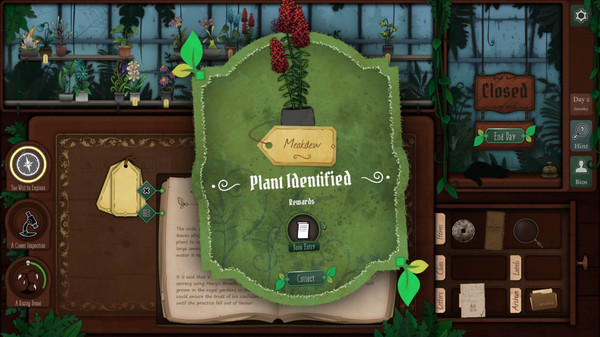 Beyond the shop — the map and expedition clues — Steam store
The Texture of Difficulty
On difficulty, the pool splits cleanly. People who write “relaxing, easy to pick up” sit beside people who write “good game but needs brain” and “I got stuck.” The publisher says “the puzzles aren’t necessarily hard, but always rewarding,” yet helpful reviews include “harder than I expected.” The gap between the developer’s “relaxing” and some players’ “needs brain” is the real shape of this game’s difficulty.
Collect where reviewers got stuck and the difficulty sorts into three kinds. First, reading the clue — parsing a metaphor-laden request into which almanac opposition it points to. Second, telling near-identical species apart — two pots whose leaves or flowers are alike, which only higher observation resolution can split. Third, reading the map on expeditions. Most stalls cluster in the first two.
Again the two camps are one design’s two faces. A grammar pared to minimal clues yields a “relaxing” flow when it meshes and a “needs brain” stall when it doesn’t. Light penalties and endless retries are the safety net. On balance I read the difficulty as toward the gentle end — not because it is shallow, but because it returns you kindly when you stall.
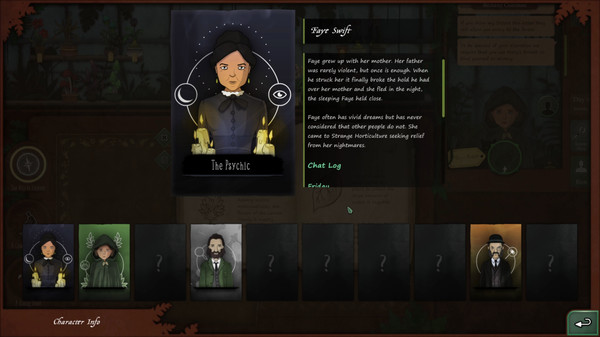 Matching at the counter — where most stalls happen — Steam store
Sources
This piece was written by reading the Steam store and community user reviews as of 2026-06-25.
· Steam: Strange Horticulture (English “Overwhelmingly Positive,” 95% of 9,715; 14,421 across all languages).
· Read helpful/recent user reviews on both the positive and negative sides via WebFetch; the negative side recurs on “the book feels insufficient,” “tedious/repetitive,” and “too short.”
· Also consulted: Rock Paper Shotgun’s review, PC Gamer (90), Metacritic (83), and a GameDiscoverCo interview with the publisher.
Closing
Stack the reviews into one sheet and Strange Horticulture turns out to ask: how far can you trust a single verb? Identify a plant — that one act — wrapped in the grammar of an almanac, the world of Undermere, and a cat you can pet, built into a small cosmos of four to six hours (the range reviews mention). That an overwhelming majority praise it and a minority back away calling it “tedious” is only a difference of whether that one verb suits your skin.
A word on the numbers. Against Steam’s overwhelming 95%, I give it 8.0 on design grounds. The two points I withhold are not for the verb’s monotony but for the moments the clues are pared so far the grammar lets go of uniqueness — what the negatives call “the book feels insufficient.” Where it meshes, this is a rare, clean design that turns observation into pleasure.
No flashy controls, no timer. At a desk, you look at a leaf, turn a page, name a pot. For those who value that quiet, it is one to save for a rainy day. For those who want heft or volume, look for another labyrinth. This review pool already predicts both verdicts correctly.
 Strange Horticulture — Steam store
Where are you with this game?
Press one and the game goes on your shelf. You can see it on your account page.
Reactions (no login)
Anonymous • one of each per visitor per day
Read next
Related reviews
Strange Antiquities
A 2D identification-and-deduction puzzler in which you mind an occult antiques shop in the lakeside town of Undermere, probing unlabelled objects by colour, touch, scent and inner perception, cross-referencing illustrated tomes, and handing each customer the item their trouble calls for — where what you hand over decides the town's fate.
The Centennial Case: A Shijima Story
Ein Krimi-Adventure in Realfilm über eine Mordserie, die eine Familie seit einem Jahrhundert verfolgt. Man sammelt Hinweiswörter aus den Szenen und setzt sie in Hypothesensätze ein, die vier Fälle aus vier Epochen zu einem Faden verbinden. Von Square Enix.
Escape Academy
Ein Escape-Room-Puzzle aus der Ich-Perspektive für ein oder zwei Spieler, entwickelt von Leuten, die echte Escape Rooms bauen. Durchsucht jeden thematisch gestalteten Raum, kombiniert die verstreuten Hinweise und gebt den Code ein, um herauszukommen – von der Bombenentschärfung bis zum Server-Hacking – eingebettet in eine leichte Geschichte über die Lehrkräfte einer Puzzle-Akademie. Coin Crew Games' einladende Tür ins Genre.


