REVIEW · 2020-10-30
Understand
Errate die versteckte Regel und ziehe eine Linie
Introduction
A board of lines and symbols sits in front of you, with almost no explanation. The dots beneath it count the hidden rules; your task is to draw a single line that satisfies all of them. The game never tells you what the rules are — draw a line and it only reports which rules you met, and from those scraps you reverse-engineer the rest. Understand is a mouse-only rule-guessing puzzle from Artless Games (reportedly close to a one-person studio), released October 2020.
I write this from the Steam review pool. The verdict reads 'Very Positive': 91% of 785 buyer reviews are positive; across all sources, 734 of 808 are positive against 74 negative (snapshot 2026-06-25). It costs $3.99, and the developer's own store copy proudly lists 'terrible artwork' as a feature. Jonathan Blow, who made Braid and The Witness, left a comment now framed on the page: 'Are you kidding me? That's a troll.'
On the numbers, a quiet little favorite. But read closely and praise and complaint keep pointing at the same thing — that the game explains nothing. This piece turns that single coin over into design terms.
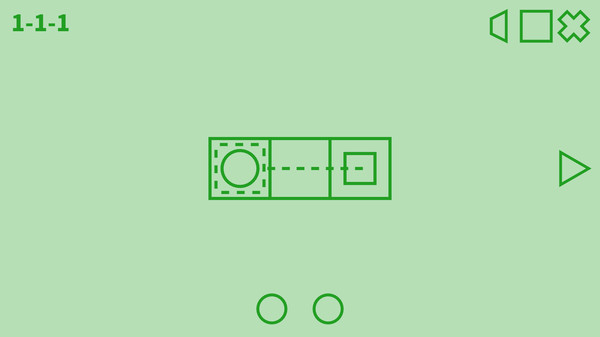 Dots count the hidden rules; draw one line that meets them all. — Steam store
First Impressions
Line up the helpful positives and the vocabulary rhymes: aha, minimalist, cerebral, and over and over 'the little sibling of the Witness.' Most describe carving out rules by hypothesis, experiment, and refutation — closer to experimental science than to a normal puzzle. Many call the music-less, language-independent minimalism 'clean.'
The negatives grab a different set: confusing UI, 'no explanation at all is unfriendly,' and the sharpest one — 'I solve it without understanding it,' since brute-forcing lines can carry you forward without ever learning the rule. Some call it dry. One reviewer notes the late meta-levels that resize the OS window can't be solved on a Steam Deck.
What's interesting is how often the same trait is read in reverse. One reviewer's 'joy of noticing' is another's 'just lazy'; one's 'purity' is another's 'uneventful.' My job isn't to stage a fight, but to translate where the verdict forks.
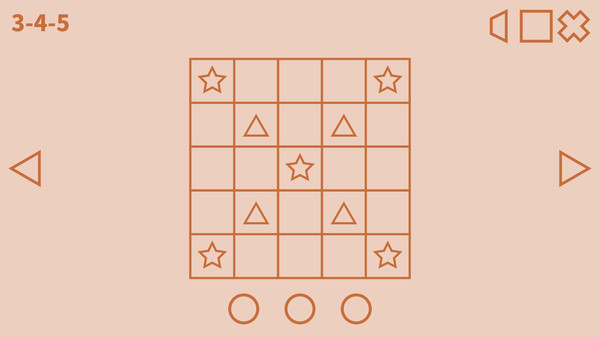 The verdict orbits one trait: it explains nothing. — Steam store
Putting the Mechanics into Words
What positives praise is how small the input is: essentially one verb — draw a line. The dots below a board count its hidden rules; draw, and only the rules you satisfied light up. The first screen of each level shows one valid line, and the next few are arranged to teach by example. In Puzzlebyrinth's terms, the verb is subtracted to one and everything else is handed to observation.
What sets Understand apart is where the grammar lives. Most puzzles teach the rule, then ask you to apply it; Understand hides the rule and asks you to infer it. It shares a family with The Witness teaching its glyphs from the environment and Baba Is You letting you rewrite grammar on the board — but it goes one step further and hands you the grammar table blank. The dev reportedly cites The Witness, Baba Is You, the board game Zendo, and psychology's 2-4-6 task as inspirations.
Here is the thing the pool keeps circling, put in design terms: you form a hypothesis, test it with a line, and refute it by the lights that come back — raising observation resolution to rebuild the hidden grammar one row at a time. The 'aha' isn't a lucky guess landing; it's the clean moment a wrong hypothesis dies. That makes Understand less a thinking puzzle than a rare game about observation itself.
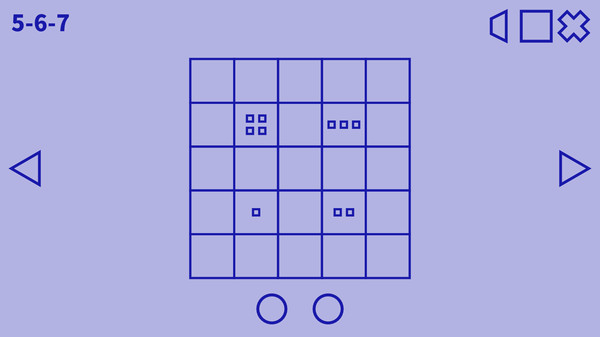 Draw, and only the rules you satisfied light up. — Steam store
Design Craft
Where positives say it 'gets hard naturally,' that's teaching. The single correct line on each level's first screen is itself the hint; the screens that follow straddle a rule's boundary on purpose, to shake your hypothesis. When a reviewer says they 'read the dev's intent in the first few screens,' they're reverse-engineering that teach-by-example design.
The most divisive trait — the unfriendly UI — also reads as subtraction. There's almost no text. Dots show the rule count, but on the final screen the dots hide and become an oval, and the game never says why. One reviewer calls it 'terrible UX'; another defends it as 'the philosophy carried all the way into the interface.' The same silence is unfriendliness to one and consistent aesthetics to the other — not a question of quality but of who it was stripped down for.
Easy to miss are the late meta-levels, where the dev extends the rules beyond the board — to window size, to OS behavior. Where Baba Is You breaks grammar on the board, Understand carries it outside the frame. 'Genius,' say some; 'physically unsolvable on Steam Deck,' say others. Ambition and exclusion are two sides of one coin.
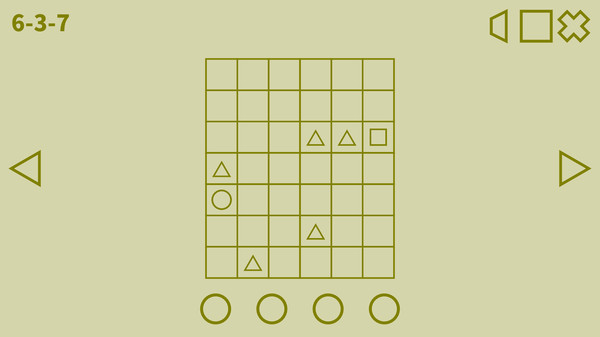 Teach-by-example: the first valid line is the hint. — Steam store
The Texture of Difficulty
Difficulty is where the pool splits most cleanly, and the stuck-points sort into roughly three kinds. One: poverty of hypotheses — not even imagining the right kind of rule. Two: failure to refute — clinging to a wrong hypothesis under confirmation bias. Three, the one negatives target: the temptation to brute-force, stumbling through without understanding.
The first two yield to higher observation resolution — the kind this game wants to reward; positives call it 'doing science.' The third is the real problem: the game can only judge a correct line, not correct understanding, so a hole for brute-forcing remains by design. 'I solved it but don't get it' isn't laziness so much as a structural limit — output is all it can measure. The stack of solution guides near the top is the flip side of that limit.
On the label: I set difficulty to 4. The tags hold both 'Casual' and 'Difficult,' and the experience swings hard; completion times reported by the pool run from a few hours to well over ten. Early rules are plain; late ones layer up, and the meta-levels make you doubt the world outside the board. Read it as a slope that's gentle for those who trust observation and suddenly steep for those who start second-guessing.
 Noting rules and refuting them — raising observation resolution. — Steam store
Sources
Written by reading the Steam store page and community reviews/discussions as of 2026-06-25. No review text is quoted directly; typical claims are reconstructed.
- Steam: Understand (Very Positive — 91% of 785 buyer reviews; 734 of 808 positive and 74 negative across all sources)
- Read via WebFetch: top helpful positives, negatives attacking the UI and brute-forcing, and recent discussions (Steam Deck meta-level and crash reports) — confirming the recurring complaints (solving without understanding, unfriendly UI, 'dry')
- Context: a LessWrong recommendation (framing it as hypothesis-testing practice) and a harsh WayTooManyGames Switch review (4.0/10) — a clean case of press and players diverging
Closing
Steam reads about 91% positive; my design-critique score is 8.0. The small gap is one thing the number can't catch. At its theme — rebuilding a hidden grammar by observation — Understand is nearly one of a kind; few games distill the hypothesis-experiment-refutation loop this purely into play. Marks come off for the structural hole (it judges the line, not the understanding) and for a UI and meta-levels so committed to their philosophy they tip into unfriendly and setup-dependent.
The press-vs-players split is telling. A critic who played the Switch port scored it 4/10 for being 'uneventful'; the people who love it on Steam love exactly that lack of event — a design that strips away spectacle and leaves only observation. For anyone who likes the 'progress by noticing' of The Witness or Taiji, or the 'play with grammar' of Baba Is You, it's about the best $3.99 experiment going. For anyone wanting feel, signposting, or an easy-on-the-eyes UI, it's outside the reach. The split itself tells you exactly who it was pared down for.
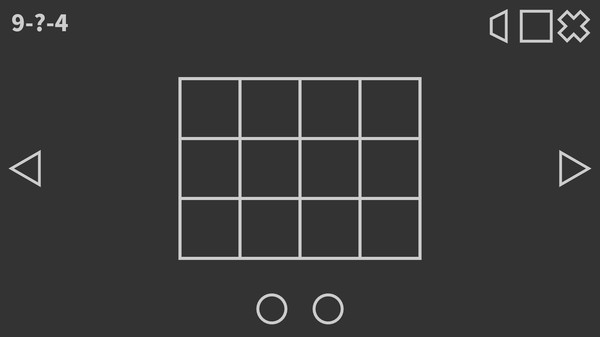 The more it strips away, the deeper the guessing game. — Steam store
Where are you with this game?
Press one and the game goes on your shelf. You can see it on your account page.
Reactions (no login)
Anonymous • one of each per visitor per day
Read next
Related reviews
Filament
Ein Puzzlespiel, in dem du eine kleine Sonde steuerst, um ein einzelnes nachgezogenes Kabel um Säulen zu wickeln und so jeden Raum eines verlassenen Raumschiffs mit einer einzigen, ununterbrochenen Linie zu lösen.
Kine
Rolle und drehe drei musikalische Maschinen — Quat die Trommel, Roo das Akkordeon, Euler die Posaune — durch über 120 3D-Rätsel in einer theatralischen Stadt und lies, wie jeder Körper wie ein gezinkter Würfel kippt. Ein räumliches Puzzle von Chump Squad (Gwen Frey).
Lucifer Within Us
Ein isometrisches Detektivspiel, in dem man die Zeitleiste von Zeugenaussagen vor- und zurückschiebt und Widersprüche aufspürt, um Mordfälle zu lösen. In einer von Dämonen heimgesuchten Gottesstadt setzt man Motiv, Mittel und Gelegenheit durch Deduktion zusammen. Ein Werk von Kitfox Games.


