REVIEW · 2013-11-15
Contrast
Reading a 2013 game where users and critics split over the shadows
First Impressions
I write this from the Contrast review pool on Steam as of 2026-07-10: 89% of 2,583 English reviews are positive, 4,526 across all languages, 'Very Positive.' Yet the Metacritic critic score sits at just 62. It is rare for users and critics to split this far, so I start from that gap in temperature.
Line up the helpful positive reviews and the vocabulary rhymes: beautiful, gorgeous, atmospheric, 'hidden gem,' and 'short but unforgettable.' Most praise the beauty of the light-and-shadow idea and the 1920s art-deco, jazz-soaked mood.
The negative side and the qualified positives keep returning to: short, buggy, janky, 'wasted potential.' What interests me is how often both point at the same action. One reviewer's 'it feels like magic' as you slip into a shadow is another's 'I clipped through the wall and fell.' My job is to translate where the opinions fork into design terms, not to stage a fight.
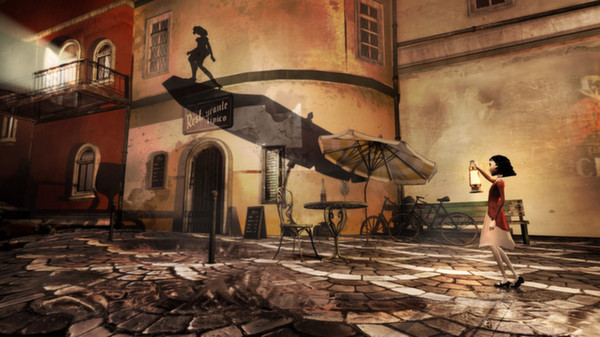 The art-deco city where light and shadow share a frame — Steam store
The World
This is where the positive heat gathers. 'Amazing soundtrack,' 'the atmosphere carries it,' 'the art style alone is worth it' — a dreamlike 1920s city of cabaret singers and circus performers, brushed by smooth jazz. The developer's own pitch sells 'dreamlike and surreal,' so here, unusually, maker and reviewers agree.
In Puzzlebyrinth terms this world isn't backdrop; it is the resolution at which you observe. Lamps, neon and projected shadow-plays cast the light, and that light is the stage. Watching the world and solving the puzzle fold into a single act — so when reviewers talk about mood, they are quietly talking about design.
But the 'in the blink of an eye' smoothness the studio advertises isn't universally echoed. The world looks smooth; moving through it, reviewers say, does not. That gap between look and feel shadows the mechanics section to come.
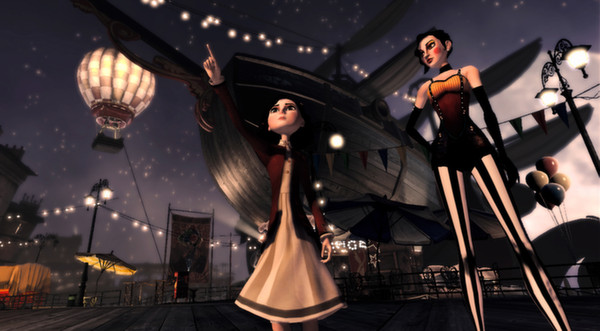 Neon and shadow-play thrown across a wall — Steam store
Putting the Mechanics into Words
What the positive reviews praise is how the core is pared to one thing: step up to a lit wall and slip into the shadow world, where the 3D girl Dawn becomes a 2D silhouette and crosses the shadows other objects cast. In Puzzlebyrinth terms the verb is subtracted down to one: enter the shadow. 'Unique,' 'clever concept' — that restraint is what they mean.
But one verb doesn't mean one rule; the grammar lives in the light. Move a lamp and the shadow stretches; move a box and the platform's shape changes. The loop — arrange objects in 3D, drop to 2D, cross — is the grammar. Where The Bridge warped a plane with gravity, Contrast edits the plane of shadow with light sources.
The negative side gathers on that same grammar. One complaint: the puzzles are too easy for genre veterans. The deeper one: loose collision becomes a hole in the grammar — 'I put a box where it shouldn't go and clipped past the puzzle,' 'I stood on a shadow that wasn't a platform.' A beautiful, subtracted verb undone by implementation seams — that is what 'janky' and 'buggy' compress into.
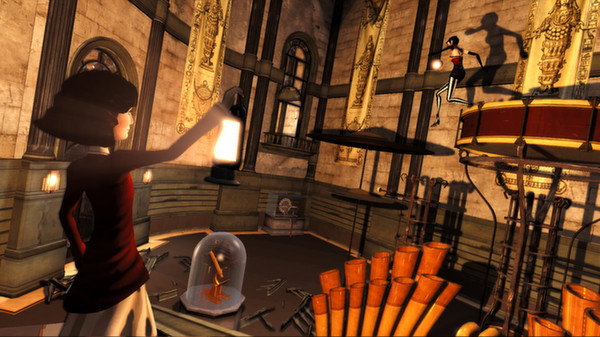 Dawn crossing a plane of shadows as footing — Steam store
The Feel of the Story
The other center of the pool is the story. You play Dawn, the imaginary friend of a young girl, Didi, glimpsing a family drama about a mother, a daughter and a father who never quite appears — all through a child's eyes. The helpful reviews carry 'emotional,' 'bittersweet,' 'the ending stayed with me.'
What I find interesting as design is how the story's motifs line up with the verb. You are a shadow, an imagined thing, always watching from outside the events. The absent father, the truths kept out of the light — the themes are made of shadow and observation. Like Limbo and Inside, it carries feeling by atmosphere, though Contrast is a step more talkative, with jazz and dialogue.
But the 'too short' complaint reaches the story too. 'It ends just as it gets going,' 'an abrupt finish' recur, and the 3-4 hour length can't quite cash in the mood it patiently builds. Reviewers rate the world and story highly and still wish for more of both — praise and complaint growing from the same root.
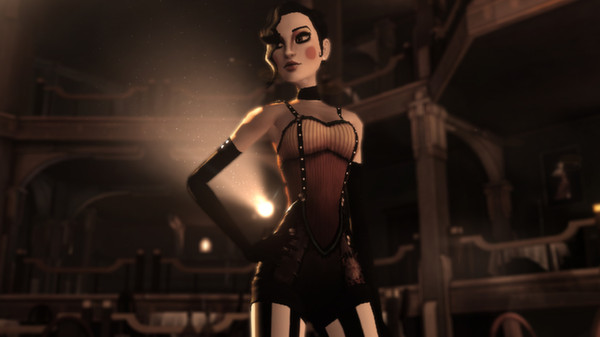 Didi and her imaginary friend Dawn — Steam store
Sources
This piece was written by reading the user reviews on the Steam store page as of 2026-07-10. No review text is quoted directly; typical claims are reconstructed.
- Steam: Contrast (Very Positive, 89% of 2,583 English reviews; 4,526 across all languages)
- Read via WebFetch: the top ~10 helpful positive reviews, 5-10 representative negatives, and several recent reviews (17 in the last 30 days, 88% positive)
- Press: Metacritic (critic 62), plus scores from IGN (7.5), Game Informer and GameSpot
Closing
Steam reads 89% positive in English; Metacritic's critics 62; my design-critique score is 7.0, landing right between them. The idea and the world — one verb that turns shadow into footing, a light that edits the puzzle plane, the jazz-and-noir air — earn high marks. The marks come off for not developing that verb far enough, and for collision and control seams that muddy an otherwise subtracted design. Critics were harsh and users forgiving, I think, over how heavily each weighs idea against implementation.
So Contrast's worth is decided mostly by what you bring to it. For anyone who wants to sit quietly in the mood and story, or touch the beauty of a single light-and-shadow verb, it's a find — released in 2013, now Steam Deck Verified and a sale regular (a record low of $2.49), with recent reviews still 88% positive; the verdict has barely moved in twelve years. For anyone wanting mechanical bite, length, or polished controls, it falls outside the reach. The split itself tells you who it's for.
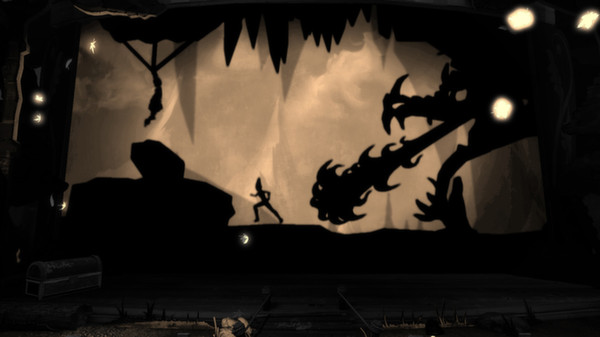 A long shadow cast across the art-deco city — Steam store
Where are you with this game?
Press one and the game goes on your shelf. You can see it on your account page.
Reactions (no login)
Anonymous • one of each per visitor per day
Read next
Related reviews
Gunpoint
A 2D stealth-puzzle where you rewire a building's security with the mouse and trap its guards on the way in. A single verb — 'connect' — branches into thousands of solutions, and a level editor extends it without end. Reportedly made almost single-handedly by Tom Francis.
Brothers - A Tale of Two Sons
Two brothers set out to find the Water of Life for their dying father. The left stick moves the older brother and the right the younger, both at once, and you cross ravines, waterways and the bones of giants by pairing what each of them can do. Every line is spoken in an invented language. Directed by Josef Fares at Starbreeze Studios, released in 2013.
Ittle Dew
A top-down puzzle adventure in which a castaway adventurer works through block-pushing rooms using only the items she picked up — a fire sword, an ice wand, a portal wand. Released by Ludosity in 2013.


