REVIEW · 2021-10-14
ElecHead
Reading the near-unanimous praise for a single-verb puzzle-platformer
Introduction
You pilot a robot whose head is a battery: touch a floor or wall and it conducts electricity, opening the way. You can throw the head, and once it is off, a ten-second timer counts down. Three ideas, and a 2D puzzle-platformer through a forgotten underground. Made by Japanese solo developer NamaTakahashi, music by Tsuyomi, released October 2021.
I write this from the Steam review pool. The label is 'Overwhelmingly Positive,' 96% of 1,362 reviews, 97% in the last 30 days (snapshot 2026-07-20). Only 47 negative reviews exist. Metacritic sits at 84, and EDGE named it PC game-of-the-year runner-up for 2021. This is not a split verdict; it is near-unanimous praise.
What is telling is that the store's own description is three emoji: ⚡+🤖+🧩. The depth is put into words by reviewers, not the developer. So I will read what, exactly, that near-unanimous 'clever' is pointing at.
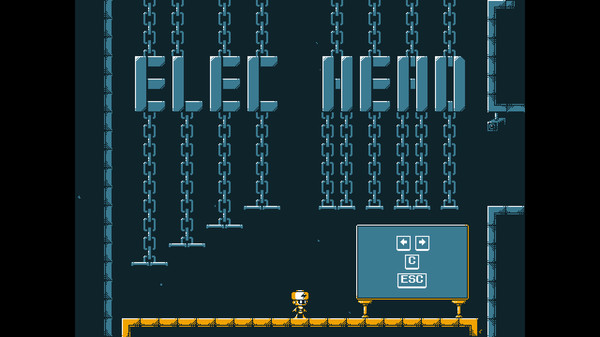 ElecHead — Steam store key art
First Impressions
Line up the helpful positive reviews and the vocabulary rhymes: elegant, clever, tightly designed, no filler, and 'galaxy-brain moments.' Most praise the payoff of a solve and the density of a two-to-three-hour run in the same breath.
The reservations collapse to one: short, and 'I wanted more.' One calls it a proof of concept; another, a box of fine chocolates. Even the complaint mourns the brevity rather than resenting it.
So the verdict is not split; a small reservation lives inside the praise. My job is to translate where 'elegant' comes from in design terms. This is a quiet cleverness, not the brain-frying kind of Baba Is You.
 ElecHead — Steam store key art
Putting the Mechanics into Words
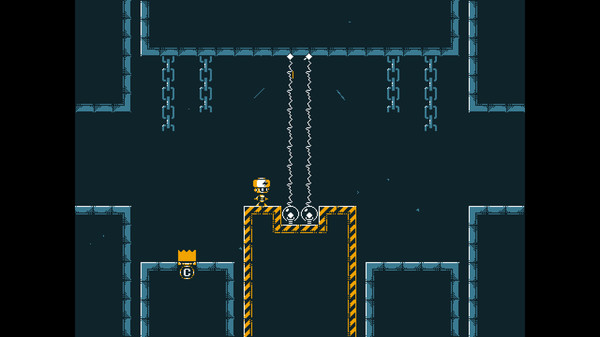
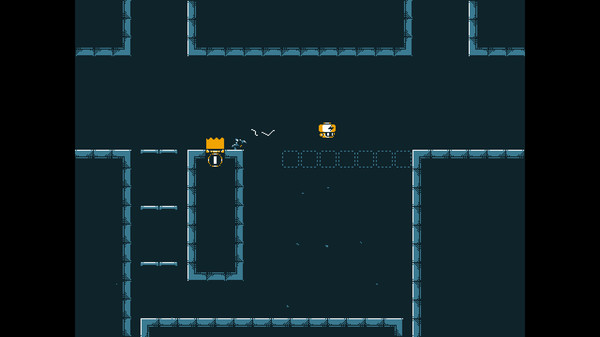
What the positive side praises most is how few verbs there are. The robot's head is a battery; whatever the body touches is electrified. Early on you gain the throw: hurl the head to power a distant switch while the body waits in the dark — and only while separated does the ten-second timer run. The core verb is one: touch to conduct.
In Puzzlebyrinth terms, that is a radical subtraction of verbs. When reviewers say the game 'takes one mechanic to its limit,' this is it. Like Patrick's Parabox unfolding 'a box inside a box,' one word — electricity — plays three roles at once: movement, switching, and the timer.
Recent reviews arrive via 2024's Öoo and circle back here, all calling NamaTakahashi 'a master of taking a mechanic to its limit.' Depth comes not from more verbs but from mining one — a design philosophy consistent across both games.
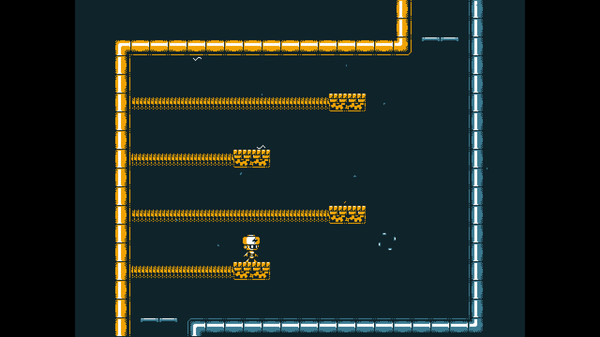
 ElecHead — Steam store screenshot
The Texture of Difficulty
On difficulty, the pool splits gently into two layers. The main path reads as 'not too hard' and 'never unfair,' and the press agrees — easy enough to avoid frustration, big on the satisfaction of a solve. The friction lives outside the main path.
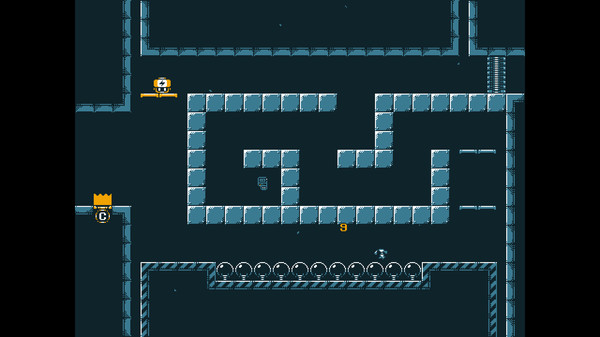
First, the collectibles: gather twenty remotes for an alternate ending, tucked behind hidden walls and careful looking. Here the few sharp negatives land — 'hidden walls on the critical path erode trust in the logic,' and 'the teleport numbering misleads you into backtracking you cannot do.' A design that rewards observation flips, for some, into 'obtuse.'
Second, timing: 'clear it in ten seconds when the run itself takes nine.' One player calls that panic fun; another, 'my fingers cannot keep up with what I have already solved.' Same design, read two ways. It is a question of kind, not amount — a quiet spatial logic with a brief graft of reflex. The main line is standard; the true-ending hunt is hard. The curve steps at the very end, on purpose.
 ElecHead — Steam store key art
Sources
This piece was written by reading the user reviews on the Steam store page as of 2026-07-20. No review text is quoted directly; typical claims are reconstructed.
- Steam: ElecHead (Overwhelmingly Positive, 96% of 1,362 reviews; 97% of 42 in the last 30 days)
- Read via WebFetch: the top ~10 helpful positive reviews, several representative negatives, and several recent reviews
- Press: Nintendo Life review, plus a Metacritic aggregate of 84
Closing
Steam reads 96% positive; my design-critique score is 8.7. The core electric verb is clear, the chapter-by-chapter teaching is careful, and the late-game structure (no spoilers) has the kind of built cleverness reviewers uniformly gasp at. The small deductions are less about brevity than about a few collectibles that skimp on fair observation.
Tellingly, the one real dispute — is the finale really that special? — is among users, not against critics. The press calls it a must-see; some forum voices calmly answer 'subversive is not the same as special.' The louder the praise, the more the counter-reservations appear. That is healthy.
Roughly two hours for the main path, four to five for completion, at $9.99. The pool's near-unanimous verdict is 'well worth it,' and I will say the same to anyone who wants to taste one verb pushed to its limit. Here, being short is not a flaw — it is part of the design.
 ElecHead — Steam store key art
Where are you with this game?
Press one and the game goes on your shelf. You can see it on your account page.
Reactions (no login)
Anonymous • one of each per visitor per day
Read next
Related reviews
Mini Motorways
A minimalist 2D puzzle game in which you draw roads, one at a time, through a city that keeps sprouting colour-coded houses and destinations. Each week you are handed a motorway, a roundabout or a traffic light to spend, and you keep redrawing the network until the traffic finally seizes up. From Dinosaur Polo Club, the New Zealand studio behind Mini Metro.
Tetris Effect: Connected
The falling-block game you already know, with its rules left exactly as they were. Across thirty-odd stages the music and light move in step with every piece you drop, and two things sit on top: a Zone that freezes time so you can clear more than four lines at once, and a three-player co-op mode that joins the boards together. Made under Tetsuya Mizuguchi's Enhance.
Inscryption
A deckbuilding card game played across a candlelit table from Leshy, a narrator holed up in a cabin: you draw woodland-creature cards and sacrifice your own pieces to put them into play. Stand up from the table and the cabin itself becomes an escape-room puzzle. By Daniel Mullins, who made Pony Island.


