REVIEW · 2019-08-12
Eliza
The main text has almost no verbs left; the appendix keeps exactly one — and in a pool of 1,009 reviews, it is the negative side that praises the solitaire
First Impressions
I read the Steam review pool for Eliza as it stood on 31 August 2026. The store page shows 92% of 1,009 reviews positive, labelled Very Positive. Counting every language, 1,591 of 1,754 reviews are positive, or 90.7%.
The provenance first. It is a visual novel about a few days in the life of a woman employed as the human voice of an AI counseling app. Zachtronics both developed and published it; Matthew Seiji Burns wrote it, and is reported to have pitched the idea while the studio was finishing Opus Magnum. Windows release 12 August 2019, Switch 10 October 2019. It was nominated for the Grand Prize and for Excellence in Narrative at the 2019 IGF.
One count stood out. Among the ten most helpful positive reviews, exactly one mentions the bundled solitaire game. Among the ten most helpful negative reviews, four praise it outright, and a fifth notes that chasing its achievement ate most of the playtime.
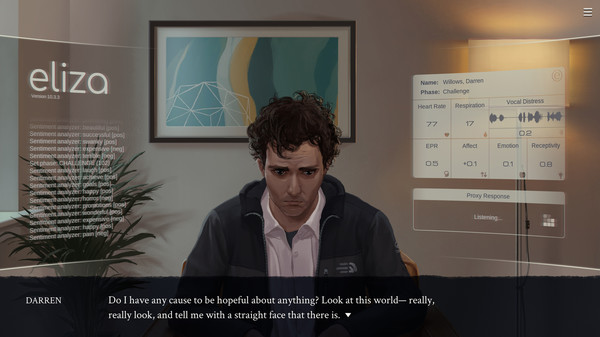 Screenshot published on the Steam store page (image 1)
Putting the Mechanics into Words
Count the verbs. The player can advance the text, and occasionally choose. Most of those choices amount to reading the script on screen aloud, or not. The protagonist is employed to speak an app's output with a human mouth, so freedom from the script was never designed in.
The negative vocabulary gathers here. The top negative review, voted helpful by 126 people in August 2020, calls it an illusion of choice. Another says in a single line that the choices barely touch the outcome. A Japanese negative review asks whether this counts as a game at all.
The positive side agrees on the fact and renames it. One review, helpful to 112 people, credits the studio with building a meta game outside the usual puzzle. Another calls the departure from puzzles a triumph. Both sides see the same thing; they differ on whether to call it the subject or the absence.
The subtraction I described in the piece on subtractive design normally thickens whatever verb survives. Here the studio ran subtraction to the end and left one verb: to speak. The subtraction landed on the job, not on the board.
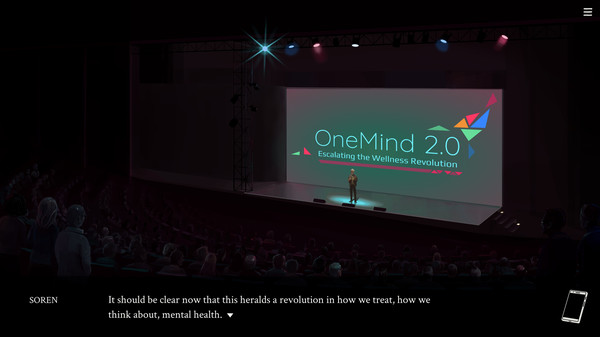
 Screenshot published on the Steam store page (image 2)
The Feel of the Story
So what is the pool grading? Line up the top positive reviews and the writers' jobs show through. One says they work in counseling, and vouches for the ethical framing. One says they have spent years in tech, and reads it as a story about deregulated development eroding daily life. A student says the burnout scenes looked like their own life.
That is an unusual shape of praise. Before measuring the craft, the reviewer brings their own workplace in. The design rewards whatever context the reader carries, and thins out for anyone who carries none. Playtimes on the positive side run from 5.0 to 15.5 hours, and on the negative side from 3.9 to 10.4: nobody here bounced off at the door.
The negative side has the same shape. Several complain that every scene, leisure included, circles back to corporate ethics; another argues the writing flatters programmers and makes everyone else look ridiculous. These are objections from inside the subject, standing on the same ground as the praise. As the piece on narrative and storyless puzzles put it, story does not remove difficulty, it relocates it. Here it moved onto the reader.
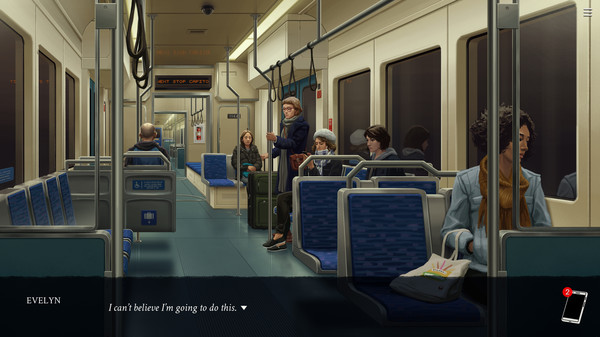
 Screenshot published on the Steam store page (image 3)
Design Craft
The interesting craft decision is that powerlessness was left in place. The top Japanese review, helpful to 33 people in September 2020, notes an unusual device late on that forces the player to repeat the script. The studio kept the moment where the player can do less, rather than cutting it.
Taking verbs away can carry a theme, when it works. It also converts, in the review format, into the sentence there is no gameplay. When powerlessness is the subject, the negative summary and the summary of the work almost coincide. The objection is not wrong; it just cannot do much work as an objection.
There is a gap between the makers' account and the pool. The studio describes this game as an expansion of its worldview rather than a reversal. The pool read it as a departure either way: the positive side calls it brave, the negative side calls it abandonment. Almost nobody read it as continuity. The bundled solitaire matters here too. Played with kabufuda cards, it is the one place that keeps try, fail, retry — the honest problem I wrote about in the piece on Zach Barth.
 Screenshot published on the Steam store page (image 4)
Place in the Lineage
The lineage makes this quick. As Opus Magnum and the piece on the grammar of Zachtronics showed, this studio's habit was to expose internal state, make you work it, and convert that labour into learning.
Eliza barely uses that habit. The internal state never opens, and there is nothing to optimise, so the pool's confusion follows. What left, though, was the verb, not the subject. Labour and automation are old ground for this studio.
The sequel to the story is decisive. In 2022 the studio shipped its last game, Last Call BBS. Its Kabufuda Solitaire is described in the official announcement as a retro demake of the difficult solitaire game that debuted in Eliza. First a game that threw its verbs away; then, in the final game, the one verb it kept was carried back to the centre. The negative reviews that praised the solitaire were right by instinct.
 Screenshot published on the Steam store page (image 5)
Sources
This piece was written by reading the Steam user reviews on the store page as of 31 August 2026, together with the official update announcements, aggregate figures, press scores and a developer interview. No review text is quoted directly; recurring claims are reconstructed.
- Steam: Eliza (92% of 1,009 reviews positive on the store page, Very Positive; 1,591 of 1,754 positive across all languages, 90.7%; $14.99 list)
- Read: the ten most helpful positive reviews, the ten most helpful negative reviews, the eight most recent, and the nine top-rated Japanese-language reviews
- Official announcements (Japanese and Portuguese added 13 December 2022; the 4 July 2022 post describes Last Call BBS's Kabufuda Solitaire as a retro demake of the solitaire that debuted in Eliza)
- Metacritic: Eliza (PC 84 from 7 critics; user score 6.4 from 38 ratings), and Wikipedia for the writing credit, award nominations and Switch date
- Note: the images here are screenshot URLs returned by Steam's own API, each checked individually for existence. This run could not reach the image CDN directly, so the pictures could not be opened and inspected. Captions therefore give only the position of each shot on the store page, with no description of what it depicts.
Closing
The figures, together. The store page: 92% of 1,009 positive. All languages: 1,591 of 1,754, or 90.7%. Metacritic: 84 from seven PC critics, and a user score of 6.4 from 38 ratings. A thumb and a ten-point scale are answering different questions.
Time has been kind to it. Recent reviews say the 2019 premise has been overtaken by events, and one from 2024 rereads the game after generative AI went mainstream. The work has not moved; the reader's stake in it has grown.
The Japanese locale runs on a different clock. A 2021 review noted that Japanese text existed in the files but was not officially supported; the official announcement dates Japanese support to 13 December 2022, and later Japanese reviews praise the translation. The same game becomes readable in different years depending on where you are.
I score it 7.4. I credit the nerve of running subtraction to the end, and the placement of the one verb left over. I cannot go as far as 92%: a design about powerlessness leans hard on what the player brings. Bring nothing, and what remains is a well-written script and a very good solitaire game. Reported playtimes scatter between five and twelve hours, clustering near seven.
 Screenshot published on the Steam store page (image 6)
Reactions (no login)
Anonymous • one of each per visitor per day
Read next
Related reviews
AI: The Somnium Files
A detective adventure set in near-future Tokyo, in which a one-eyed police detective works a serial murder case alongside the artificial intelligence housed in his prosthetic eye. First-person investigation scenes alternate with third-person 'Somnium' dives into a suspect's dream, where a six-minute budget must be spent to open Mental Locks, and an in-game flowchart lets you walk the branches toward several endings. Written and directed by Kotaro Uchikoshi of the Zero Escape series, from Spike Chunsoft.
MOLEK-SYNTEZ
In a cramped 2092 Romanian apartment, you program a home-built synthesizer to turn benzene and acetone into small pharmacological molecules — a Zachtronics optimization puzzle you operate only from the edges of a finite board.
Röki
A point-and-click adventure through a snowbound forest drawn from Nordic folklore, following Tove as she gathers and combines objects to search for her sister. Polygon Treehouse's game has no combat and no fail state, carried instead by hand-drawn landscapes and a story about loss.


