REVIEW · 2019-09-17
AI: The Somnium Files
The 92% is a vote for the story — on the other game buried inside it
First Impressions
AI: The Somnium Files shipped on September 17, 2019 in North America for Windows, PlayStation 4 and Nintendo Switch, with an Xbox One release following on September 30, 2021. It is a detective adventure from Spike Chunsoft, written and directed by Kotaro Uchikoshi of the Zero Escape series, with character designs credited to Yūsuke Kozaki. The structure is two-layered: first-person investigation scenes alternate with third-person 'Somnium' sequences, in which a Psync Machine drops you into a suspect's dream. Inside a dream you have at most six minutes, every object you touch spends some of it, and the right sequence opens a Mental Lock. The story branches, and seeing all of it means jumping back through an in-game flowchart. Its Japanese launch week was modest — 2,267 copies on PS4 for 27th place, 1,767 on Switch for 33rd — while on Steam it was reported among the best-selling new releases of September 2019.
The aggregates first. As of my 2026-08-19 snapshot Steam reads Very Positive: 92% of 4,440 reviews. The last thirty days sit at 80% of 56 — still inside the Very Positive band, but twelve points lower. Metacritic's PC page carries a critic score of 78 from 21 reviews (16 positive, 5 mixed, 0 negative) and a user score of 8.6 from 414 ratings, broken down as 348 favourable (84%), 29 mixed (7%) and 37 negative (9%). Taken as numbers, all of that is healthy, and there is no obvious gap to point at.
But from what I read, the 92% is not a vote on the whole game. Almost every one of the most helpful recommendations is about the story, the cast and the voice acting; only a handful mention the Somnium puzzles at all. The negative and mixed reviews, meanwhile, attack that untouched layer by name — the six-minute budget, the trial and error. There are two games stitched together here, and the aggregate is measuring one of them. This piece goes looking for the seam.
 AI: The Somnium Files — Steam store key art
The Feel of the Story
The positive vocabulary is remarkably consistent: hooked, banter, masterpiece, cinema, and a steady stream of people reporting that they cried. What recurs most is the partnership between the detective and the AI — several of the most helpful recommendations are a single line naming the partner and nothing else. The longer ones treat the swing between comedy and atrocity as the appeal itself. Worth noting: a recommendation logged at 59.7 hours openly grants that the plot has 'glaring holes in logic' and recommends anyway. The reservation does not stop the vote.
The negative vocabulary is just as consistent: juvenile, annoying, sex jokes, never takes itself seriously. In the store discussions the central complaint is that every serious beat gets interrupted by a badly timed joke. What makes this interesting is that the critics land on the same diagnosis. Cubed3 scored it 50 and wrote that the game is 'largely crippled by just how slow and repetitious it all is,' that 'the whiplash between attempts at humour and serious moments are too ham-fisted,' and that the plot 'could easily be cut by more than half.' Tone is the one place where the user pool and the press agree.
These are not two readings of the same thing. Both sides see the same object and split on whether it is load-bearing. My reading is that the comedy here is a refusal to subtract: to keep a thirty-hour text moving, the writer left the crude jokes in as a structural pacing device. Cut them and the tension holds, but the reader tires. So this is not a question of quality but of design range — if you can take the humour as a support beam it carries the full length, and if you take it as noise you are out by chapter two. Set beside Return of the Obra Dinn, which carries a reader on deduction alone with no such scaffolding, it is easier to see what this game agreed to take on.
 AI: The Somnium Files in play — Steam store screenshot
Putting the Mechanics into Words
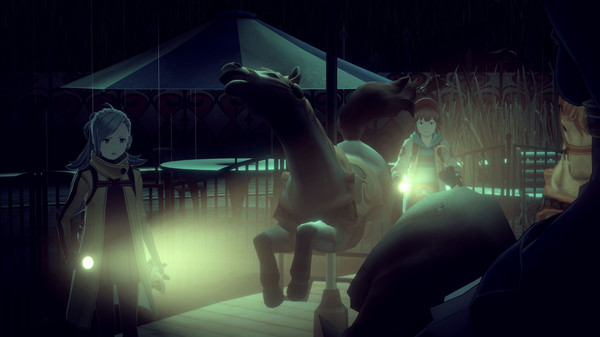
The Somnium's specification is easy to confirm from the official description. You dive into a suspect's dream, moving your partner's avatar and interacting with objects in the environment. The limit is 'a maximum of six minutes for the Psyncer and subject's safety.' Every interaction spends some of that; the correct chain opens a Mental Lock; and the state you exit the dream in feeds the story's branching. Where the investigation half is first-person clicking, this half is third-person and denominated in time.
The review pool names this accurately. One recommendation describes the escape rooms of the earlier games being replaced by 'point-and-click' exploration and 'time-rationing puzzles' — as a summary of the spec, that is close to exact. The negative and mixed vocabulary is harsher: the Psyncs are 'universally awful,' their logic is 'questionable,' and the randomised time-modifier pickups are singled out as maddening. One mixed reviewer sums it up simply as trial-and-error puzzle design.
In Puzzlebyrinth's vocabulary, the Somnium has already done the subtraction of verbs — what you can do to a dream lives in a small neighbourhood around look, touch and talk. What breaks is the grammar downstream of that. No rule is offered for what any given verb costs, so the six-minute budget never becomes something you can plan against. Observation resolution goes up and never converts into prediction, which is sharply at odds with the other half of the same game, where clicking costs nothing at all. It gets stuck in much the same place as Twelve Minutes, another game that made retrying its subject and then split its audience over what failure was supposed to mean.
 AI: The Somnium Files in play — Steam store screenshot
The Texture of Difficulty
On difficulty the split is cleanly asymmetric. The positive side barely mentions it — for those readers this is a text, and getting stuck is not even a topic. Only the negative and mixed reviews raise it, and there the words converge on tedious, boring, replay. One negative user writes that the major story branching depends entirely on choices inside the dreams with no in-game guidance at all, which means replaying the same material because of a random outcome.
Collect the places reviewers got stuck and the difficulty here sorts into three kinds. There is difficulty of moves — how to divide the six minutes. There is difficulty of interpretation — reading which real-world fact a dream's metaphor stands for. And there is difficulty of repetition — walking back through the same scene because of randomness and undisclosed branch conditions. Only the second is the one the game was designed around. The other two are closer to difficulty in costume.
Combinatorial explosion is not the problem; the dreams offer relatively few options. The problem is that failure teaches nothing. A puzzle with cheap retries can afford trial and error, but a retry here is priced in replayed dialogue and revisited chapters. The cost accumulates while the learning curve never gets off the ground. That is why I have left the difficulty rating at 3 and said plainly in the text that the experience divides: easy for anyone who passed through it as a novel, close to unfair for anyone who met it as a puzzle.
 AI: The Somnium Files in play — Steam store screenshot
Design Craft
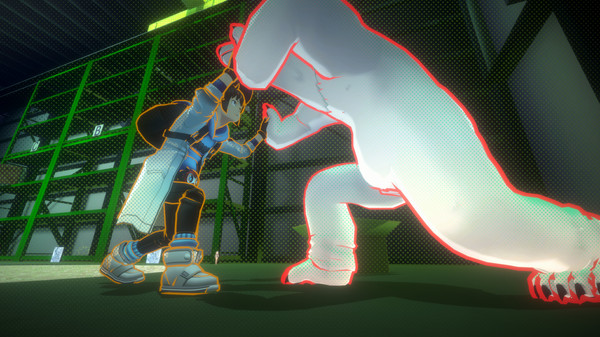
The one thing the review pool agrees on in the game's defence is the flowchart. Recommendations keep restating the same facts: there are seven endings, you can jump to any chapter without restarting, and the first set of credits is only the beginning. It is a design that takes the revisit cost of a long branching text and absorbs it directly into the interface. For an adventure game in 2019, I read that as a genuine step up on the standard of the time.
The same pool also marks its limit. The complaint is that the major branches are decided by choices inside the dreams, with nothing in the game pointing at them. The map draws perfectly where you have already been and says nothing about what determines where you go next. Completely legible after the fact, invisible before it. That asymmetry reads less like a design position than like something left unfinished.
Put in Puzzlebyrinth's terms, the flowchart externalises the learning curve into the interface. A branching narrative normally earns its difficulty by making the reader build the map in their head; put the map on screen and the difficulty shrinks into travel time — which is a defensible trade, and plenty of reviewers were glad of it. The remaining step would have been small: disclose, after the fact, not the route you took but what decided the branch. Next to Ghost Trick: Phantom Detective, which follows narrative causation all the way through the player's hands, that one step is a wide gap.
 AI: The Somnium Files in play — Steam store screenshot
Sources
This piece was written by reading the user reviews on the Steam store page as of 2026-08-19. No review text is quoted directly; typical claims are reconstructed.
- Steam: AI: The Somnium Files (Very Positive, 92% of 4,440 reviews; the last thirty days read 80% of 56)
- Read via WebFetch: the ten most helpful positives, the ten most recent, six most helpful from the German locale, and three surfaced by the negative filter — roughly 25 reviews once duplicates are removed. I also read the critical store-forum thread
- Metacritic critic score 78 (21 reviews: 16 positive, 5 mixed, 0 negative), Metacritic user score 8.6 (414 ratings: 348 favourable, 29 mixed, 37 negative)
- Wikipedia: AI: The Somnium Files (credits, per-platform release dates, the Somnium specification, Japanese launch-week sales, awards and nominations). The images below the text are official assets served by the Steam store page itself; the image CDN was unreachable from the environment this piece was written in, so their contents could not be checked by eye and the captions are kept generic
Closing
Against Steam's 92%, the critics' 78 and Metacritic's user 8.6, I am putting 7.8 on the board. Not because I think less of it, but because I am measuring something else. Most of those 4,440 votes were cast for the story and the cast; the second game — the Somnium — is barely present in them. Judged as a novel this is close to a nine. This piece is judging both halves of the stitched object, and I have taken a point or so off for a design that makes time the currency and then hides the price list.
The playtimes visible in the reviews I read run from the mid-twenties to ninety hours, with the middle landing in the low thirties. Since the game assumes you will walk every branch, that length is effectively the floor rather than the ceiling. One more thing worth watching: the last thirty days read 80% of 56, twelve points under the all-time 92%. The sample is small and I would not conclude anything from it yet, but where a newer, sale-driven cohort stalls is worth keeping an eye on.
This is for readers with the stamina for a long detective novel who can take the crude jokes as a tuning device. It is not for anyone who wants real resistance from the puzzles, or who wants to see in advance what their choices are going to change. For the first group the game is overwhelming; to the second it never gives an answer. That is not a failure — it is what falls outside the range.
AI: The Somnium Files — Steam store key art
Where are you with this game?
Press one and the game goes on your shelf. You can see it on your account page.
Reactions (no login)
Anonymous • one of each per visitor per day
Read next

Related reviews
Zero Escape: The Nonary Games
Two Spike Chunsoft mystery adventures in one package: nine people are locked inside a facility and must pass through numbered doors to get out. It bundles the DS-born Nine Hours, Nine Persons, Nine Doors with its sequel Virtue's Last Reward, alternating first-person escape-room sections with branching novel sections.
Phoenix Wright: Ace Attorney Trilogy
A courtroom adventure in which you play defense attorney Phoenix Wright, matching one line of testimony against one piece of evidence to break a lie. Capcom's collection gathers all fourteen episodes of the three games first released between 2001 and 2004, with the art redrawn frame by frame.
Eliza
A visual novel about a woman who returns to work as the human voice of an AI counseling app, reading its scripted lines aloud to clients. Written by Matthew Seiji Burns and made by Zachtronics, the studio behind Opus Magnum, it ships with a kabufuda solitaire game on the side.


