REVIEW · 2023-06-29
Ghost Trick: Phantom Detective
97% positive and 193 negatives are talking about different things
Introduction
One gunshot, and the protagonist is already dead, with no memory of who he was. Within the few hours until dawn he has to work out how he died, using the powers of the dead to possess nearby objects, move them, and rewind time to four minutes before someone's death. Directed by Shu Takumi, originally released for the Nintendo DS in 2010; the Steam version arrived on 29 June 2023 as an HD remaster from Capcom.
I am writing this from the review pool on that store page. The aggregate reads 7,882 positive against 193 negative out of 8,075 across all languages — 97% positive, labelled Overwhelmingly Positive (snapshot 2026-08-05). English alone accounts for 2,018 reviews, and the last 30 days sit at 97% of 72.
By the numbers this looks settled. But reading the negative side from the top of the helpful sort, almost nothing there is about the design. DRM, resolution, the 4:3 letterboxing, the keyboard mapping — it is nearly all about the box. The design critique is not on the negative side at all; it is buried inside the recommendations.
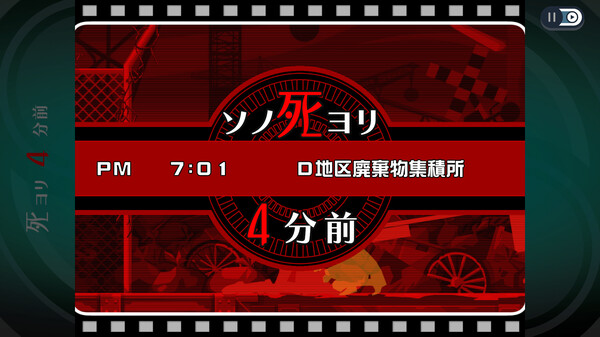 A film-strip eyecatch card reading four minutes before that death, with a time of 7:01 PM and a location name — Steam store screenshot
First Impressions
The first surprise in the helpful positive reviews is that the praise barely touches the puzzles. Close your other game and spend ten hours on this. Play it and you turn into a walking advertisement for it. I want my memory wiped so I can play it fresh. And a great deal of affection for the dog. Nearly half of the top ten are declarations of enthusiasm rather than descriptions of content, and when the puzzles do come up it is usually a single clause about them being engaging enough.
That skew tells you what the pool thinks it bought. Not difficulty: the story's motion, the cast, and the pacing. One top review's line about every second being paced perfectly is the shortest available summary of the positive axis.
Read the negative side in the same order and the vocabulary swaps out entirely: DRM, always-online, blurry upscales, compression artefacts, a 4:3 window, keys assigned with no apparent logic, refund windows. And almost every one of them opens by saying the game itself is great. Steam's three percent is filed as a protest against the packaging, not the work.
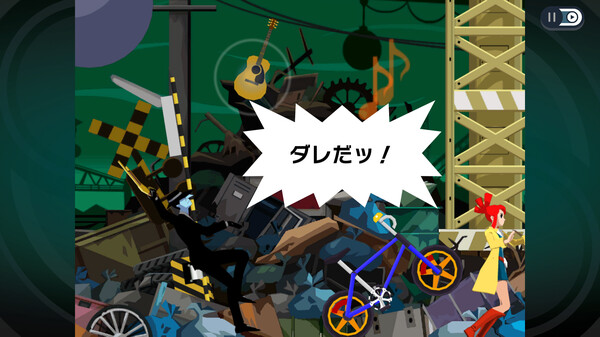 A greenish junkyard scene: piles of scrap and a bicycle, a woman in red on the right, and a jagged speech bubble in the middle — Steam store screenshot
Putting the Mechanics into Words
Cross-referencing the reviews, the structure is this. As a ghost you can do two things: possess an object in view, and trigger the single action that object owns. Movement exists only as hopping from object to object, and reach is set by physical distance. Where someone has died, you rewind to four minutes before that death and rearrange the chain of objects inside those four minutes to prevent it.
The metaphor positive reviewers reach for most often is working out how to operate a Rube Goldberg machine. It is an accurate figure and it names the design point. The player's verbs are subtracted down to two, and all expressive power is moved out into the objects. A fan spins, a barrier drops, a bicycle falls: the objects hold the grammar, and you only choose the order of connection. Where Patrick's Parabox keeps adding rules, this fixes the verbs and swaps the dictionary.
What matters is that the subtraction all but closes off combinatorial explosion. Reach is bounded by distance, each object owns exactly one action, and the clock is cut to four minutes. However wide the board looks, the real search tree stays in the tens of moves. The positive chorus that it never demands a weird leap, and the negative note that it tests observation and reaction more than strict logic, are two faces of that same structure.
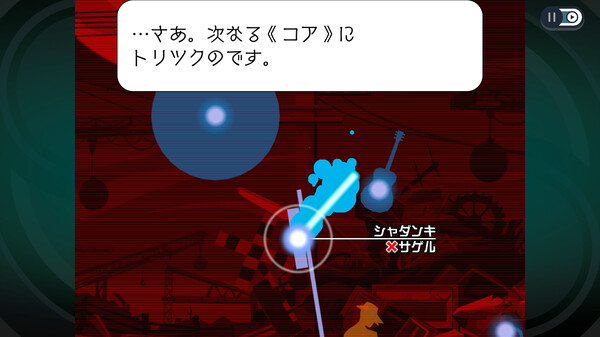 The all-red ghost-side view: blue points of light scattered across the scene, joined by a glowing line, with a label on the object currently selected — Steam store screenshot
The Feel of the Story
When positive reviewers talk about the story, they use one shape: I came for the dog and the puzzles, I stayed for how hard the plot swings. They praise the volume of setup and how tightly it pays off, and they append, almost as a formula, a warning to go in knowing nothing. The reviewers themselves understand that spoiler damage here is structural.
From the design side, the story and the mechanic are the same shape. Rewinding to four minutes before a death is both a narrative rewind and a board-level undo. As set out in time loops and puzzle design, few games get to spend a loop on the fiction and the board at once. Here each chapter carves one death out as one board, and the solution to that chapter becomes the premise of the next. Where Return of the Obra Dinn makes the moment of death an object of observation, this makes it an object of editing.
The negative side does discuss the story, rarely but consistently: it is fuzzy and hard to follow, avoid it if you dislike text-led games, characters carry important roles without ever being named, the cast starts behaving alike in the back half, and the late twist is a shape other games have already used. That complaint lands exactly on the fault line described in narrative versus abstract puzzles. A structure that pulls you forward on trust in the telling rather than resistance on the board leaves nothing in your hands the moment that trust breaks.
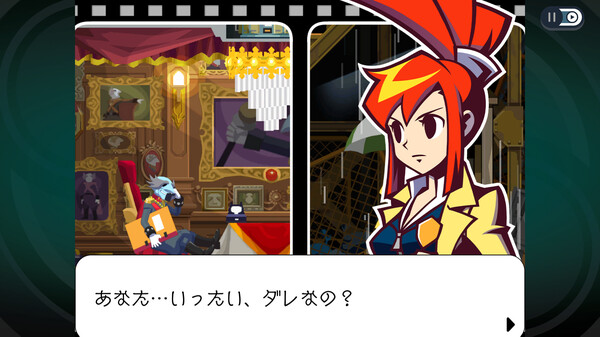 A film-framed conversation: a picture-hung interior on the left, a red-haired character in a hat on the right, and a line of dialogue in the window below — Steam store screenshot
The Texture of Difficulty
On difficulty the pool converges across the divide: it is easy. The positive side writes that it engages you without demanding all of your brain; the negative side writes that it is too easy for their taste. One observation, two price tags. Both sides also note the built-in help for players who stall, and that the punishment for failure is small.
Collect the places reviewers actually got stuck, though, and the difficulty splits three ways. First, observation resolution — simply not having noticed which object on screen owns an action. Second, fitting the order of the chain to the clock, which is the designed difficulty. Third, difficulty unrelated to logic: the slide puzzles added for the remaster, and the reaction-speed demands of particular chapters (chapter 14 gets named repeatedly). Only the third makes reviewers raise their voices.
Separately from difficulty, three complaints recur. You can only save at chapter ends and during puzzles. Fast-forwarding read text and the dialogue log are both limited. And when a short loop fails, you cannot skip the presentation on the retry. None of these are board difficulty; all three are the cost of retrying. A structure built on trial and error was not built to make the retries cheap. That single point explains the distance between a positive review calling it the thing missing from the remaster and a negative review calling it painful to play.
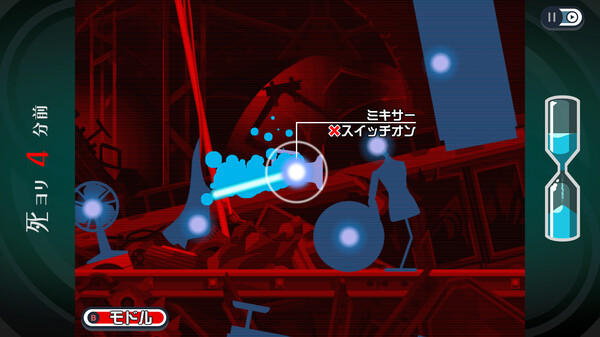 The red ghost-side view with a vertical countdown label at the left edge, an hourglass gauge at the right, a red rewind button at the lower left, and several blue points of light with object labels — Steam store screenshot
Reviews Consulted
This piece was written from the Steam user reviews as they stood on 2026-08-05.
・Steam: Ghost Trick: Phantom Detective (7,882 positive against 193 negative out of 8,075 across all languages, 97% positive, Overwhelmingly Positive; English 2,018 at 97%; last 30 days 72 at 97%, Very Positive)
・Read in full: the top 10 English positive reviews by all-time helpfulness, the top 10 negative by the same sort, and the 10 most recent. Thirty in total.
・Steam Community: review listing (helpful / recent / positive / negative sorts)
・PC Gamer: Ghost Trick: Phantom Detective review and Metacritic (PC metascore 90), used to compare the critical axis against the user axis.
・Release date, developer credit, tags, price and DRM disclosure were checked against the store page itself. All images are official screenshots from that same store listing (appid 1967430).
Closing
Steam reads 97% positive; from a design standpoint I put it at 8.5. Two reasons for the gap. First, nearly all of the 193 negatives inside that denominator are not judgements about design at all. Second, the load that does exist concentrates in the retry cost described above, and the remaster did not lift it. The subtraction of verbs and the four-minute cut are still sharp — the 2010 design has not aged — while the 2023 work around it is thin.
Who it suits falls out of the pool's own phrasing: people who enjoy reading as reading, people who value the moment setup folds shut, and people who want the pleasure of observing and chaining rather than an assortment of strict logic. Buy it for hard puzzle resistance and it will feel thin; the negative review noting it is not for hardcore mystery and puzzle solvers is an accurate statement of range. That is design reach, not a defect.
Completion times cited in reviews run from a little over eight hours to around eighteen, clustering near ten to thirteen. The critical metascore of 90 points roughly the same way as the users' 97%, but the centre of gravity differs: critics score the presentation and the script, while users file the roughness of the port as a separate, angrier line item. Reviews also report that Denuvo was later removed, and that protest over the DRM that replaced it became the main body of subsequent negatives. Opinion on the game itself has barely moved in six years.
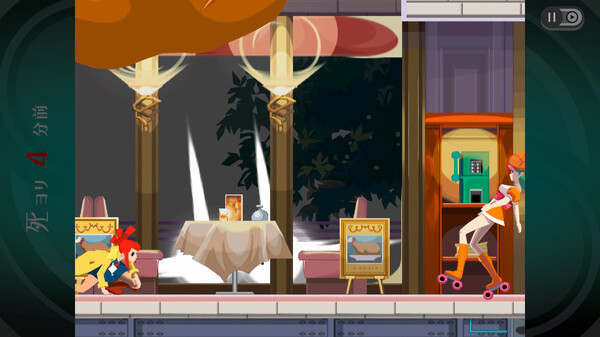 A wide colour scene: an orange awning and pillars, a cloth-covered table, and an orange-haired character inside the building on the right — Steam store screenshot
Where are you with this game?
Press one and the game goes on your shelf. You can see it on your account page.
Reactions (no login)
Anonymous • one of each per visitor per day
Read next

Related reviews
Phoenix Wright: Ace Attorney Trilogy
A courtroom adventure in which you play defense attorney Phoenix Wright, matching one line of testimony against one piece of evidence to break a lie. Capcom's collection gathers all fourteen episodes of the three games first released between 2001 and 2004, with the art redrawn frame by frame.
Underground Blossom
A point-and-click escape puzzle that rides down seven metro stations through the life of a woman named Laura. You buy a ticket, search each room, and reassemble the pieces of her memory. A 2023 release from Rusty Lake, the studio behind the Cube Escape series.
Firmament
A first-person puzzle-adventure from Cyan Worlds, the studio behind Myst and Riven. You plug a wrist-mounted tool, the Adjunct, into sockets to work cranes and generators as you cross three abandoned steampunk realms — a meditative world with no ciphers and no notes to take.


