REVIEW · 2013-04-15
La-Mulana
The clues are there. Only the index is missing
First Impressions
I wrote this from the Steam review pool for La-Mulana. As of 2026-08-09, with the filter set to All, there are 2,625 reviews and 2,090 of them positive — about 80%. Restricted to English it is 1,470 reviews at 81% positive, labelled Very Positive; across all languages from Steam purchasers, 2,061 reviews, it slips to Mostly Positive. The last thirty days: 15 reviews, 86% positive.
The words the helpful positives reach for are strange as praise: cryptic, obtuse, unfair, 'it consumed me,' and 'take notes.' One recommendation opens by saying you probably will not have fun, then explains why the reviewer could not stop. Another sums the game up as a monumental refusal of modern design philosophy. The reasons for recommending are made of the words that usually mean a defect.
The negative side uses almost the same vocabulary. Unfair, tedious, hints scattered too far, moon logic, old Sierra adventure logic. Only the last sentence differs. From the identical observation — the clues are strewn across the whole ruin — one camp concludes the world feels real, the other concludes the puzzle and its hint no longer form a pair. This piece is about that fork.
 The title menu, TIME ATTACK and all, announcing up front that this ruin expects to be entered more than once — Steam screenshot
The World
Almost every positive review reaches for the texture of the ruin itself. One says no other game has made them feel so much like an explorer descending into something ancient and hostile: everything wants to kill you, the way forward is never marked, and you assemble your next move out of fragmentary, sometimes unreadable remains. That condition is what gets praised.
The Japanese-language reviews point at the same place — the mythology braided into the level layout, and, more practically, the warning that the ruin folds back on itself in non-Euclidean ways and that you had better remember how. Atmosphere and walkthrough note are the same sentence here.
Read as design, the game spends its world entirely as storage for information. Tablet text, room decoration, a villager's aside, a carving in the background: each is both mood and index entry. In Puzzlebyrinth terms this makes raising your observation resolution a survival condition rather than a flourish. Enjoying the place and reading the board are not separable acts.
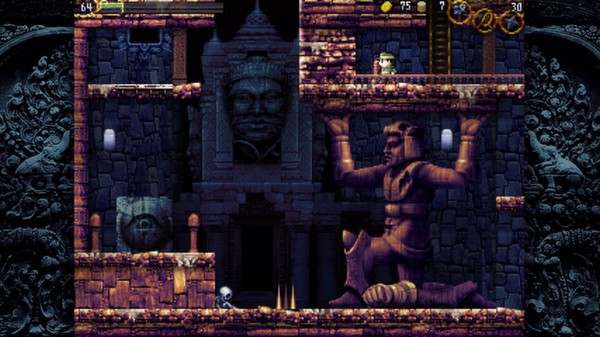 A dim chamber inside the ruin: a giant carved face and a statue with both arms raised — Steam screenshot
Putting the Mechanics into Words
The single most repeated piece of advice in the pool is not about controls or builds. It is 'take notes.' One long recommendation is explicit: transcribe every tablet, photograph the ones with drawings, capture any odd object in a room you cannot use yet and tag where it was, and assume a villager will not repeat himself. Another describes pinning paper transcriptions to a physical wall, arranged by where they were found, and connecting them with string.
So the central verb of this game is not implemented inside the game. It is 'build an index,' and the player supplies it. Because a hint and the thing it applies to are almost never on the same screen, the entire cross-referencing job is externalised. In hint-system terms, the design does not withhold hints — it withholds only the index to them.
That externalisation is the fork itself. The positive camp treats assembling the index as archaeology role-play and loves it. The negative camp treats it as an offloaded search cost. One critical review argues that if you cannot read the link between a clue and its answer, the clue has stopped being a clue. I take that as an accurate critique of hint design rather than a mood.
Then there is combinatorial explosion. With the relevant hint possibly anywhere in the ruin, being stuck expands the search space to every map times every tablet times every item. The Japanese reviews' recurring line — when stuck, sweep every dungeon again — is a measurement of that explosion. What has been subtracted is the number of verbs, not the size of the space.
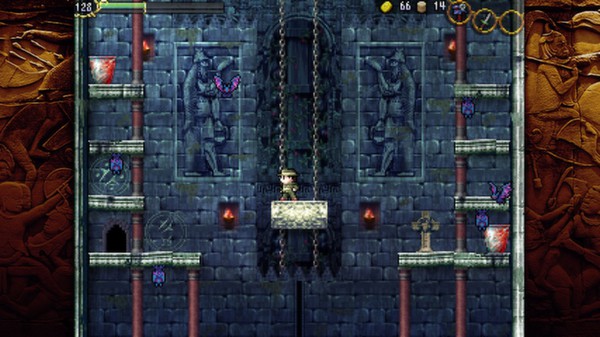 The player standing on a chained platform, human figures carved into the walls on either side — Steam screenshot
The Texture of Difficulty
Reviews of this game, positive and negative alike, have a habit of quoting a number: the completion achievement sits in the low single digits. Japanese reviews from 2014 and from 2022 both reach for it. The accuracy matters less than the impulse — reviewers want to express difficulty as 'almost nobody finished' rather than 'it is hard.'
Read side by side, the difficulty separates into three kinds. First, finding where the puzzle is at all; what needs solving is itself concealed. Second, interpreting the hint, whose wording sits further from the required action than plain association reaches. Third, the cost of getting back: save points are far from boss rooms, and knockback can drop you several screens.
The positives celebrate the first two. The negatives break on the third. One critical review narrows its complaint precisely — the puzzles and systems are interesting, but the walk from save point to boss door takes nearly a minute. Another says this is not high difficulty so much as busywork. In this game, difficulty that deepens the experience and difficulty that merely spends time can be told apart.
So it is more exact to say that tolerance for the three kinds splits inside a single player than to say opinions differ between players. I set the difficulty rating at the top of the scale because all three arrive at once, not because the riddles alone are sharp.
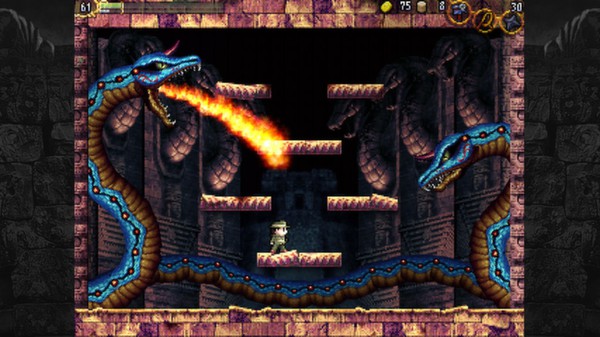 A boss fight against a blue two-headed serpent breathing fire across floating stone blocks — Steam screenshot
Feel of the Controls
On controls, both camps write nearly the same sentences. No air control once you jump. If you slip off a ledge or get knocked back, you cannot act until you land. Enemies sit immediately past a screen transition, so a careless jump drops you into a pit. The description matches; only the verdict at the end points the other way.
One Japanese recommendation reads this not as failure but as deliberate homage to older action games, and admires how far it is carried. A critical review asks whether the clumsiness of that era really needed reproducing too. When the facts agree and only the judgement splits, the argument is about the legitimacy of the intent, not about quality.
As design, the stiffness is load-bearing. Without air control you must choose the landing before you jump, which raises the pressure to read the room. The same stiffness also raises the third kind of difficulty — the cost of getting back. One decision produces the virtue and the defect together, and you cannot remove only one of them.
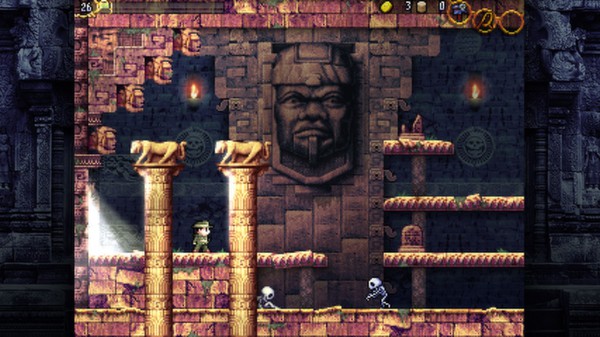 A lit stone chamber with a giant carved face at its centre and two skeleton enemies on the floor — Steam screenshot
Sources
This piece was written by reading the Steam user reviews as of 2026-08-09 — a reading of reviews, not a play diary.
· Steam: La-Mulana (with the filter set to All, 2,090 of 2,625 positive / 81% of 1,470 English reviews, labelled Very Positive / Mostly Positive across 2,061 all-language Steam purchasers / 86% of 15 in the last 30 days)
· Read via WebFetch, roughly 30 reviews in all: top 10 by helpfulness in English, top 10 by helpfulness in Japanese, and the top 10 negative-only, most recent
· For the press, I used the quotations printed on the store page (Destructoid 8/10, Game Informer 8.5/10) and Metacritic's 80
Closing
In closing: La-Mulana is not a game that withholds hints. It is a game that withholds the index to them. Tablets, carvings, a villager's remark — the clues are genuinely placed. What is missing is the line joining each clue to its lock, and drawing that line yourself is where both the pleasure and the pain of this game are concentrated.
Playtimes in the pool range from a few abandoned hours to over three hundred, but among reviewers who finished, the middle sits somewhere around forty to fifty. My score does not stray far from Steam's ~80%: on design grounds, 8.2. The deduction is not about the quality of the riddles but about the third kind of difficulty — the cost of getting back — eating into the time you spend building the index. If indexing is the substance, friction that shortens it is not on the theme's side.
For: those who love doors that open with knowledge, as in Void Stranger or TUNIC, and who do not mind graph paper and sticky notes. Not for: those who want a self-contained snap of solution in a short sitting. One review says the game never assumed you would play it, enjoy it, or finish it. I read that as a statement of design reach, not a confession of failure.
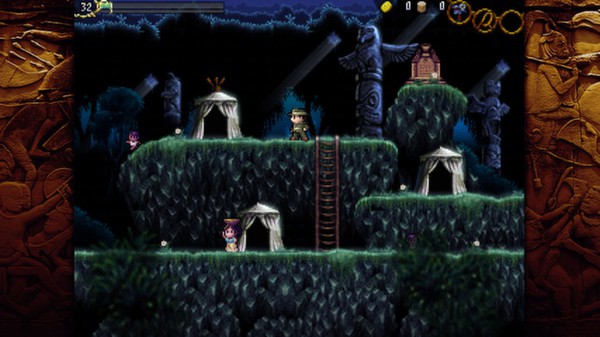 The surface village outside the ruin: white tents on grassy terraces with two figures standing — Steam screenshot
Where are you with this game?
Press one and the game goes on your shelf. You can see it on your account page.
Reactions (no login)
Anonymous • one of each per visitor per day
Read next

Related reviews
La-Mulana 2
A 2D exploration-puzzle action game in which Lumisa Kosugi descends into the ancient ruins of Eg-Lana with a whip and a notebook. You copy down the inscriptions on the walls and match them to contraptions several rooms away. NIGORO's sequel to La-Mulana.
Teslagrad
A hand-drawn 2D puzzle-platformer about climbing an abandoned Tesla Tower on magnetic polarity - like poles repel, opposite attract - plus a blink through electric barriers. There is no text or dialogue; the story is told entirely through murals and backgrounds. By Norway's Rain Games.
Toki Tori 2+
A puzzle adventure across an open forest island where your only moves are whistle and stomp. You never unlock new abilities — only knowledge of how each creature behaves — in Two Tribes' 'Metroidbrainia.'


