REVIEW · 2018-07-24
Semblance
Reading the split: a puzzle you solve with your head and fight with your thumbs
Introduction
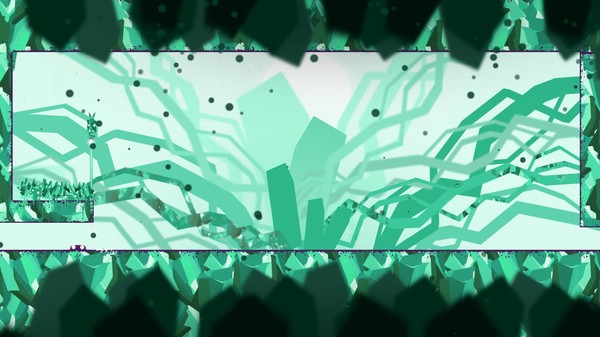
In Semblance you dent and raise the ground itself, molding your own footholds to slip past spikes and lasers and return each essence to the world-trees, healing a soft world overrun by hard crystal. It is the 2018 debut of the South African studio Nyamakop, published by Good Shepherd Entertainment.
I write this not as my own playthrough but as a reading of the Steam review pool. The label is Very Positive — 84% of 316 reviews (2026-07-20 snapshot). Safe on paper, yet the dissenting 16% and the caveats buried inside the praise split cleanly along a single axis.
Name that axis up front: you see the solution in seconds, but performing it takes minutes. Almost every disagreement gathers here — count the difficulty in your head or in your thumbs, and the same game looks like two different ones.
 Semblance — Steam screenshot
First Impressions
Across the helpful positive reviews the words rhyme: innovative, fresh, clever, and 'more brains than agility.' Many prize the novelty of a single deforming trick and its low stakes — die and you respawn at once with your deformations intact — as something you can solve while relaxed.
The negative side, and the caveats inside the praise, keep returning to slippery controls, the lack of key rebinding, and 'I can solve it in my head but my fingers can't keep up.' The game shipped in 2018, yet reviews from 2026 rehearse the same points. Eight years, one unmoved fault line.
What's telling is that both camps point at the same things. The instant respawn and loose handling one player calls 'relaxing,' another calls loose enough that you fight the game instead of the puzzle. My job isn't to inflame that, but to locate where the experience forks, in design terms.
 Semblance — Steam screenshot
Putting the Mechanics into Words
What the positive reviews praise is the smallness of the trick. The core is nearly one action — a 'terra-dash' that dents or raises a platform — plus a reset that undoes your deformations. In Puzzlebyrinth terms, the verb is subtracted down to one: deform. That restraint is what 'innovative' really names.
But one verb doesn't mean deep grammar. Reviewers keep noting that platforms bend only one way and that some terrain can't be morphed; even fans write that it's 'a good base that never does more.' The verb is small, its legal combinations few, so the combinatorial explosion never lights — and solutions read fast.
That's the root of the split. When combinations are shallow, the puzzle shifts from 'what to do' to 'how to do it precisely.' Pure puzzles like Baba Is You or Stephen's Sausage Roll zero out execution cost and put all difficulty in thought. Semblance inverts that: easy to conceive, costly to perform.
 Semblance — Steam screenshot
The World
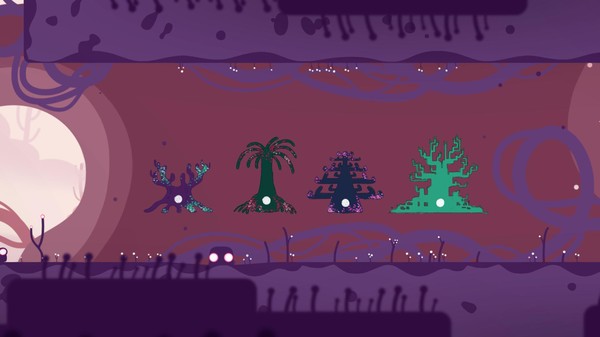
One of the few things reviews agree on, across the divide, is how the world looks and sounds: minimalist, great soundtrack, cute, relaxing. The studio says it laced the score with an 'African aural distinction,' and the soft coral vistas and quiet melodies get praised in nearly the same words by fans and detractors alike.
As criticism, this world has high 'observation resolution.' Soft and round means deformable and safe; hard and angular crystal means death — a visual grammar so consistent that almost no one complains about reading the board. The negative reviews always say 'I can see it but can't perform it,' never 'I can't see it.'
The story is where opinion wobbles. The wordless tale of a crystal infection, told through wall paintings, delights some and reads as 'vague' or 'falls apart up close' to several detractors. Unanimous atmosphere, optional narrative — a choice to keep the story as a scent, and a matter of range rather than a flaw.
 Semblance — Steam screenshot
The Texture of Difficulty
The sharpest friction is over the texture of the difficulty. Sort the reviews and two kinds of stuck emerge. One is pure insight — and that gets called 'fair' and 'just right.' The other is the later 'solve it with reflexes and precision' rooms, where a reset beam or a slingshot deform must land exactly or you restart.
Here the same design is read in opposite directions. One detractor: 'I see the answer in seconds and spend minutes doing it — I bought a puzzle game.' A fan: 'the scramble is part of the fun.' The clincher is the missing key rebinding; several say they wrote a macro or 'play on a controller.' Some of the friction is input mapping, not pure design.
My read: this is a difference of kind, not amount. One detractor lines Semblance up beside brain-only puzzles like Snakebird and Baba and finds it short of them. Fair — but Semblance isn't aiming there. The tactile feel of pushing soft ground is the point; it fuses thought and execution on purpose, and leaves the calm solver outside its range by choice.
 Semblance — Steam screenshot
Sources
This article was written by reading the Steam user reviews as of 2026-07-20. No review text is quoted directly; typical claims are reconstructed.
・Steam: Semblance (Very Positive, 84% of 316; across all 401, 343 positive / 58 negative)
・Read the top ~10 helpful positive reviews, 20+ negative reviews spanning 2018–2026, and several recent ones. The developer replied to some 2018 reviews, promising control rebinding and a fix for getting stuck in walls.
・(Press) Metacritic 79; Rock, Paper, Shotgun, plus Destructoid (9/10) and Eurogamer (Recommended).
Closing
Steam's verdict is 84% positive; my design score is 7.0, and the two don't diverge much. The idea — solving a soft world with a single 'deform' — is lovely, and the learning curve that doles out one new element per world is clean. I dock it for a thin grammar that never reaches combinatorial explosion, and for outsourcing part of its difficulty to imprecise execution.
The near-unanimous advice is 'buy it on sale.' Against a $10 list it lives at $1–2 discounts, and a run is about 4–5 hours. Fair enough. Purists chasing brain-only clarity are outside its range; anyone who wants the tactile feel of reshaping soft ground — ideally on a controller — will be well served.
In the end the game is loved and refused at the same spot: where idea dissolves into execution. Eight years of an unmoving split isn't a mark of failure but proof the maker fixed a stance early. What you bring to it decides its worth — and that 84% is exactly what teaches you so.
 Semblance — Steam screenshot
Where are you with this game?
Press one and the game goes on your shelf. You can see it on your account page.
Reactions (no login)
Anonymous • one of each per visitor per day
Read next
Related reviews
La-Mulana 2
A 2D exploration-puzzle action game in which Lumisa Kosugi descends into the ancient ruins of Eg-Lana with a whip and a notebook. You copy down the inscriptions on the walls and match them to contraptions several rooms away. NIGORO's sequel to La-Mulana.
Hue
A 2D puzzle-platformer where one button swaps the world's background between eight colours, making anything of that colour vanish. Walls, boxes and lasers are all handled through colour as you restore hue to a grey world and search for a missing mother. From Fiddlesticks Games.
The Spectrum Retreat
A first-person puzzler set in the art-deco Penrose Hotel: you pull a colour out of one wall, carry it, and hand it to a matching barrier to open the way. Steam sits at 'Mostly Positive,' 76% of 223 (snapshot 2026-06-16); opinion splits over its double structure of puzzle and story.


