REVIEW · 2015-12-07
SquareCells
Reading the reviews of the Hexcells maker's stripped-down Picross-meets-Minesweeper
Introduction
You fill (keep) a hidden pattern in a grid and break away the rest, guided only by the surrounding clue numbers — Picross crossed with Minesweeper's deduction, shrunk to its essentials. Matthew Brown, the maker of Hexcells, built and released it solo in 2015 (Unity, 36 puzzles).
I write this from the Steam review pool. The label is 'Very Positive,' 90% of 1,223 reviews (snapshot 2026-07-16). Even the small recent sample sits at 84%, so nearly ten years on the verdict has barely moved.
There is almost no standalone press coverage: a $3 micro-puzzle falls outside the big outlets' reach, so the user reviews carry the whole evaluation. That is exactly why I read them as design-critique material.
 SquareCells — Steam store
First Impressions
Line up the helpful positives and the praise converges on one point: 'no guesswork,' 'no circular logic,' 'you can't back yourself into a corner,' and 'fair.' Nothing turns on luck; everything is reachable by pure reasoning — that is the pool's core recommendation.
The other constant is tone: calming, chill soundtrack, minimalist. A Japanese review calls it soothing to paint and shatter squares to gentle music. Stillness and strictness sit side by side.
Yet caveats live inside the praise itself: '36 puzzles is far too few,' 'achievements unlock instantly,' 'no random generation, so little to return to.' The same reviewer admires and wants more — approval and reservation share one voice here.
 SquareCells — Steam store
Putting the Mechanics into Words
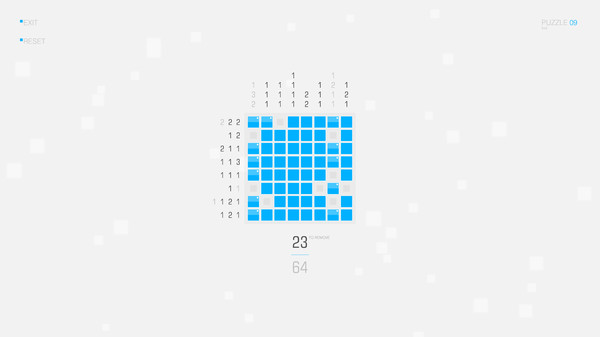
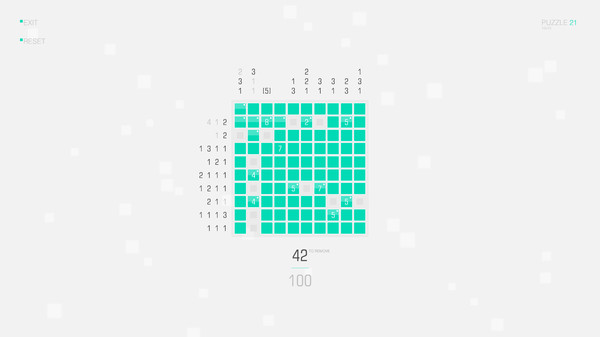
Reviewers love to explain Brown's twist: a number inside a cell counts not nearby mines but how many filled cells connect to it, itself included, horizontally and vertically (diagonal corners don't count). One review nails it: the rule lets him 'present less information while still making fair puzzles.'
In Puzzlebyrinth's terms this is grammar, not verbs. Your verbs are only two — fill or break. The grammar that binds the board is a bundle of small rules: bracketed row and column totals, connection length, and rows with no hint at all. 'You need two or three layers of assumption,' one review says — that is solving the grammar in your head.
Picross veterans report the most friction: 'approach it like Hexcells and you'll be thrown.' Because the finished grid is not a picture, you can't reverse-engineer the answer from an image — observation is redirected onto numbers and connectivity.
 SquareCells — Steam store
Subtraction
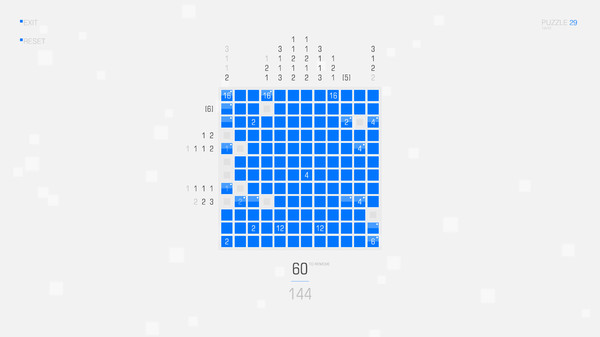
In one line: a puzzle built by subtraction. Information a normal Picross would always give — every row and column hint — is deliberately missing; blank rows appear without apology. You fill the gaps with the connection rule and the remaining-cell counter. The scarcity of hints isn't a flaw; it's the core.
This is where opinion forks. For the positive side the scarcity is 'room to think' and the source of the click. For the reserved side the same scarcity reads as 'under-explained' and '36 puzzles is shallow.' One design choice looks like restraint to one reader and thinness to another.
Subtraction has a side effect too: with no random generation and no forced reset on error, brute force can clear a board, as Japanese reviews note. Brown guarantees a unique, luck-free solution but doesn't police how you reach it — the texture of difficulty is left to your own discipline.
 SquareCells — Steam store
Place in the Lineage
Almost everyone reaches for two rulers: Picross and Hexcells. Brown made the Hexcells trilogy, and this is its square-grid, Picross-leaning sibling — continuous with the same 'no luck, only logic' creed I discussed in Hexcells Infinite.
The same ruler marks the split: many write that the challenge and payoff fall short of Hexcells and that the volume is thin, while others find the reasoning 'genuinely different, and fresher for it.' Seen in lineage, SquareCells isn't a straight sequel but a sideways experiment by the same author.
On pure deduction it shares a shelf with Tametsi and 14 Minesweeper Variants. Where those push with volume and variation, SquareCells competes by stripping away. On this shelf, 36 puzzles is both a weakness and the shape of the thing.
 SquareCells — Steam store
Sources
This piece was written by reading the user reviews on the Steam store page as of 2026-07-16. No review text is quoted directly; typical claims are reconstructed.
- Steam: SquareCells (Very Positive, 90% of 1,223 reviews)
- Read via WebFetch: the top ~10 all-time helpful positives, plus several helpful and recent (2018-2024) Japanese reviews. The reserved/negative axis is reconstructed from caveats inside positive reviews and the ~10% (125) negative share.
- There is essentially no standalone press review; users carry the verdict. Developer, release date and puzzle count were verified against SteamDB.
Closing
Steam reads 90% positive; my design-critique score is 8.0, and the two barely diverge. Credit goes to the luck-free uniqueness of every solution and to the connection rule that makes 'fair on little information' actually work. Marks come off because that precision is poured into a 36-puzzle cup, with presentation and replay pared away too.
The pool's advice reduces to two lines: 'if you like logic puzzles, buy it,' and 'if thinness worries you, wait for a sale.' Calling $3 'too cheap' and urging a discount are two angles on the same small vessel. For anyone who wants only the quiet click of pure deduction, this is a quietly strong recommendation — measured in purity, not quantity.
 SquareCells — Steam store
Reactions (no login)
Anonymous • one of each per visitor per day
Read next
Related reviews
Hexcells Infinite
A Minesweeper-lineage logic puzzle: find the hidden blue cells on a hex grid using only adjacency counts, line hints and consecutive/non-consecutive markers — pure deduction, no guessing. Matthew Brown's third entry layers an endless puzzle generator over 36 hand-made boards.
Keep Talking and Nobody Explodes
One player sits in front of a bomb; everyone else reads the defusal manual. The reader cannot see the bomb and the person seeing it has no manual. You hand conditional instructions across by voice and cut the wire before the clock runs out. A game-jam-born co-op puzzle from Steel Crate Games, with VR support.
Contradiction: Spot the Liar!
A live-action (FMV) murder mystery in which Detective Inspector Frederick Jenks spends one evening - 5pm to midnight - reopening a drowning in the small English village of Edenton. You interview the residents, collect what they say, then pair two statements that clash and confront the liar to unlock the next thread. Designed and scored by Tim Follin for Baggy Cat.


