TAG
#behavioral-economics
0 reviews · 3 essays
Related essays
Hendijani and Steel: Letting people choose moved nothing; a number in the corner of the screen did — Fukai Reads
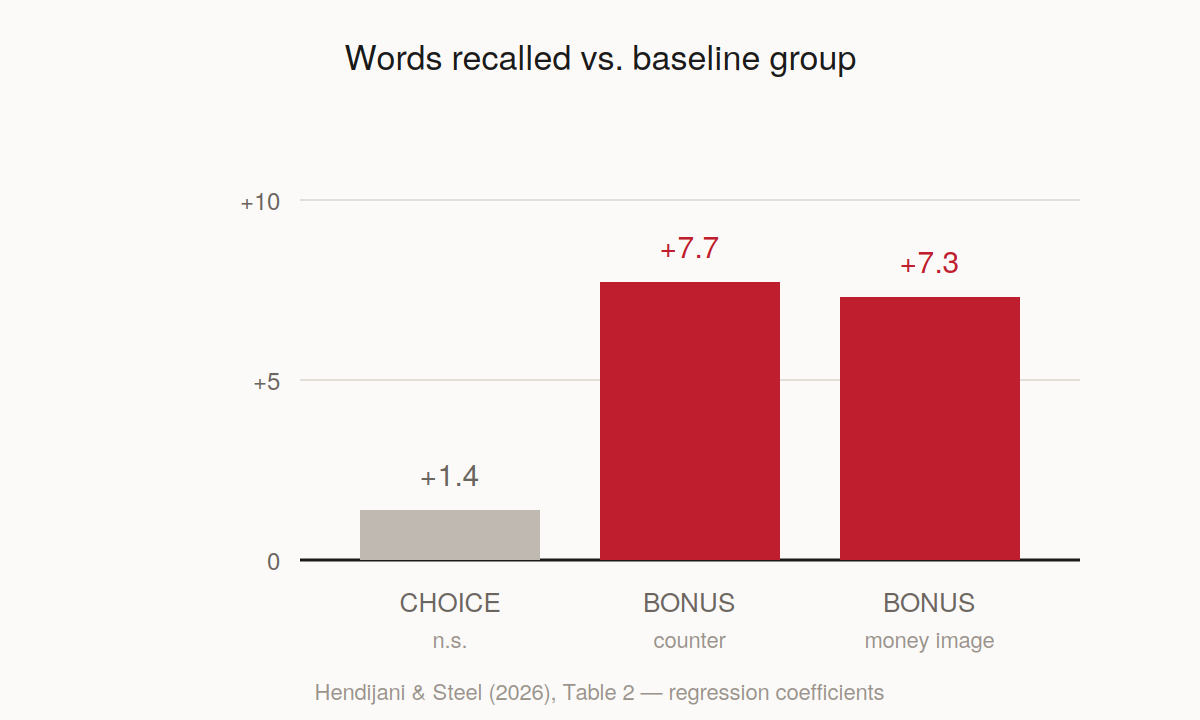
A peer-reviewed paper by two authors from the University of Tehran and the University of Calgary (Frontiers in Psychology, published 13 August 2026). In a memory test with 270 people it compared letting participants choose against paying them per correct answer: the reward added about seven recalled words, while choice produced no statistically confirmed effect. Eye tracking showed the reward's effect ran through whether people looked at the on-screen reward display.
Nagaya et al.: Delete "don't bet" from the menu, and twice as many people take the risk — Fukai Reads
A peer-reviewed, open-access paper by Kazuhisa Nagaya and Fuminori Ono (Yamaguchi University) and Kazuya Nakayachi (Doshisha University), published in Judgment and Decision Making on 13 July 2026. It re-measures small-stakes loss aversion by rewriting the choice as "bet or bet" instead of "bet or don't bet". Across three studies with 1,345 participants, the share of people picking the risky option jumped from 23.3% to 50.0%. Much of what has been called loss aversion may be a separate habit: a preference for not acting.
Ghasemi et al.: People know what a default does — and aim it differently at allies and rivals — Fukai Reads
A peer-reviewed paper by Omid Ghasemi, Ben R. Newell and colleagues (Judgment and Decision Making, 4 September 2026) pushing back on the well-known 2017 finding that people fail to use defaults strategically. Across three card-game experiments, participants set the default in their own favour on more than 80% of trials — the high-value card for teammates, the low-value card for opponents — and, shown only someone else's default choice, worked out which option was better 79.5% of the time.