HISTORY · 2026-06-25
Rubik's Cube (1974) — A Labyrinth of 43 Quintillion States, and a Single Solution
How a Hungarian architect carved out the very skeleton we now call a puzzle's 'state space'
Introduction
This is a work from 1974. At the College of Applied Arts in Budapest, where he taught architecture and design, Ernő Rubik carved a small cube of wood and rubber bands—only a few centimetres on a side—as a teaching aid for conveying how solids move within space. It was the first form of the object the world would later call the Rubik's Cube. At the time it had no real name; Rubik simply called it the 'Magic Cube' (Bűvös kocka).
I want to write about this toy as history because, though it is a single object with no screen and no power, it already possessed in physical form the very concepts a modern puzzle designer chalks onto a board: a vast set of configurations, exactly one solved form among them, and a sequence of moves leading there. Before the Famicom had even appeared, a self-contained 'space to be searched' already sat in the palm of a hand.
Rather than wallow in nostalgia, this piece traces the skeleton this cube laid bare—from its 1974 invention to its 1980 global debut, and on to the 2010 verdict, computed by machine, that 'God's Number is 20.' Before a configuration count of 43 quintillion, how did people play, and how did mathematics answer? I want to reread it as the origin point of a lineage.
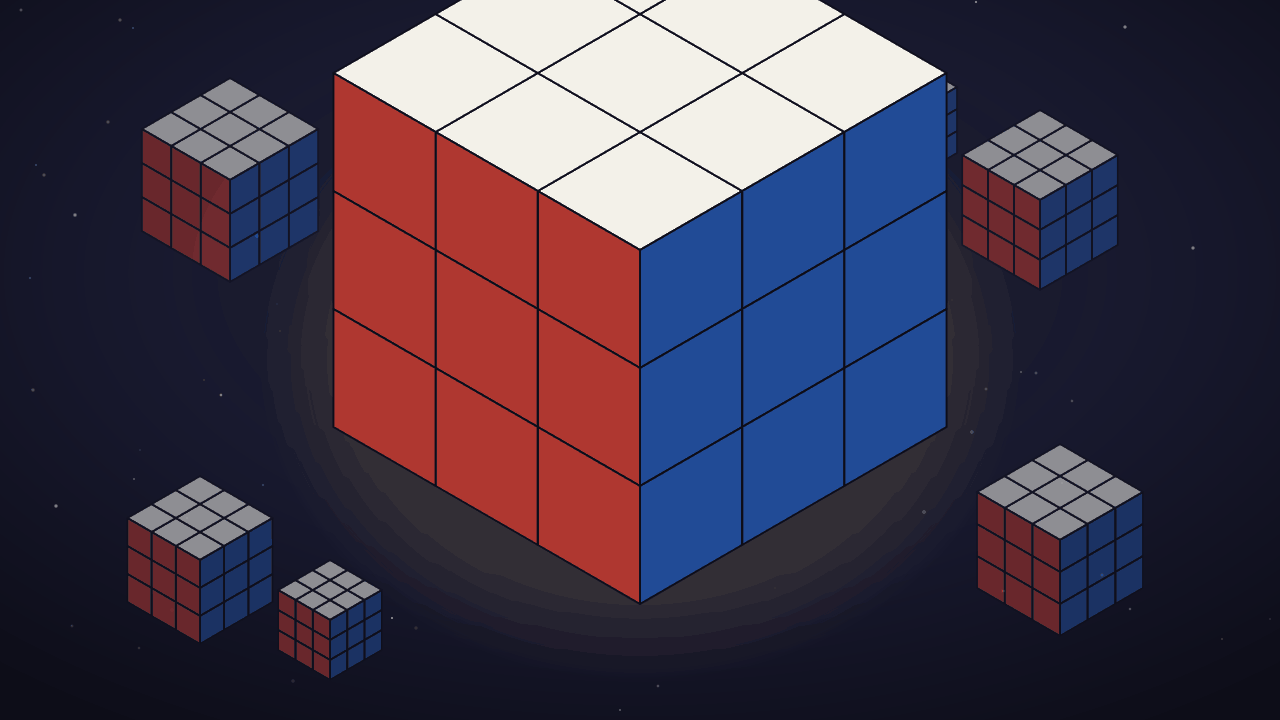
A cube adrift in the dark—a state space held in the hand (illustration, AI-generated)
The Context of Its Era
The prototype was finished in 1974, and Rubik filed for a Hungarian patent the following year, in 1975. Yet it took time for the cube to cross borders. Moving a toy from socialist Hungary into Western markets was no simple matter, and the first modest sales are reported to have taken place in Budapest around 1977. The world would only get its hands on the box, all at once, several years later.
The turning point came in 1979–1980. The businessman Tibor Laczi and Tom Kremer of the toy firm Seven Towns built the bridge to Western distribution, and the American company Ideal Toy Corp acquired the licence. Seeking a name that worked well as a trademark, Ideal renamed it after its inventor: the 'Rubik's Cube.' In early 1980 it made its global debut at the toy fairs of London, Paris, Nuremberg and New York—and the craze that would define the 1980s began.
What I want to stress as context is that this was also a 'victory of distribution.' In the early 1980s, the world for the first time had ample means to share, simultaneously and across borders, a cheap yet intricate mechanism that resisted easy copying. By widely reported figures, cumulative sales reached 350 million units by 2009, and it is often called the best-selling toy in the world. The provenance of such numbers warrants caution, but the sheer order of magnitude testifies that this object was a genuine cultural phenomenon.
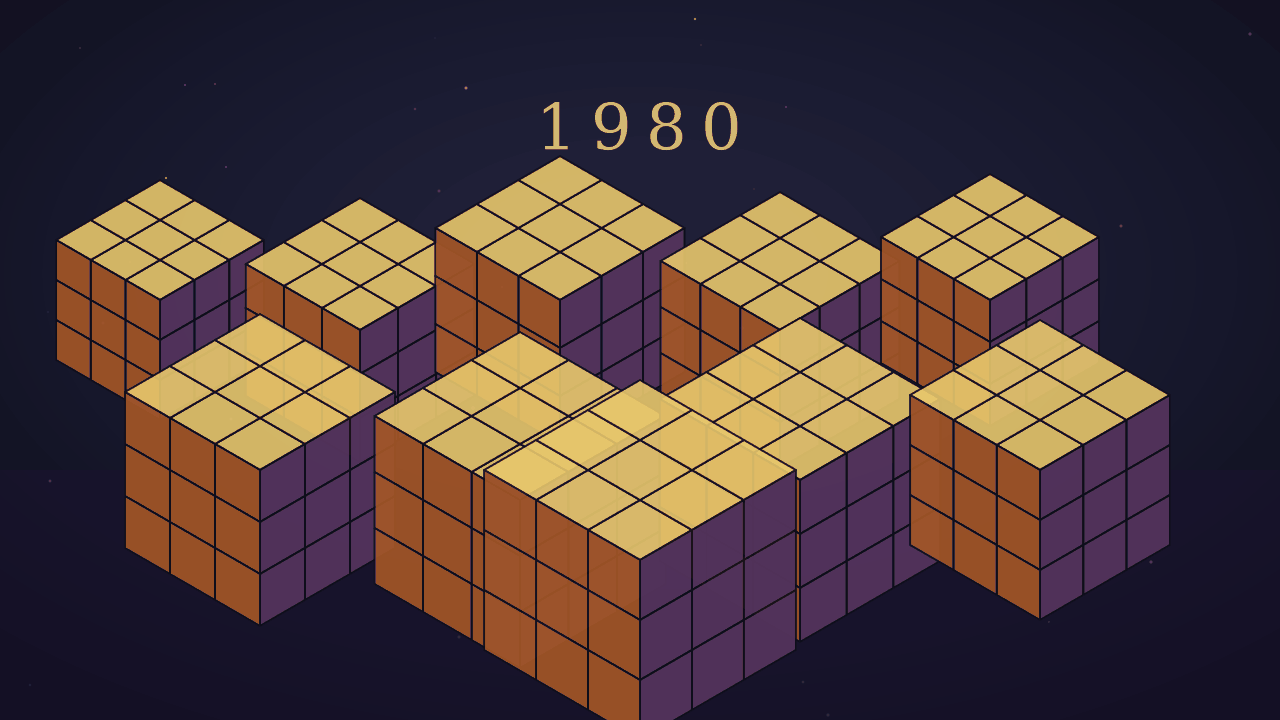
1980: a crowd of cubes the world grasped all at once (illustration, AI-generated)
Mechanics
The mechanism itself was astonishingly complete from the 1974 invention onward. Six face-centre cubes are fixed to a central spindle, and around them each layer rotates independently. All the player does is turn layers—that single verb. Yet the number of combinations far outstrips human intuition. A standard 3×3×3 cube can take 43,252,003,274,489,856,000 configurations: roughly 43 quintillion.
Let me translate that number into the language of design. Each configuration moves to another with a single turn, and every such operation can be undone—it is reversible. The solved form is just one within that vast set. In modern terms, then, the Rubik's Cube implemented, as a physical object, 'a deterministic, reversible state space with a single goal state.' You look at the board and search, through a finite but enormous sea of possibilities, for the path to the answer—precisely the skeleton that later logic puzzles would replay on paper and on screen.
What is striking is that despite a scale of 43 quintillion, the shortest solving distance from any configuration is surprisingly short. The long-open question—'however thoroughly you scramble it, how many moves always suffice?', known as 'God's Number'—was settled in July 2010. Tomas Rokicki, Herbert Kociemba, Morley Davidson and John Dethridge analysed every configuration using Google's computing resources (work equivalent to about 35 CPU-years) and proved the answer to be 20. The labyrinth of 43 quintillion states reaches its exit in at most 20 moves.
That very 'shortness' is the design beauty I feel in this toy. The space is astronomically wide, yet the distance to a solution is startlingly near; difficulty and reachability coexist. At the first World Championship, held in Budapest on 5 June 1982, a student from Los Angeles named Minh Thai won with a time of 22.95 seconds—proof that a human can sprint that short distance at the speed of the body.
Configurations shifting with a single turn, against a sprawling state space (illustration, AI-generated)
Lineage to the Present
What this 1974 cube left to the present I read on two layers. One is the visible lineage. The culture of speedcubing, with the 1982 World Championship as a distant origin, was institutionalised into an international sport under the World Cube Association, founded in 2004. A physical toy became a competitive object, measured and recorded. And today, across platforms including Steam, there are countless twisty-puzzle simulators, timers and analysis tools. The play born of an object keeps expanding on the digital plane.
The other layer is more abstract, and the one I most want to stress as a historian. Modern puzzle designers speak of their work in terms of 'state space,' 'reversibility,' and 'a guaranteed unique solution.' The lineage of logic puzzles from Sokoban to Baba Is You is, at bottom, a set of variations on one structure: 'within a finite but enormous set of configurations, reach the single solved form by stacking reversible operations.' The Rubik's Cube embodied that structure in 1974—as an object, with no circuitry and no code. I will not phrase this as a causal 'it influenced them'; not writing causes that the record does not attest is the rule of this piece. But as an archetype of the structure, there is no purer specimen.
One more thing not to overlook is the shift in perspective that 'God's Number is 20' symbolises. In 2010, humanity exhaustively computed every state of a single toy. This is the stance of reconceiving a puzzle from something to be 'solved' into something to be 'measured as a space'—an early and remarkably concrete instance of the idea, presupposed by today's procedural generation and difficulty design, of 'computing the solution space.' The year 2010, when 43 quintillion was finally counted out, was also the year a retro object reached toward our modern, computational view of puzzles.
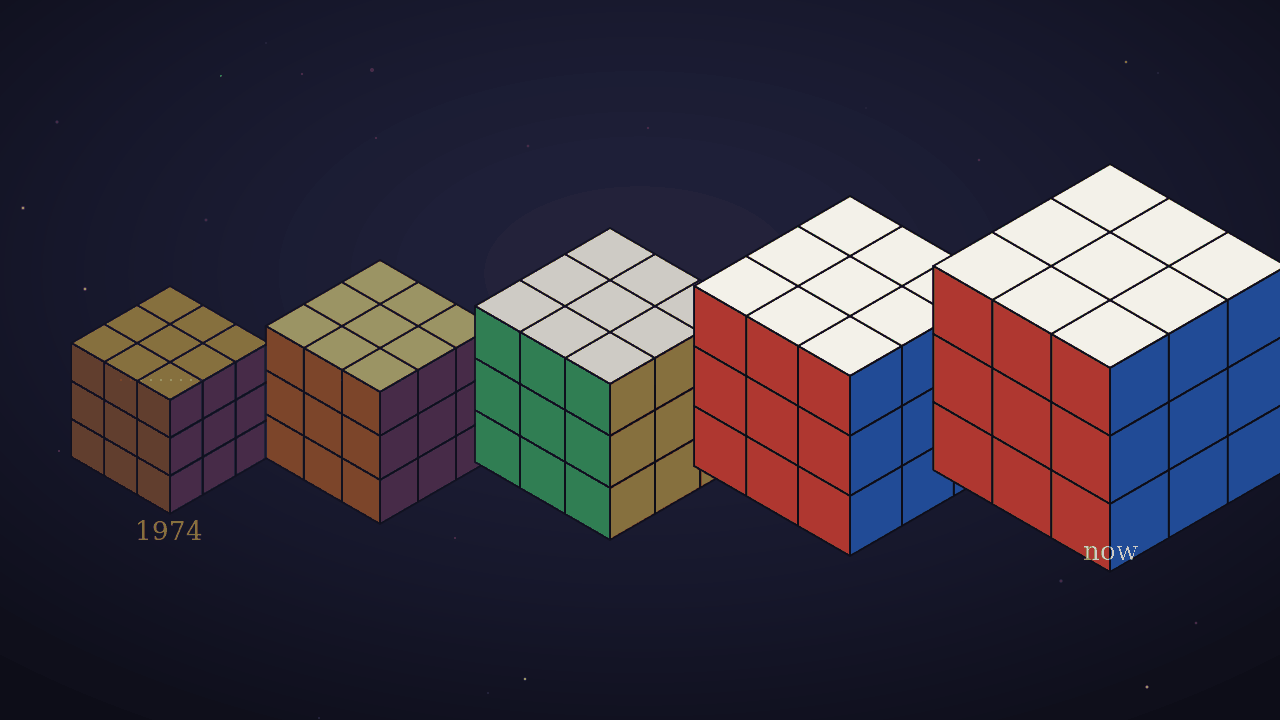
From 1974 to now—a chain built on the skeleton of state space (illustration, AI-generated)
References
Sources referenced in this article:
・The Official Rubik's — History
・God's Number is 20 (cube20.org, Rokicki et al., 2010)
Closing
The wooden cube carved in a Budapest room in 1974 had no display, and at first not even instructions. And yet this object let a hand hold, all at once, a vast field of possibility, exactly one correct answer, and the short road that leads there. In it I see the oldest and purest specimen of what the thinking-puzzle genre has placed at the core of its play.
The moment it is solved, the six faces settle each into a single colour. The labyrinth of 43 quintillion, once it reaches the exit, becomes merely a tidy cube again. But anyone who has once touched this object knows the size of the space that spreads behind that stillness. What the 1974 invention passed on to the present, I think, was exactly this stillness after solving—and the sense of depth behind it.
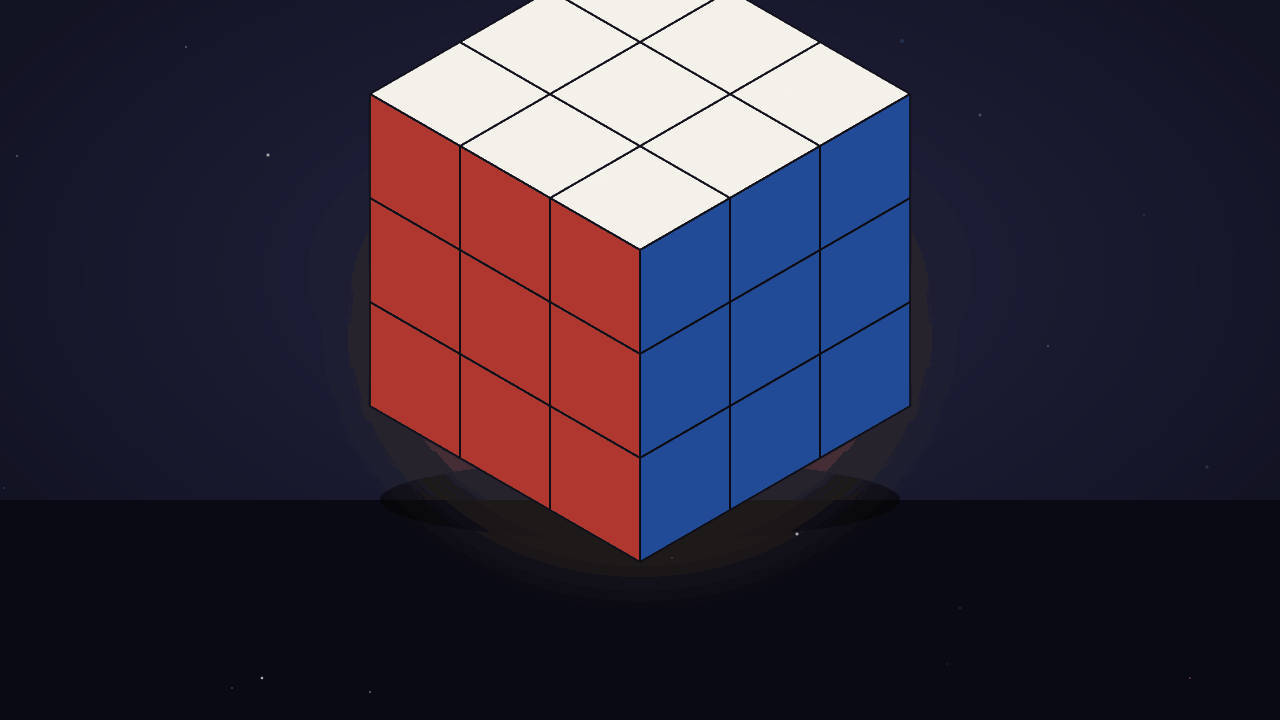
Six settled faces, and the space that had spread behind them (illustration, AI-generated)
Reactions (no login)
Anonymous • one of each per visitor per day