HISTORY · 2026-08-05
Nurikabe (1991) — A Ban on Two-by-Two, Borrowed from a Yōkai's Name
Puzzle Communication Nikoli #33, and renin's rules for "islands" and "sea"
Introduction
Let me tell the story of Nurikabe. It first appeared in 1991, in the "How an Omopa Puzzle Gets Made" column of Puzzle Communication Nikoli issue #33 (spring 1991), submitted under the pen name "renin." It began as a modest grid: some cells hold numbers, the rest are undetermined black or white. White cells form clusters called "islands," each sized to match its number. Black cells form a single connected "sea" that must never form a two-by-two block. Just four rules — and thirty-five years later, they still haven't grown stale.
The name Nurikabe borrows from a yōkai — an invisible wall that blocks travelers on dark roads — and Nikoli even ran an original mascot based on the spirit in its pages. Overseas, the name Nurikabe stuck as-is, though it has also gone by Cell Structure and Islands in the Stream. When it was first set at the World Puzzle Championship, in its 7th edition, it appeared under yet another title: Lay Bricks. One puzzle, several names, each time it crossed a border.
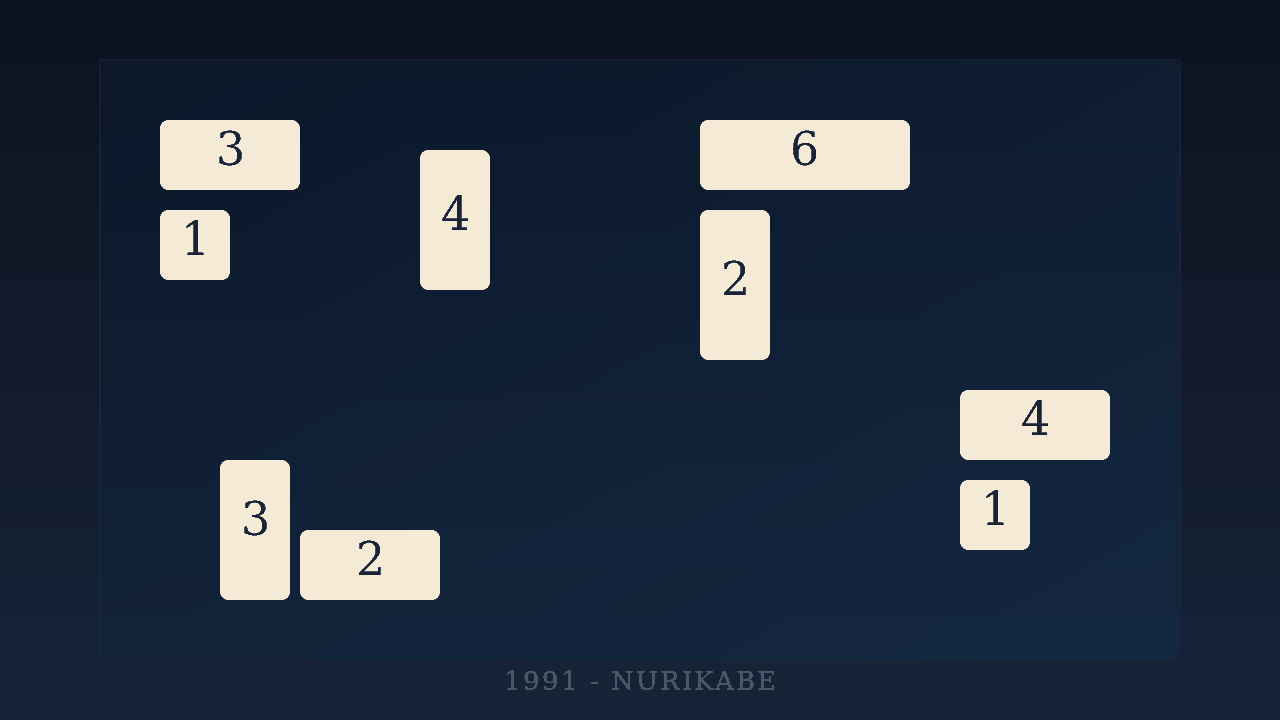 Islands defined by numbers, and a single connected sea (illustration, AI-generated)
The Context of Its Time
Place 1991 in Nikoli's own timeline. Number Place, the format that would later become Sudoku, had already been running for roughly a decade, and Slitherlink had debuted two years earlier, in 1989. The magazine was quarterly, and it ran a column — "How an Omopa Puzzle Gets Made" — where editors developed puzzles submitted by readers. Nurikabe grew out of that column. According to Japanese Wikipedia, renin's idea was to take an earlier format called "Area Block," which simply partitioned a grid by number, and add the twist of painting cells black.
Yet Japanese Wikipedia also notes that, at launch, the editors didn't expect it to catch on — four rules seemed too fussy next to the magazine's other pencil puzzles. Even so, by issue #38 it had earned its own regular section. Nikoli has since published multiple books devoted entirely to Nurikabe, including its compilation Omopa Puzzle Complete Works. A ruleset that looked complicated on paper turned out to become second nature once a solver got used to it — the editors' initial doubt didn't hold.
 A puzzle born from a quarterly magazine's reader column (illustration, AI-generated)
Mechanics
Four rules govern the grid. A numbered cell is never black. Each number denotes the size of the white "island" containing it, and each island holds exactly one number. All black cells together form a single connected "sea." And the sea may never contain a two-by-two black square. When two numbers touch diagonally, the cell between them is forced black; a lone "1" is already a complete island, so its four neighbors can be blacked out immediately. The puzzle is built to be solved through a chain of such deductions, never guesswork.
In 2004, this same four-rule grid became a subject of computational complexity research. Brandon McPhail and James Fix presented that Nurikabe is NP-complete, and Markus Holzer, Andreas Klein, and Martin Kutrib published a paper proving the same, showing the hardness survives even when only 1s and 2s appear on the board. A puzzle designed so a human can reach a unique answer through pure logic turns out to belong, on the theory side, to one of the hardest complexity classes known. That gap, to me, is exactly what makes pencil puzzles worth studying.
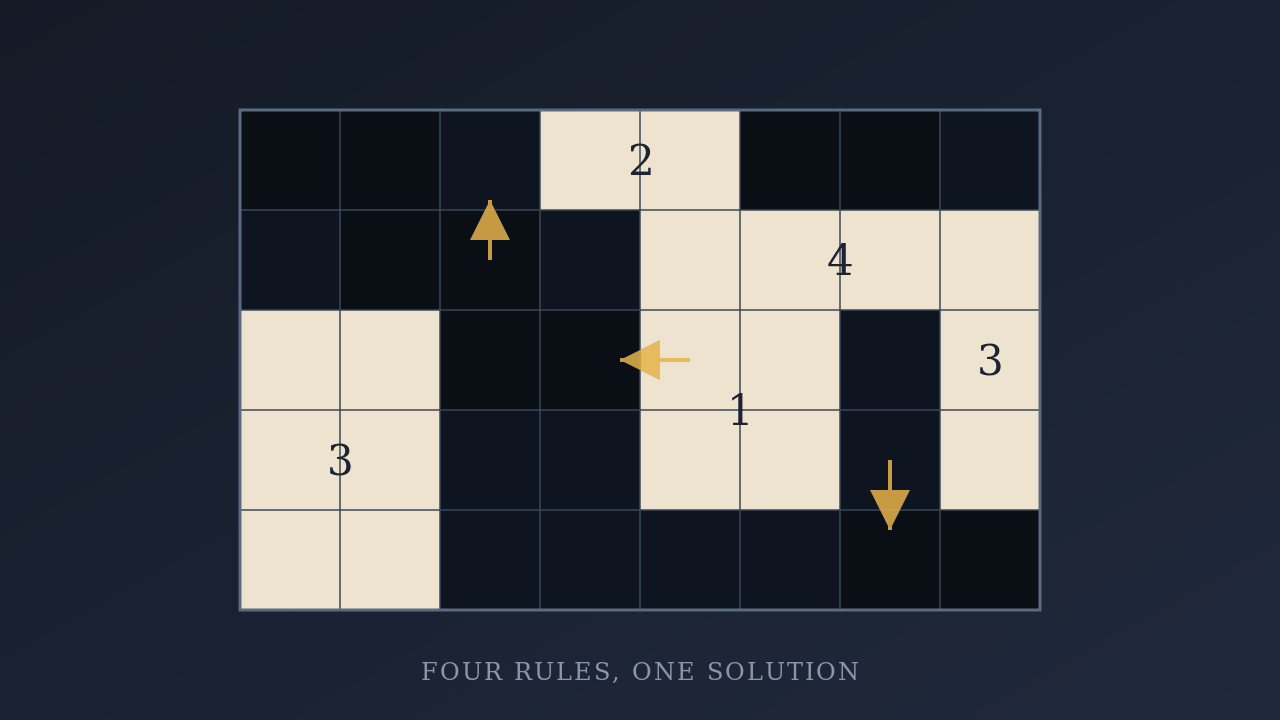 A grid where four rules push back against each other (illustration, AI-generated)
A Lineage into the Present
Nurikabe's "no two-by-two black" rule outlived the puzzle itself. In 2004, Nikoli issue #106 introduced Nuruomino — now known internationally as LITS — where a pre-printed polyomino must be painted down to a single tetromino such that the painted cells across the whole grid form a valid Nurikabe. English Wikipedia states plainly that this constraint was carried over directly from Nurikabe. As of 2024, Japanese Wikipedia notes, LITS is the only puzzle that has promoted this borrowed rule to a genuine mainstay. A lineage can survive at the level of a single constraint.
On the digital side, 2025 brought Nurikabe World (developer: Hemisquare) to Steam, keeping the original name intact. It recasts the grid as terrain turning into water, with trees and buildings sprouting once an island is sealed off correctly. Kotaku's John Walker called it a rare case of "a logic puzzle game designed and presented this well," and Buried Treasure noted its 150 hand-built levels and its appearance on the Cracking the Cryptic channel. Four rules set down on paper in 1991 are still, thirty-four years on, the literal foundation of a game — right down to the name.
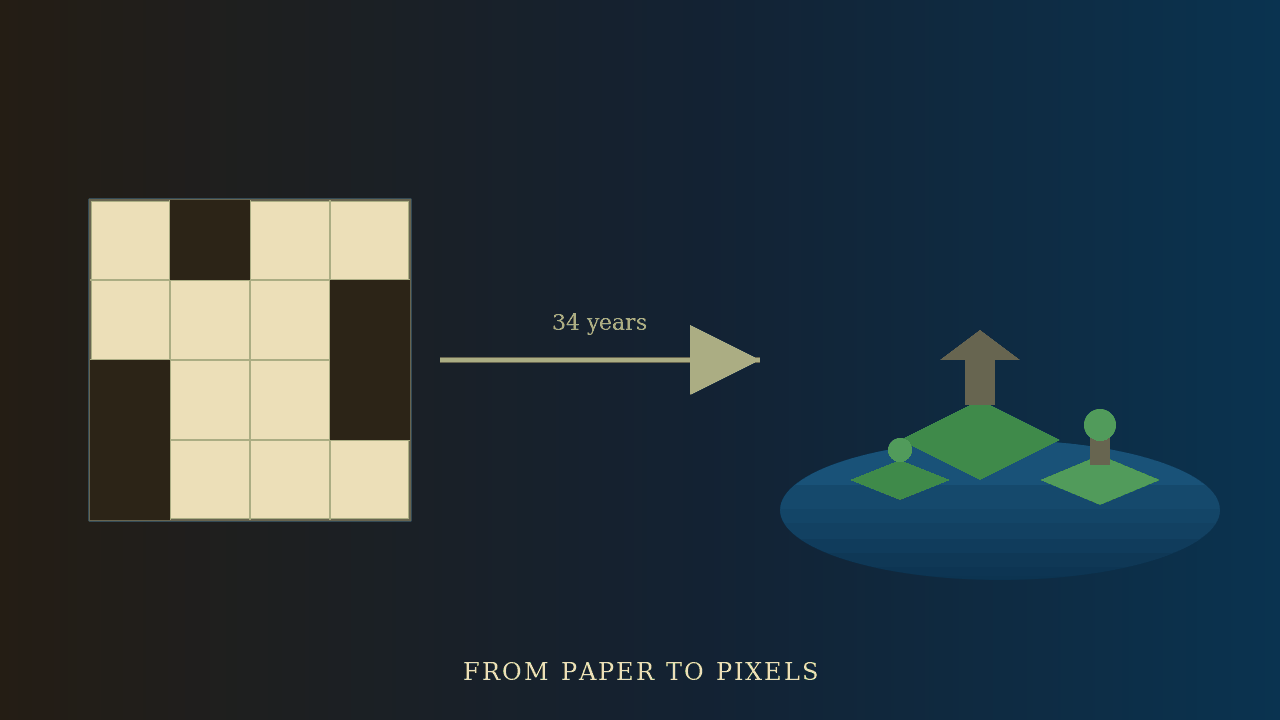 A lineage from paper grid to modern digital game (illustration, AI-generated)
Sources
Sources consulted for this article:
・Wikipedia (Japanese): Nurikabe (puzzle)
・Kotaku: I Cannot Stop Playing This Extraordinary Puzzle Game
Closing
What Nurikabe teaches is that the rules that look most complicated are often the ones worth the patience to refine. A puzzle the editors doubted would catch on earned its own section by issue #38, became a subject of complexity theory by 2004, and reclaimed its own name on a Western storefront in 2025. Thirty-four years should be more than enough for a single constraint to feel dated — yet the ban on two-by-two black squares still trips up solvers today.
As a historian, what I can say is that Nurikabe is a rare case of success built on a single invented rule. Borrowing a folklore name, starting life in one column of a reader-submission magazine — those were accidents of its era. But the core idea, that a unique solution can emerge purely from the tension between black and white cells, has found no replacement in thirty-five years. That, I think, is why this grid is still active duty.
 A filled sea and a remaining island (illustration, AI-generated)
Reactions (no login)
Anonymous • one of each per visitor per day
Learn — Curriculum
LearnTeil 2 Lineage — Where Puzzles Came FromKapitel 4 Pencil Puzzles and Nikoli8 / 12
関連シリーズ
Puzzle Incident History第21回 / 全41回