RETRO-REVIEW · 2026-08-28
Puzzle Bobble (1994) — The Side Project Whose Grammar Is Still Live on Steam, 32 Years Later
The rule "link three of the same color" is still being sold new, today, in 2026
Introduction
This is the story of June 1994. Taito quietly shipped a small arcade game built on characters from an eight-year-old hit, Bubble Bobble. Its name was Puzzle Bobble. Inside the company, it was treated less like a real sequel and more like a side project — a bit of fun on the side.
That low expectation was quickly overturned. Within months of its debut, revenue kept climbing, and by the following year it had won an award at the Gamest awards. And in April 2026, the newest entry in this same series, Puzzle Bobble Everybubble!, arrived on Steam. A rule born in 1994 is still being sold, live, 32 years later.
What I want to dig up today is the reason for that longevity. Why did a throwaway spin-off of Bubble Bobble become the start of a lineage that outlived the original? The answer, I think, has less to do with a bold idea than with an obsession over details.
The Context of Its Time
The story starts on June 16, 1986. Taito's arcade release Bubble Bobble had players control the bubble dragons Bub and Bob, blowing bubbles to trap enemies and popping them for the kill. Eight years later, in 1994, those characters were still loved inside the company.
Puzzle Bobble's design was credited to Seiichi Nakakuki. In a 1998 interview, he said the idea started from "an image of marbles and billiards." Rather than following the usual process of locking a spec document first, he and a programmer shaped the game through casual back-and-forth. Its working title was "Billiards" — at first a plain shooting game with no particular rule, to which the same-color-clearing mechanic was added bit by bit.
Development took just a month and a half. Nakakuki himself recalled that "the hardest part was the schedule." It first ran on Taito's proprietary B System board in June 1994, and a Neo-Geo MVS version — Taito's very first MVS title — followed six months later, on December 21. Early location tests underperformed, but revenue climbed as the game kept running; by the 1995 Gamest awards it placed fifth for Best Action and won a special editors' award.
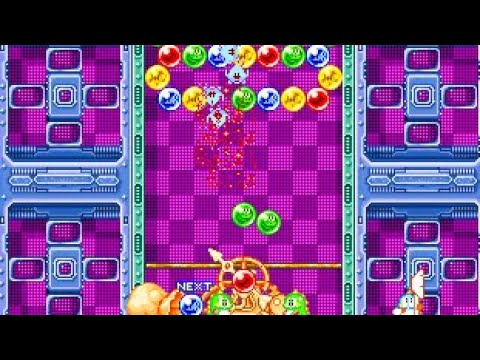 Footage of the 1994 arcade original on real hardware (The Best Retro Games Channel, YouTube)
Mechanics
The rules are simple. Swing the launcher at the bottom of the screen, aim, and shoot a colored bubble upward. It sticks to the ceiling or to bubbles already in place, and the instant three or more of the same color form a cluster, they pop. Shots bounce off the side walls, so a curved shot can reach corners a straight line never could.
The ceiling itself creeps downward over time. Take too long lining up a shot and, within tens of seconds, it presses closer, pushing the board toward a dead end. Where Bubble Bobble asked for whole-body control — run, jump, trap with a bubble — Puzzle Bobble distills all of that down to a single verb: aim and shoot.
The detail Nakakuki himself credited for the game's success was what made that simplicity work: "that a fired bubble settles neatly along an invisible grid, and that the next bubble in the launcher is chosen based on the state of the board." The satisfaction of a clean shot, and the absence of unfair surprises, both come from tuning that never shows up in a design document.
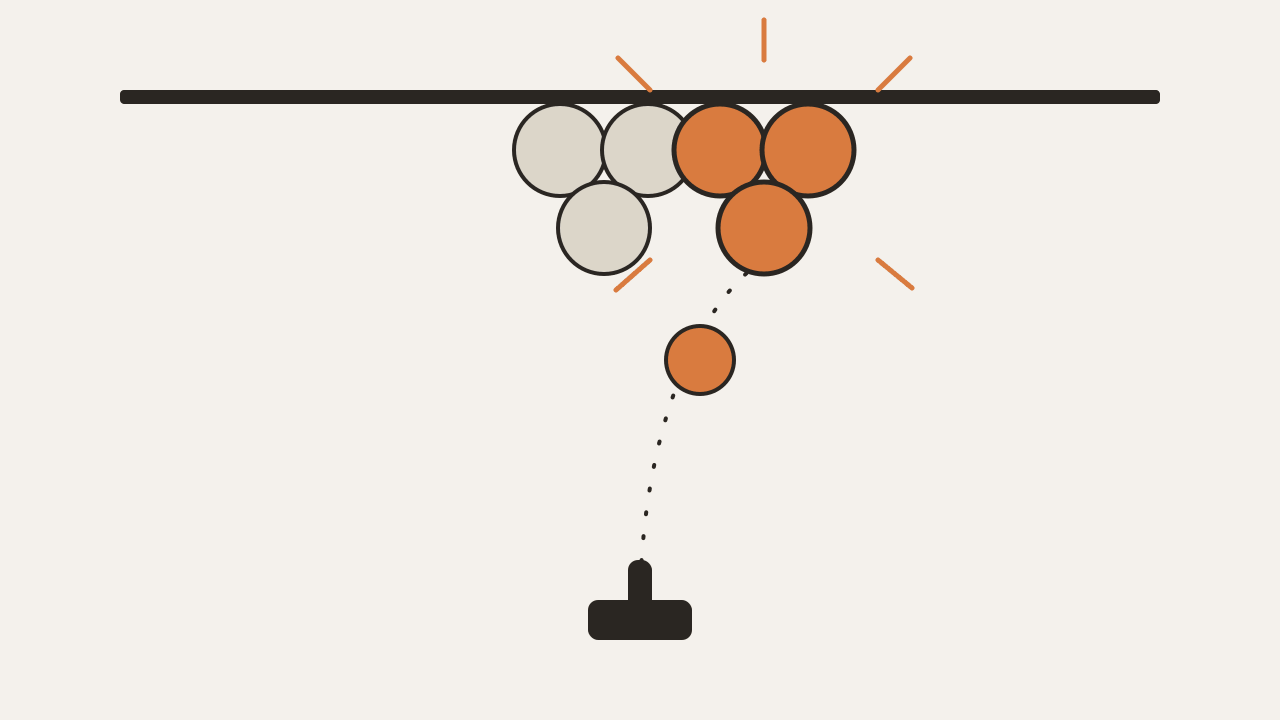 The whole structure in one idea: a shot that hits a cluster of three same-colored bubbles pops it (illustration, AI-generated)
The Lineage to Today
That "three or more of the same color" grammar traveled overseas under the name Bust-A-Move. Ports and sequels followed without a real break — Super Famicom, Neo-Geo, 3DO, WonderSwan, Game Gear, Windows 95, feature-phone apps, and modern consoles. Wikipedia notes that the simplicity of this rule went on to shape later color-matching puzzles such as Snood, Worms Blast, and Bubble Witch Saga.
The lineage isn't only a matter of history. The series returned on May 23, 2023 as Puzzle Bobble Everybubble! for Nintendo Switch, and in April 2026 a PC release arrived on Steam, credited to Taito and Arc System Works together. A rule assembled in a month and a half back in 1994 is, 32 years on, sitting on Steam's shelves right now.
Working from the same "clear by color" family, 1991's Puyo Puyo chose the verb of stacking falling pieces into chains, while Puzzle Bobble chose the verb of aiming and firing. Both set out from Japan in the same era, and each grew a different line of descendants. This site groups the aim-and-fire branch under the mechanic tag Match Action.
Sources
Sources consulted for this article:
・Japanese Wikipedia: Puzzle Bobble
・Arcade History: Puzzle Bobble (1994)
・Shmuplations: Puzzle Game Creators — 1998 developer interview
Closing
Puzzle Bobble was, at first, seen as little more than a Bubble Bobble side-project. Looking back, that judgment was wrong. What survived in history wasn't ambition, but details the player never consciously notices — snapping to an invisible grid, a launcher that picks its next bubble fairly.
As a historian, this is exactly the kind of small work I want to look at closely. Buried under an unglamorous pitch, a pile of quiet tuning can sometimes build a grammar that outlasts thirty years. Puzzle Bobble is one clear example of that.
The side project from 1994 still isn't over.
Reactions (no login)
Anonymous • one of each per visitor per day
関連シリーズ
Retro Revisited第36回 / 全45回