RETRO-REVIEW · 2026-09-02
Puzznic (1989) — The Credits Screen That Never Existed, and the Five Names Found in the ROM Decades Later
Taito's third block-matching puzzle of the same year, polished past Flipull and Plotting, and the ports that carried it everywhere
Introduction
Puzznic is a logic puzzle game Taito put into arcades in October 1989. Select a block with the cursor, slide it sideways as far as you like, and bring two or more of the same pattern into contact to clear them. No blocks fall at random; every board is designed in advance.
That same year, Taito released three puzzle games back to back using only its own pieces: Flipull, Plotting, and Puzznic. Plain as it looked, this third one ended up with the widest spread of home ports.
This piece isn't nostalgia for its own sake. I want to dig it up as the work of developers whose names went unrecorded — names that would surface from inside the arcade board's ROM more than three decades later.
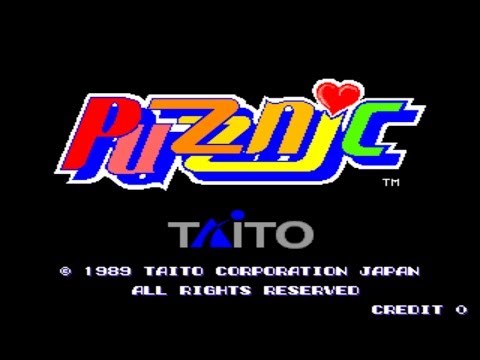 Thumbnail from "Puzznic 1989 Taito Mame Retro Arcade Games" (MamePlayer, YouTube)
The Time It Came From
No contemporary record officially names Puzznic's developers. What's known is only that Taito developed it and put it into arcades in October 1989, running on Taito's own "L System" board.
Ports spread quickly from the following year. Taito America released an NES version in North America in 1990, and the Japanese Famicom version followed on July 19, 1991, published by I.G.S. Game Boy, PC Engine, and Sharp X68000 versions arrived in 1990-91 as well, and Ocean Software handled the European home-computer ports (Amiga, Atari ST, Amstrad CPC, Commodore 64, MS-DOS, ZX Spectrum). An Apple IIGS version was even finished in 1990 but never released, staying dormant until it leaked years later.
The trade paper Game Machine's December 1, 1989 issue listed Puzznic as the fourth most successful table arcade unit in Japan that month. Amiga Power's May 1991 issue named it the 34th best game of all time. Plain as it looked, it wasn't rated lightly.
 Thumbnail from "NES Longplay [623] Puzznic" (WorldofLongplays, YouTube)
Mechanics
The controls are simple. Slide the block under the cursor sideways as far as you want. Two or more blocks of the same kind touching each other vanish, and clearing every block on screen wins the stage.
Walls and moving platforms raise the difficulty. Obstacles block a piece's path and limit which combinations can be cleared. On top of that, when an odd number of a given block type remains on the board, clearing them two at a time will always leave one behind — the stage is only solvable if you find a way to bring three of them into contact at once.
The NES version added an exclusive "Gravnic" mode. Going by the name alone, it likely involved some variant rule tied to gravity, but no primary source spells out exactly how it worked. Adding one console-exclusive mode per port without touching the core rules was also a common porting habit of the era.
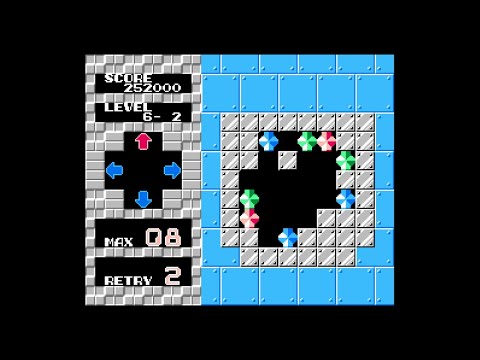 Thumbnail from "Puzznic - Gravnic mode (NES, 1990) (Longplay)" (MS-DOS Friends, YouTube)
A Lineage Into the Present
Puzznic wasn't an isolated release. It shares screen layout and feel with Flipull and Plotting, two other Taito games from the same year, and the English Wikipedia article notes the resemblance among all three. Within a single company, the matching-and-clearing puzzle genre was being reworked every few months that year.
Refusing to bring randomness onto the board, and hand-designing every stage instead, is a stance that echoes distantly in later, more demanding logic puzzles. Modern indie puzzle games like Baba Is You and Patrick's Parabox also choose designs that guarantee a solution rather than leaning on luck. That said, no record shows either developer citing Puzznic as a reference. What can honestly be shown here is only a lineage-level observation: the idea of keeping luck off the board keeps recurring, reshaped, across companies and eras.
There's a second kind of excavation here. For a long time, nobody knew the names behind the arcade version of Puzznic. But hidden credits survive in the board's main CPU region, and hobbyist analysis has confirmed five names: Takahisa Horimoto, Hiroyuki Sakou, Akira Saito, Takahiro Natani, and Hiromitsu Mihara. Names that never once appeared on screen were dug back out of the ROM more than three decades later.
 An impression of one design idea persisting in changing forms (illustration, AI-generated)
Sources
Sources consulted for this article:
・Wikipedia (Japanese): Puzznic
・The Cutting Room Floor: Puzznic (Arcade) — ROM analysis of the hidden staff credits
Closing
A year with no credits screen — that was where this piece started. The five people who made Puzznic designed every board without a single player of their time ever learning their names.
Today, most independent puzzle games put the maker's name right next to the title. That's exactly why it's worth looking at the era from the side whose names were erased. The clearing rule that five nameless hands built up in 1989 traveled all the way down to the Game Boy's small screen, and still sits on the board today, reshaped but intact.
 Thumbnail from "Puzznic (パズニック) [GB] - Real Time Longplay (No death)" (Pribalway, YouTube)
Reactions (no login)
Anonymous • one of each per visitor per day
関連シリーズ
Retro Revisited第39回 / 全39回
