REVIEW · 2019-07-18
Etherborn
Schwerkraft mit einem einzigen Verb spielen — der Riss in den Wertungen
First Impressions
Etherborn is a third-person puzzle where walking up a curved surface flips your own sense of gravity: a wall becomes a floor, then a ceiling. As a voiceless, translucent being you gather light-orbs and slot them to grow new paths toward a voice calling you. Altered Matter (Spain) is credited with making it; Akupara Games published it in 2019. I wrote this by reading the Steam review pool.
Steam reads Mostly Positive — 327 of 447 reviews are positive (~73%; 78% across the recent 100, 2026-06-28 snapshot), Metacritic 69. The numbers sit mid-table, but the pool splits cleanly. The helpful positives collapse to three words: beautiful, relaxing, short. Only the last one flips sign depending on who is writing.
So the disagreement is not about new ground; it is the same fact — short, easy, quiet — read as a virtue by some and a shortfall by others. The names cited most are Monument Valley and Portal, with Youropa as the rival. I will untangle the two readings through one idea: the reach of a design.
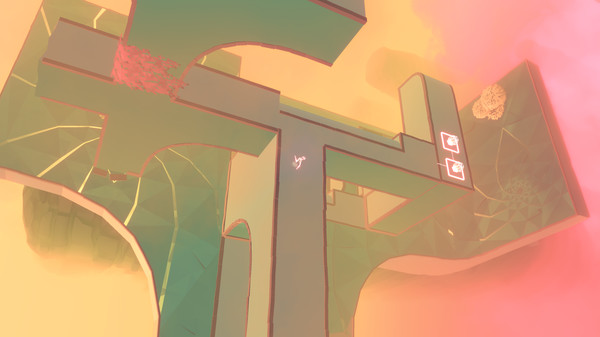 A voiceless being arrives in a world where gravity pivots on curves — Steam store
The World
What the positives hand you first is not gameplay, it is mood: beautiful, calm, 'zen,' and 'the soundtrack carries it.' Most lead with the 20th–21st-century abstract architecture and the per-level music. One Japanese review nails it: 'colour design that makes the destination obvious.' The shared axis is the solitude of walking an empty, giant ruin.
The narration is where it forks. A disembodied voice muses on human potential; some take it as quiet story, while the negatives call it 'pretentious nonsense,' mere flavour. A long Japanese review shrugs: 'a story that leaves nothing in your head.' What survives for both camps is the temperature the voice lends the space, not its content.
In design terms, the world here is not decoration — it is the board. The Escher-like architecture that swaps wall for floor is both the visual surprise and the grammar you solve. Among gravity-and-geometry games like The Bridge and Manifold Garden, this is the one that puts beauty out front; the thin story is the flip side of a world built as terrain, not plot.
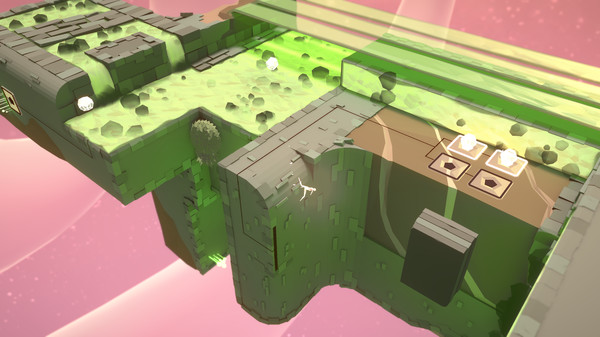 Abstract architecture evoking 20th–21st-century art — Steam store
Putting the Mechanics into Words
Reconstruct the mechanics from the reviews and they are startlingly small. You walk and you jump — there is no button for gravity. Walk up a smooth slope and the wall quietly becomes your floor; keep going and you stand on the ceiling. The positives' refrain — 'the slopes become second nature,' 'like a portal gun' — is praise for how few inputs there are.
This is verb subtraction at its limit: a flashy phenomenon, gravity reversal, implemented not as a new verb but as the tail of an old one — walking. The grammar is a single line — 'a curved surface is a hinge for gravity' — and every level is written in it. The Japanese note about 'reasoning backward from which slope to take' describes solving from that one rule.
On top sits a second layer: collect orbs, slot them, grow platforms. Monument Valley gets cited for the illusion, Portal for using space itself as the tool. But the negatives note this layer stays a single path and never branches into combinations — the verb is elegantly subtracted, yet offers few moves out of it. That sets up the difficulty question.
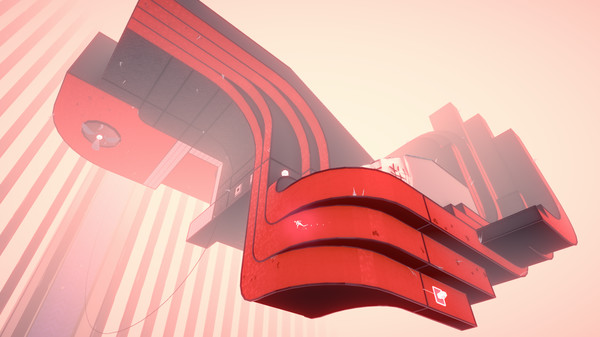 Walk up a curve and the wall becomes the floor — Steam store
The Feel of the Controls
The most repeated negative is not difficulty or length — it is the camera. 'The camera is not your friend,' 'no mouse look,' 'you cannot zoom out to see the whole puzzle.' The Japanese reviews echo it: the view is cramped, 'I wanted a free camera to spin around.' The official 'best played with a gamepad' reads as cold to mouse-first PC players.
What is striking is that other reviewers praise the same camera. One writes: 'the camera turns based on where you stand, so follow it — do not try to survey the stage for a route.' That is not the complaint inverted; it is an accurate read of intent. Not being able to look freely is spec, not bug.
In our vocabulary, the game holds observation resolution deliberately low. Instead of a god's-eye board, the world re-renders every time you walk and flip. 'Cannot survey' and 'the view inverts as you move' are two faces of one choice. So the camera gripe is both a control flaw and testimony about what the game put at its center — see observation as play. This is where it picks its audience.
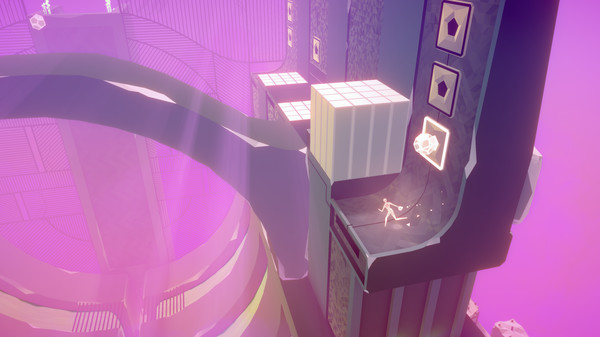 A camera that swings around on its own as you move — Steam store
The Texture of Difficulty
On difficulty the pool is unusually unanimous: easy. 'Makes you think a little, not a lot,' 'never needed a walkthrough, yet felt like a genius at the exit.' Most finish a first run in 2–3 hours, 4–5 with all achievements. Death has no penalty and retries are instant. The texture is 'solved pleasantly,' not 'stuck.'
What divides people is volume and the post-game Game+: same levels and gadgets, only the orbs moved. Some find it 'a little fresh'; the negatives and several Japanese reviews are harsh — 'it just hides orbs in invisible bushes; the puzzle quality drops below run one.' Padding difficulty muddies the beauty that subtraction bought.
As criticism: the game deliberately avoids combinatorial explosion. It chose the easiness of a space that reads to a single solution over the bite of branching moves. Against Steam's 73%, I give it 7.0 for consistency, docking points for closing the verb's reach after only five levels and for the padded second run.
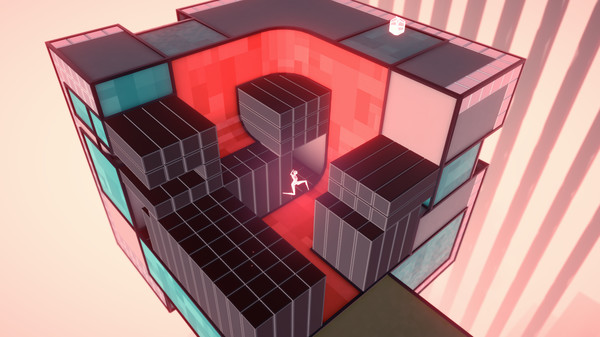 Easy by design: spaces that read to a single solution — Steam store
Sources
This piece was written by reading the Steam store user reviews as of 2026-06-28. No review text is quoted directly; typical claims are reconstructed.
- Steam: Etherborn (Mostly Positive, 327 of 447 reviews ~ 73% positive)
- Read via WebFetch: ~10 top helpful positives, representative negatives, several Japanese reviews, and the recent trend (78% across the last 100)
- Press: Rock Paper Shotgun, Kotaku, IGN España (8), Metacritic 69 (as cited/aggregated on the Steam store)
Closing
What is left after the pool is a conviction: judge this by fit, not quality. If you want bite, length, and a free camera, it is not for you. If you want to walk a quiet space and feel gravity flip for a couple of hours, it fits with nothing to spare. That the reviews split is the design telling you, honestly, which it chose.
The pool's near-consensus is 'buy it on sale.' Many call $17 steep, and for a 2–3 hour piece that is fair advice. But set price and length aside and the way it makes gravity and geometry playful from a single verb still reads as a clean textbook of subtraction. What you bring decides the experience — and the split itself explains the design best.
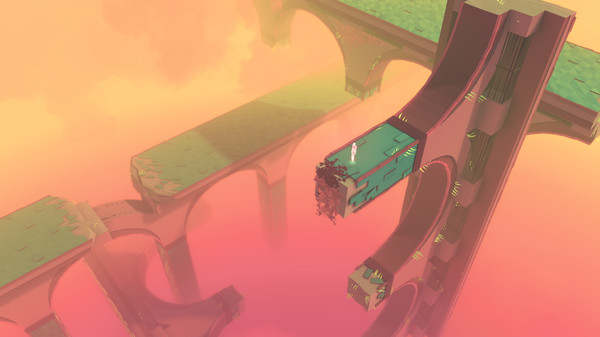 A small study that makes gravity and geometry playful from one verb — Steam store
Where are you with this game?
Press one and the game goes on your shelf. You can see it on your account page.
Reactions (no login)
Anonymous • one of each per visitor per day
Read next
Related reviews
ISLANDERS
Ein minimalistisches Platzierungspuzzle: Gebäude werden auf prozedural erzeugte Inseln gesetzt und punkten je nach dem, was daneben liegt. Kein Ressourcenmanagement, keine Einwohner – ein einziges Verb: legen. Ein kleines Werk von Grizzly Games.
Trüberbrook
Ein Point-and-Click-Adventure um den amerikanischen Physiker Hans Tannhauser, der 1967 mit einer gewonnenen Reise in ein abgelegenes westdeutsches Dorf kommt. Auf der Suche nach einer gestohlenen Abhandlung gerät er in eine Geschichte über eine andere Dimension, die sich tief im Dorf verbirgt. Ein Werk des deutschen Studios btf, dessen Schauplätze als reale Miniaturen gebaut und fotografiert wurden.
Tangle Tower
Ein handgezeichnetes, voll vertontes Detektiv-Abenteuer: ein Mord in einem seltsamen Herrenhaus, den man löst, indem man Verdächtige verhört, gesammelte Hinweise abgleicht und die im Turm versteckten Rätsel knackt. SFB Games' Fortsetzung von Detective Grimoire (2019).


