REVIEW · 2015-06-25
Portal Stories: Mel
Die 5 Prozent, die dem Titel „Portal 3“ widersprechen
First Impressions
The Steam label reads Overwhelmingly Positive. As of 2026-09-26 the all-language, all-purchase-type count stands at 23,805 reviews, 95% of them positive. For a free unofficial campaign that only asks you to own Portal 2, the number looks beyond argument.
Yet sort the positive reviews by helpfulness and the praise collapses into a single phrase: this is Portal 3. One reviewer writes that until further notice, this is Portal 3. Others say it does not feel like a mod, that they would believe it if told Valve had made it. Surprise at the finish has become the name of the thing.
Sort the remaining 5% the same way and they converge too. The difficulty, they argue, does not come from clever solutions but from solutions that are hard to notice. The most-upvoted negative review reaches for Portal 2's developer commentary and sets its stated aim, making the player feel smart, against what Mel actually feels like.
So the two sides are not talking about different things. Both stand on one measure, how it compares to Portal, and face opposite ways along it. I read this review pool to read the marks on that ruler.
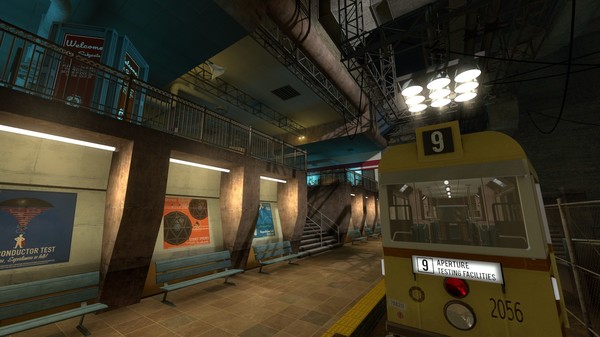 Portal Stories: Mel in play — image 1 as listed on the Steam store page (Steam store screenshot)
Place in the Lineage
Mel has a history. She is recorded as a candidate protagonist for Portal 2, then a candidate for its co-op mode, before being replaced by ATLAS and P-body. This mod picks up a lead character the official game left on the shelf.
Work began in 2011, passed Steam Greenlight in 2014, and shipped free on 25 June 2015. It won Best Fan Creation at The Game Awards 2015 and Mod DB's Mod of the Year. That the prizes sit in a fan-creation bracket describes its reception precisely. Rock Paper Shotgun is recorded as calling it an impressively made campaign.
When the positive side says it does not feel like a mod, what it praises is the finish: voice, music, light, the build of the facility. The store page confirms more than 350 new lines and over an hour of new music. But not feeling like a mod and looking like Valve's design are two claims. Read the pool closely and the praise for finish and the praise for design do not always come from the same people.
Five days ago I read Portal: Revolution, where the negative side gathered around time spent walking. Mel's negative side gathers around things being hard to notice. Two extensions built on the same Portal 2, and the complaints differ that much. One stretched the running time; the other raised the density.
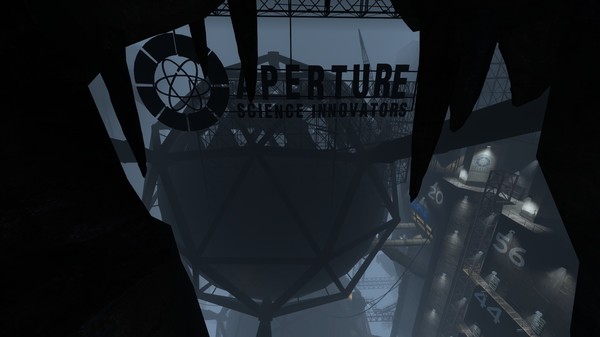 Portal Stories: Mel in play — image 2 as listed on the Steam store page (Steam store screenshot)
Putting the Mechanics into Words
The verbs barely grow. Place two portals, carry, fall. Both sides agree on this. The setting moves to a 1952 Aperture Science and the gun is a prototype, but the number of things your hands must learn is the same as in the base game.
What grows is not the verb list but the amount of cancellation placed on the board. The most frequent proper noun in the pool is the fizzler, the emancipation grid. A review from this week says that if they see another fizzler they will lose it. The positive side reads it as constraint doing its job; the negative side reads it as a wall built to narrow the solution to one.
In Puzzlebyrinth's vocabulary, Mel did not add verbs; it tightened the grammar. Same verbs, fewer places to put them and fewer things allowed through. There are two kinds of subtraction: the kind that removes options to deepen thought, and the kind that seals everything except the answer. The negative side is saying that Mel's subtraction leans toward the second in places.
What makes it interesting is that the top positive reviews also praise multiple solutions, and one describes escaping with a ninja portal placement. Open chambers and sealed chambers live together across the 22 rooms. The plainest reading is that the ratio between them simply looks different from different seats.
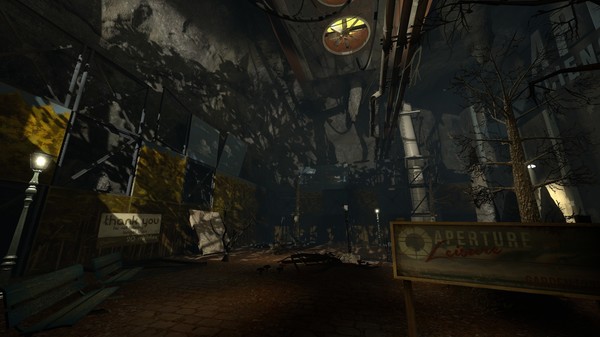 Portal Stories: Mel in play — image 3 as listed on the Steam store page (Steam store screenshot)
The Texture of Difficulty
Everyone grants the difficulty. Even the positive side writes that it is harder than the base game. The dispute is about kind, not amount. Collect the sticking points named across the pool and they sort into three.
First, logical difficulty: reading how the devices combine. Both sides are largely positive here. Second, difficulty of noticing: behind walls, ledges that are hard to see, places visible only from one spot. This is what the negative side calls hidden walls and weird spots. Third, difficulty of execution: timing and landing precision. One review points at the gap between a pitch of purely logic-based puzzles and what the fingers are actually asked to do.
The first is a design achievement. The second and third are matters of observational resolution and input precision, which sit on a different axis from depth of thought. Split difficulty along those three and you can see why 95% and 5% describe the same game differently. Those satisfied by the first call the whole thing meaty; those stopped by the second and third call the same hours unfair.
On the learning curve, Mel's introductory steps are thin. Even a favourable review notes that the difficulty has no entry ramp. Portal 2 spent its whole campaign teaching before testing; compress that into 22 chambers and what gets cut is the teaching. That looks like what was cut.
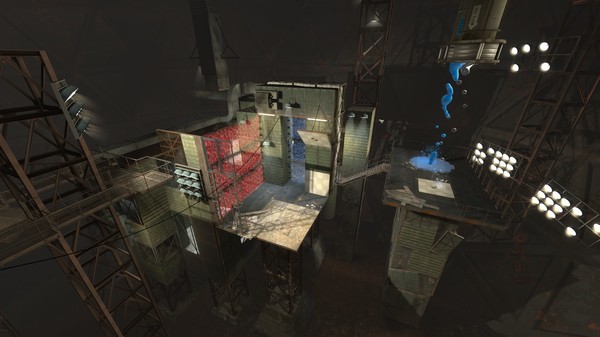 Portal Stories: Mel in play — image 4 as listed on the Steam store page (Steam store screenshot)
Reviews Consulted
This article was written from the Steam user reviews as they stood on 2026-09-26. No review text is quoted directly; typical claims are reconstructed.
・Steam: Portal Stories: Mel (Overwhelmingly Positive, 95% of 23,805 reviews; last 30 days 85 reviews at 90%, Very Positive)
・Read: top 10 positive by helpfulness, top 10 negative by helpfulness, 8 most recent (28 in total)
・Development history and awards follow Wikipedia: Portal Stories: Mel
・The images use screenshot URLs exactly as returned by Steam's appdetails API for this app. This environment could not reach Steam's image hosts, so the contents could not be checked by eye, and the captions therefore do not identify what is shown.
Closing
I give it 8.4. That sits below Steam's 95% because I do not count difficulty of noticing and difficulty of execution as design achievements.
This is not a charge of failure. Mel took on the brief of a Portal harder than the original, and inside 22 chambers the fastest way to deliver that is to lodge the difficulty in noticing and executing. It is a choice, not an accident.
It suits players who finished Portal 2 wanting more resistance, and who do not mind walking the facility while stuck. It does not suit players who came for Portal's particular feeling of being smart. The most-upvoted negative review is about exactly that gap.
Being free is not a reason to grade gently. Even so, the fact that an eleven-year-old fan project still draws 85 reviews in thirty days says more than any score. It belongs on the shelf next to Portal 2.
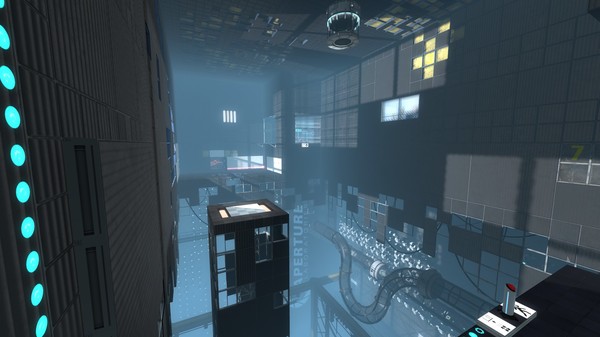 Portal Stories: Mel in play — image 5 as listed on the Steam store page (Steam store screenshot)
Where are you with this game?
Press one and the game goes on your shelf. You can see it on your account page.
Reactions (no login)
Anonymous • one of each per visitor per day
Read next
Related reviews
Mushroom 11
A 2D puzzle-platformer in which a green fungal mass is moved by erasing it: whatever you delete grows back somewhere else, so choosing what to cut is how you travel. Untame's descent through an emptied ruin, scored by The Future Sound of London.
Portal: Revolution
Eine kostenlose inoffizielle Erweiterung zu Portal 2, angesiedelt in der Lücke seiner Geschichte, mit rund vierzig neuen Testkammern und neuer Hardware wie einem Würfel, der Laser umlenkt. Sie beginnt mit nur einem verfügbaren Portal und lässt einen zwischen den Kammern zu Fuß durch die Anlage gehen.
Grim Fandango Remastered
A 3D point-and-click adventure in which you play Manny Calavera, a skeletal travel agent in the Land of the Dead, following a journey and a conspiracy told across four years. Double Fine's rebuild of a film-noir-meets-Day-of-the-Dead world, with repainted textures, dynamic lighting and a re-recorded live score.


