REVIEW · 2016-11-17
SHENZHEN I/O
Wo das Lesen des Handbuchs das erste Rätsel ist
Introduction
You join a fictional Shenzhen electronics firm as an engineer, writing terse assembly for cramped virtual microcontrollers and wiring components onto a board to build client products. SHENZHEN I/O ships no tutorial: reading its 30-plus-page datasheet manual is itself the first puzzle. Zachtronics released it in November 2016; Zach Barth designed it, with writing and art by Matthew Seiji Burns.
I write this from the Steam review pool rather than my own save file. The English label is 'Overwhelmingly Positive,' 95% of 2,188. Across all languages there are 3,662 purchaser reviews; of 4,428 including off-topic, only 224 are negative (snapshot 2026-07-01). The last 30 days hold at 90% of 21.
But that 95% is not 'almost everyone is satisfied.' By one reviewer's reading of the achievement stats, roughly 2% finished the main campaign — so the score is the voice of the few who stayed. Praise and complaint keep pointing at the same spot: a design that makes you read a manual and refuses to teach. I read the game from there.
 SHENZHEN I/O — Steam store
Putting the Mechanics into Words
Put the mechanics into words and the verbs split in two: a terse assembly you write onto virtual chips — mov, add, teq, a dozen-odd instructions — and a spatial act of placing parts and routing wires across a board. Reviewers who say they are embedded-systems engineers keep calling it 'an accurate experience of assembly programming,' praising how realistic the low-power, few-register constraints feel.
What does the work is what Puzzlebyrinth calls subtraction of verbs. Cap the instructions near fourteen and the registers at two, and a one-line job on a modern language stops being solvable. That is why reviewers call the late game 'an exercise in extreme modularization' — the same combinatorial search that SpaceChem ran inside reactors and Opus Magnum ran through arms, in a different vocabulary.
Submit a solution and a histogram places your cost, power and line count inside everyone else's distribution. The helpful positives name this 'compete for the smallest' feeling as the pleasure. Showing a spread instead of one right answer leaves room to go deeper the more closely you look — when an engineer asks for 'more instructions,' that is the flip side of a floor you cannot see.

The Manual as Gatekeeper
The sharpest divide is the design that ships no tutorial and offloads learning onto a 30-plus-page datasheet manual. The positive side loves the unfriendliness itself: 'the great manual with terrible data sheets is accurate,' 'I loved the Chinese-only data sheet.' The qualified side, in threads asking about classroom use, keeps returning to 'the manual is obtuse about many concepts' and 'forty pages of required reading — no twelve-year-old gets there alone.'
I read this as a question of learning-curve design. The developer puts 'RTFM' on the store page and deliberately subtracts the teaching verb from the game, promoting the act of reading into the first puzzle. So 'unfriendly' and 'accurate' do not contradict: one names the learner's cost, the other the fidelity of a recreated workplace. One side calls the same spec a wall; the other calls it the setting.
The point is reach, not quality. That ~2% completion shows the game aiming precisely — not at everyone, but at the few with the patience to read and a base in programming. When the community tells a teacher to try the gentler Opus Magnum instead, it is reading that difference in reach correctly.
The Texture of Difficulty
Sort the difficulty by where reviewers get stuck and it falls into three layers: the coding difficulty of building logic from a tiny instruction set; the spatial difficulty of fitting every part and wire onto a finite board; and the timing difficulty of synchronizing outputs. The positives call the moment all three mesh a 'brain gym.'
The complaints land hardest on the second layer. One qualified review says, 'Play TIS-100 instead. This is harder, but for the wrong reasons — the back half is more chip-shuffling than coding.' Another quit at the late 'cocktail' level, worn down by redesigning every time a single wire would not fit. The line between intended resistance and mere spatial busywork flips from player to player right here.
To me the board is the wager. Code alone would put it beside SpaceChem and TIS-100; adding physical area lets it hold an aesthetic — 'a clean solution naturally fits small.' One reviewer sums it up: anything ugly simply will not fit on the board. Whether that reads as pleasure or pain is the whole split.

Place in the Lineage
The reviews almost always place it beside the same studio's other work: a spiritual successor to TIS-100, contiguous with SpaceChem, Infinifactory and Opus Magnum. The comparison threads split — 'TIS-100 is easier to enter,' 'Opus Magnum looks better and has a gentler curve,' 'SpaceChem gives the most freedom' — yet most concede the core is identical: take input, transform it, produce output.
In Puzzlebyrinth's terms these are dialects of one grammar written with different verbs: atoms in SpaceChem, arms in Opus Magnum, assembly and wiring here. What sets this one apart in the family is its narrative skin — the pretense of a real job, propped up by the concrete Shenzhen setting and a manual written in deliberately cheap marketing prose.
Tellingly, the helpful reviews keep repeating a version of 'coming home from my programming job to my fake programming job, which is more fun.' Look closely and that is praise less for the difficulty than for the comfort of repeating familiar work at no risk — the fatigue of the workplace distilled with no deadline and no boss. It is the game's quietest appeal.

Sources
This article was written by reading the Steam store and community user reviews and discussions as of 2026-07-01. No review text is quoted directly; typical claims are reconstructed.
- Steam: SHENZHEN I/O (English reviews 'Overwhelmingly Positive,' 95% of 2,188; 3,662 across all languages; 224 negative of 4,428 incl. off-topic; recent 90% of 21).
- Read via WebFetch: the top ~11 helpful English reviews, plus two General Discussions threads on difficulty and classroom use (20-plus comments). The completion figure comes from user posts citing the achievement stats.
- Press/reference: Rock, Paper, Shotgun, 'Premature Evaluation' and Wikipedia: Shenzhen I/O (development history; IGF 'Excellence in Design' nomination).
Closing
In closing: SHENZHEN I/O cuts the teaching verb, makes you read the manual, and folds your solution onto a finite board — and with that consistent subtraction it hits a narrow but deep target. The few who stayed are what build the 95%.
Steam's English overall is 95% positive; from a design standpoint I give it 8.5. The half point comes off not for any flaw but for narrow reach: as that ~2% completion shows, this is not a vessel to recommend to everyone. For those with a base in programming and the patience to read, it sits near full marks. Times vary widely — a dozen-odd hours for the campaign, tens more if you chase optimization.
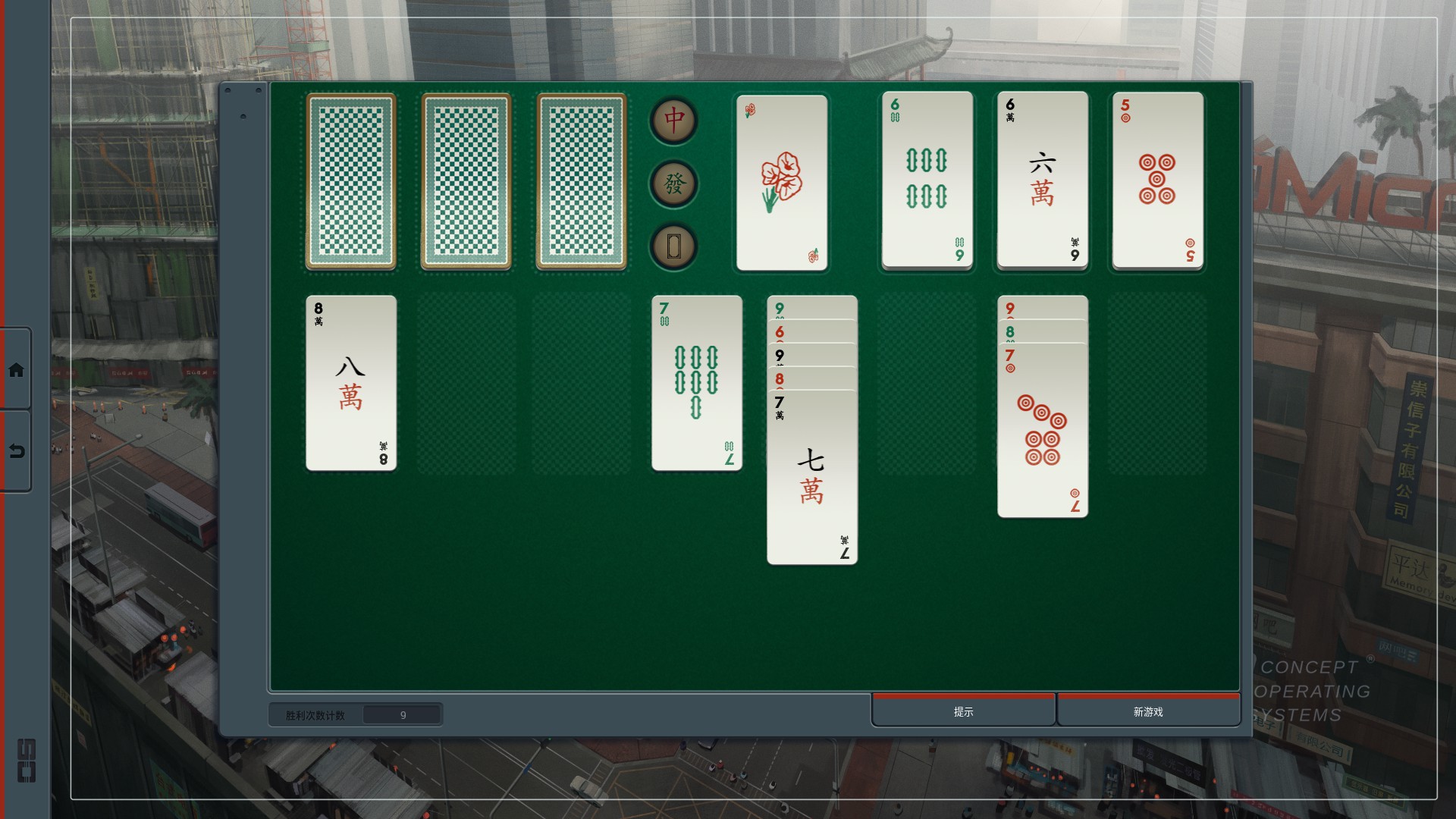
The store page says, 'Engineering is hard! Take a break and play solitaire.' Ironically — by one reviewer's reading of the stats — more people have won 100 games of solitaire than have finished the campaign. A game that sells difficulty is played most in the diversion from it. That twist feels like proof it knows its own reach exactly.
Where are you with this game?
Press one and the game goes on your shelf. You can see it on your account page.
Reactions (no login)
Anonymous • one of each per visitor per day
Read next
Related reviews
TIS-100
Ein Assembler-Programmier-Puzzle: Man schreibt Code auf einem Raster winziger paralleler Knoten, um einen defekten Computer zu reparieren. Jeder Knoten hat nur zwei Register und kaum ein Dutzend Befehle, und die Datenuebergabe zwischen Knoten kann blockieren — unter diesen Beschraenkungen wetteifert man um Zyklen, Befehle und Knotenzahl. Von Zachtronics, den Machern von SpaceChem und Opus Magnum.
Infinifactory
Ein 3D-Puzzle aus der Ego-Perspektive: Aus Blöcken und Förderbändern baust du Fabriken, die herstellen, was deine außerirdischen Entführer bestellen. SpaceChem in drei Dimensionen von Zachtronics – wenige Verben, bodenlose Optimierung.
EXAPUNKS
Ein Hacking-Puzzle in einer Cyberpunk-Welt von 1997: Du schreibst Pseudo-Assembler für kleine Programme namens EXAs und schickst sie durch die Netzwerke von Banken und Universitäten. Mit einem druckbaren Untergrund-Zine als Handbuch schöpft es aus wenigen Verben eine bodenlose Tiefe — ein Zachtronics-Spiel.


