REVIEW · 2013-12-13
Teslagrad
Einen Turm allein per Magnetismus erklimmen - die gespaltenen Meinungen zu Bossen und Sammelbarriere
Introduction
Teslagrad is a 2D puzzle-platformer Rain Games released in 2013: a boy strays into an abandoned Tesla Tower and climbs it on magnetic polarity alone, with no text or dialogue anywhere. I wrote this from the Steam review pool, not from playing it myself.
The label is Very Positive — 84% of 2,466 reviews, and 83% of 1,700 Steam purchasers (2026-07-14 snapshot); Metacritic 77. Eurogamer praised its "show, don't tell"; 3D Juegos called it a mix of Braid and Limbo. The numbers are steady, but the pool is quietly split: praise lands on the magnetism, the art, the wordless story; complaint lands on the bosses, the instant death, the collectible gate.
 Teslagrad — Steam store
First Impressions
Across the helpful positive reviews, the first words are almost always "gorgeous" and "atmospheric" — the rain-soaked tower, the shadow-play backgrounds. Many say they were staring at the art before they had learned the controls.
That is an observation-resolution design. With zero text, every wall scribble and poster becomes information you must read; the game quietly trains you to scan the frame. But the same early hours are where the "floaty controls" complaint is already seeded.
 The hand-drawn Tesla Tower — Steam store
Putting the Mechanics into Words
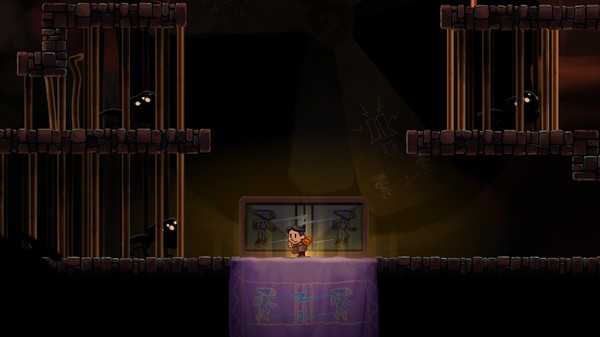
What positive reviews keep calling "mind-bendy" is one idea: magnetism. The boy carries blue or red polarity — like poles repel, opposite poles attract — plus a "blink" through barriers. There are really only two verbs.
Two verbs, but the grammar multiplies: hang from ceilings, fling blocks, launch yourself. The verb is subtracted and the depth comes from combination — the lineage of Braid and Limbo. The negative side counters that the rooms repeat — blink, hang, repeat — so the combinatorial explosion stalls. Praise calls it "spare"; complaint calls it "samey." Same rooms, two readings.
 A polarity-based puzzle room — Steam store
Design Craft
The one craft everyone names, positive or negative, is the wordless storytelling — no loading, no GUI, no cutscenes; the story runs on murals and backgrounds. Even reviewers who do not recommend the game single this out as excellent.
It teaches without words: the corridor before a boss paints how to beat it — decoration if you ignore it, a solution if you look. That is the Limbo school of silent tutorials. But the craft has a seam: reviewers note the bosses drop the magnetism vocabulary for twitch reflexes, which leads straight into the difficulty debate.
 A world narrated without words — Steam store
The Texture of Difficulty
"Too hard" and "just right" split almost evenly. Reading where reviewers got stuck, the friction sorts into three patterns.
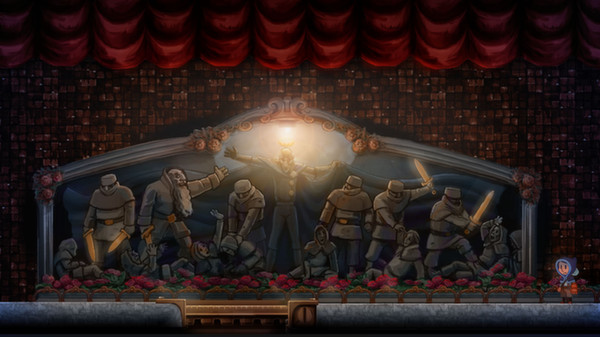
One: instant death and sparse checkpoints — a single slip erases ten minutes. Two: bosses as pattern-memorization, where the recurring words are "trial and error" and "padding." Three: a collectible gate — you need roughly 15 of 36 scrolls to reach the final area, unannounced, with no map for the backtrack. None of this is a bug; it is a deliberately retro intolerance. Not better or worse — a question of design reach: who it is for, and who it is not.
 A one-hit-death boss fight — Steam store
Reviews Consulted
This piece was written from the Steam store's user reviews as of 2026-07-14.
・Steam: Teslagrad (84% of 2,466 reviews positive; 83% of 1,700 Steam purchasers; "Very Positive", 2026-07-14 snapshot)
・Read the top helpful positive and negative reviews plus recent ones via WebFetch; the negative side clusters on instant death, boss pattern-memorization, and the collectible gate.
・Critic context via Metacritic 77 (Eurogamer, Destructoid, 3D Juegos, etc.).
Closing
The three pillars — magnetism, art, wordless story — are real, and the idea of climbing a hand-drawn tower on two verbs has not aged. The trouble is that the game shakes its own pillars at the climax.
Against Steam's 83-84%, I give it 7.5 as a design read: I rate the magnetic grammar and the art highly, but the bosses abandoning the game's own vocabulary and the unannounced collectible gate reliably erode the back half. Recommended for anyone who wants to climb the tower — just know the final staircase asks for a different kind of patience, one magnetism cannot help with.
 Toward the top of the tower — Steam store
Where are you with this game?
Press one and the game goes on your shelf. You can see it on your account page.
Reactions (no login)
Anonymous • one of each per visitor per day
Read next
Related reviews
Teslagrad 2
Ein 2D-Puzzle-Platformer, in dem man magnetische Pole umschaltet und mit Schwung einen Turm erklimmt, der über einer nördlichen Fjordlandschaft aufragt. Rain Games behält die textlose Erzählweise und die handgemalten Hintergründe des Vorgängers bei, steuert aber vom „Anhalten und Nachdenken" hin zum „Gleiten und Vorankommen".
Toki Tori 2+
Pfeifen zum Anlocken, Stampfen zum Vertreiben — mit nur zwei Aktionen durch eine bewaldete Insel ohne Anleitung. Ein Puzzle-Abenteuer von Two Tribes im Metroidbrainia-Stil, bei dem nicht neue Fähigkeiten, sondern das Wissen um Tiergewohnheiten der einzige Schlüssel ist.
Tetrobot and Co.
Man steuert den winzigen Reparaturroboter Psychobot, saugt Blöcke ein und stößt sie wieder aus, um das Innere eines defekten Riesenroboters zu reparieren – ein gitterbasiertes Denkrätsel. Allein mit den materialspezifischen Eigenschaften von Holz, Sand und Stein und der Regel, dass nur gleiche Materialien aneinanderhaften, hat Swing Swing Submarine über fünfzig Level aufgebaut.


