REVIEW · 2014-07-28
The Room
Eine Schachtel, die sich öffnet, je genauer man hinsieht — die fast einhellige Zustimmung gelesen
Introduction
A strange metal box sits on a table. You peer at it, rotate your view, hunt for a seam, turn a key, slide a drawer — and unpick it one mechanism at a time, until a smaller box appears inside. A special lens reveals marks the naked eye can't see. Fireproof Games built it for iPad in 2012 and brought it to PC in 2014: a puzzle box about looking closely and touching.
I write this from the Steam review pool. The label is 'Overwhelmingly Positive' — 30,607 of 31,312 reviews across all languages, about 98% (English: 97% of 14,306; snapshot 2026-06-30). A decade-old mobile port still sitting at 97% over the last 30 days is itself unusual.
But it isn't a clean consensus. Metacritic's PC score is 73 ('mixed'), against 88 on iOS, and a small, persistent negative current runs through the user reviews too. What I want to read is where the line falls between 'almost everyone loves it' and 'a few keep snagging.'
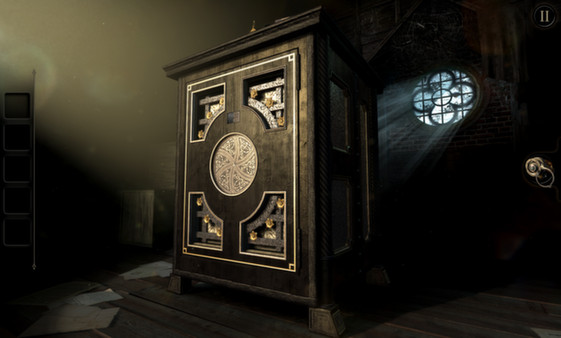 The metal box on the table — Steam store
First Impressions
Line up the helpful positives and the vocabulary rhymes: atmospheric, satisfying, relaxing yet absorbing, and 'every screenshot is art.' Most praise the minute-by-minute pleasure of things opening, and the click of a box turning under your hand.
The negatives and qualified positives keep returning to: short (3-4 hours), and 'this was a phone game first' — the mouse can't quite reproduce the feel of a finger. Recent reviews mostly describe discovery on sale, or arriving as a gateway to the series.
Here too, praise and complaint often point at the same spot. One reader's 'savor every morsel' is another's 'short for the price.' My job isn't to stage that as a fight, but to translate where opinions fork into design terms.
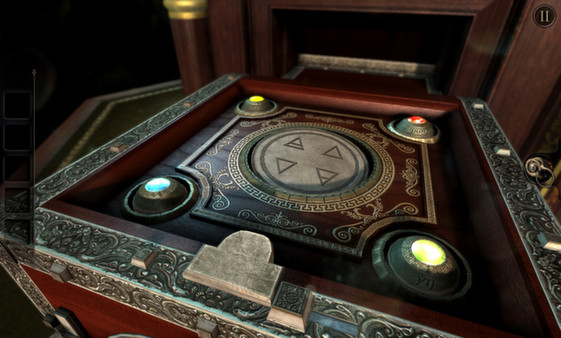 Peering in to find a seam — Steam store
The World
The first thing reviewers praise is mood: candlelit light, creaking metal, steampunk filigree. Story is barely spoken — only fragments of letters about the 'Null,' a supposed fifth element, tucked around the boxes. As one phrasing goes, it leaves more questions than answers.
This world is delivered at a resolution of attention. The lore is buried in background documents, skippable yet there for anyone who looks. That active-search design sits in the same lineage as The Witness, where space itself teaches, and COCOON, which speaks through atmosphere.
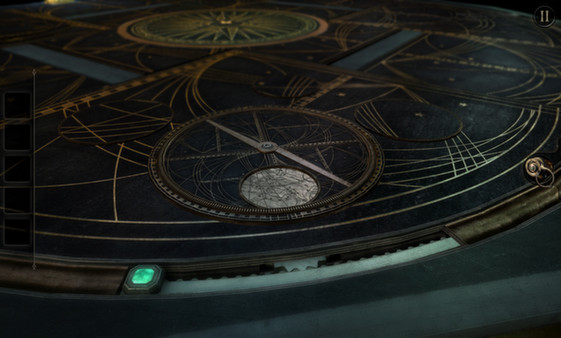 Candlelit filigree and texture — Steam store
Putting the Mechanics into Words
Reviewers all describe the same loop: peer, rotate, find a seam, push, turn. At its core is the lens — equip it and Null marks surface on the box; move your view until they align, and a new mechanism opens. 'Tactile' recurs because every moving part carries physical weight.
In design terms the verb set is tiny — 'look closer' and 'touch.' The lens is observation resolution made literal: the same scene at two resolutions. The verbs are subtracted hard, and complexity comes from the box's nesting; the combinatorial blow-up is sealed inside, with box one doubling as the start of the control learning curve.
The PC tension lives here. On touch, the verb is your finger; on PC, a mouse comes between. The minority complaint targets that grammar of input. The design is purest on touch or in VR — and the pleasure of peering in is exactly what carried this box's lineage forward into mansion puzzlers like Blue Prince.
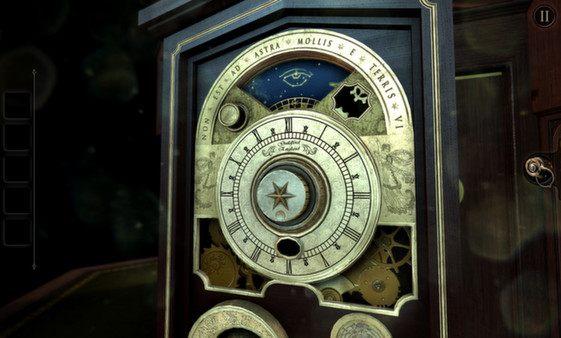 The lens reveals hidden marks — Steam store
Closing
Steam reads ~98% positive; my design-critique score is 8.5. I sit just below the rapture for two reasons: it's short, and on PC its core tactility thins out through the mouse. But the subtraction of verbs, the crystallizing of observation resolution into a single tool, the physics of turning a box, and the world sunk into the background are all exemplary.
Who's it for? Anyone wanting 3-4 hours of pure looking-and-touching — almost unconditionally. It's purest on touch or in VR, but the PC build still carries the skeleton of the design. That a small tactility-minority persists inside an overwhelmingly positive verdict is less a flaw than a question of reach: which hands was this box built for? It opens the closer you look — and a decade on, 98% of reviews still agree.
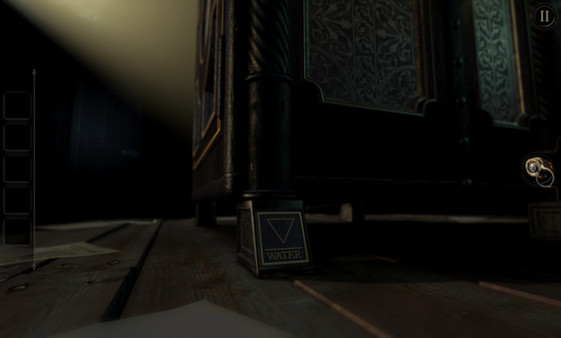 The nested box unpicks one step at a time — Steam store
Sources
This piece was written by reading the Steam store page's user reviews as of 2026-06-30. No review text is quoted directly; typical claims are reconstructed.
- Steam: The Room (Overwhelmingly Positive, 98% of 31,312 across all languages; English 97% of 14,306)
- Read: the top ~10 helpful positive reviews, representative negative complaints, and several recent reviews
- Reference: Wikipedia, Thinky Games deep dive, Metacritic (PC 73 / iOS 88)
Where are you with this game?
Press one and the game goes on your shelf. You can see it on your account page.
Reactions (no login)
Anonymous • one of each per visitor per day
Read next
Related reviews
The Room Two
Ein Escape-Puzzle aus der Ich-Perspektive, in dem man seltsame mechanische Kisten auf Tischen oder in Räumen betrachtet, dreht und mit einer speziellen Linse verborgene Markierungen sichtbar macht, um sie Schritt für Schritt zu öffnen. Der zweite Teil der The-Room-Reihe des britischen Studios Fireproof Games, der sich von einer einzelnen Kiste zu mehreren ineinandergreifenden Mechanismen erweitert.
The Room 4: Old Sins
Ein Rätselspiel aus der Ich-Perspektive, in dem man in ein auf dem Dachboden gefundenes altes Puppenhaus blickt, die Mechanismen Raum für Raum öffnet und die in anderen Räumen fehlenden Teile ergänzt. Der vierte Teil der The-Room-Reihe von Fireproof Games, neu umgesetzt für den PC.
Broken Age
A village girl chosen as a sacrifice and a boy aboard a spaceship run by an overprotective computer. Switch freely between their two stories, combining objects to solve puzzles, in a hand-painted point-and-click adventure — built in two acts by Tim Schafer's Double Fine on crowdfunded money.


