REVIEW · 2019-01-17
while True: learn()
Das Versprechen, „maschinelles Lernen zu lernen“, und was das Node-Verkabelungs-Puzzle wirklich ist
Introduction
At its core, while True: learn() has you drop nodes on a canvas, wire them together, and sort nine kinds of data—red/green/blue circles, triangles, squares—into the right output bins. The nodes wear the names of real machine-learning algorithms: decision trees, perceptrons. Developed and published by Luden.io, released January 17, 2019.
This isn't my own playthrough. It's a meta-review: I read the Steam user reviews as of July 13, 2026 and translated their recurring praise and complaints into Puzzlebyrinth's design vocabulary. Across all languages there are 8,136 reviews, 7,428 positive—about 91%, labeled "Very Positive." In English alone, 88% of 3,158 are positive. The numbers look safe, yet the pool splits cleanly in two.
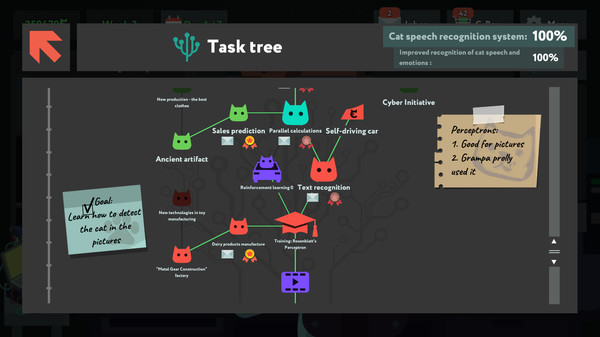 Key art for while True: learn() — Steam store
First Impressions
Across the helpful positives, the same notes recur: "simple to start, hard to master," "I ended up reading ML articles for hours," "as fun as any Zachtronics game." People praise the accessibility and the click of a sorting run finally passing. One called a hard-won gold medal "like defusing a nuclear bomb."
The top negatives are just as coherent: "this is not a programming game," "the machine learning is only names and Wikipedia links," "it's really sorting nine symbols, and you've seen it all in an hour or two." What they repeat is a gap between the label and the substance.
What struck me is that the two camps aren't seeing different things. Both agree the core is color-and-shape sorting, not machine learning itself. What splits is the verdict, not the observation—one side calls it an approachable puzzle skeleton, the other a false promise. That fork is the interesting part.
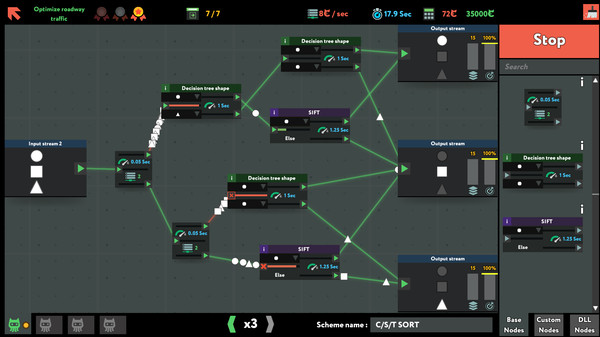 The node-and-wire visual of sorting data — Steam store
Putting the Mechanics into Words
Stitch the reviews together and the board comes into focus. The input boxes emit just nine symbols. The nodes—decision tree, SIFT, perceptron—sort them by color or shape. You place nodes, wire inputs to outputs, and push every symbol to the right exit within a time limit. One reviewer scoffed that you "connect three parts and you've built a disruptive startup."
In Puzzlebyrinth terms: the nodes look like many verbs, but the verb underneath is really one—"sort." Decision tree or perceptron, the costume is machine-learning history; the grammatical job on the board is nearly the same. And the data is subtracted down to nine symbols. That radical subtraction is where the split begins.
The positives read the sparseness as a virtue: it looks like a toy at first, then solutions thicken and you learn without noticing. A small input alphabet lets you focus on the single grammar of wiring. Whether subtraction reads as clean or as thin—that fork deepens next.
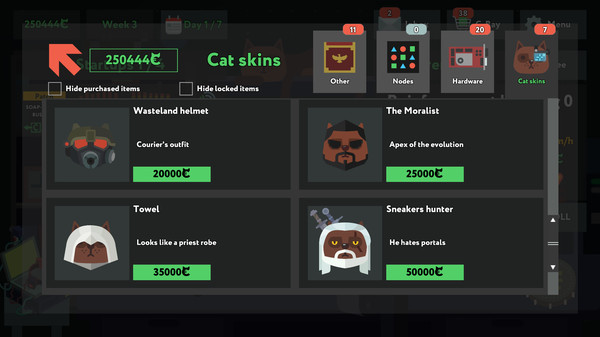 Wiring nodes to route data across the board — Steam store
Place in the Lineage
The game is forever measured against its elders. "If you like TIS-100 or Human Resource Machine, buy it," the positives say; the negatives invoke TIS-100, Shenzhen, Infinifactory too. It's a title you can't discuss outside its lineage.
The sharpest negative comparison: in Zachtronics games the developers don't know the optimal solution. They guarantee one exists and leave the rest to community leaderboards, so you can dig into optimization forever. while True: learn() instead assumes a designer-intended best, baked into its 30s-gold, 40s-silver star system. One reviewer called it "forced premature optimization."
To me the aims simply differ. Zachtronics sells bottomless optimization; this sells a guided tour of ML history. Tellingly, the line "it teaches machine learning about as well as Civilization teaches history" shows up on both sides—as attack and as defense. Placed in the lineage, it's not a hardcore optimizer but a wide-door introduction.
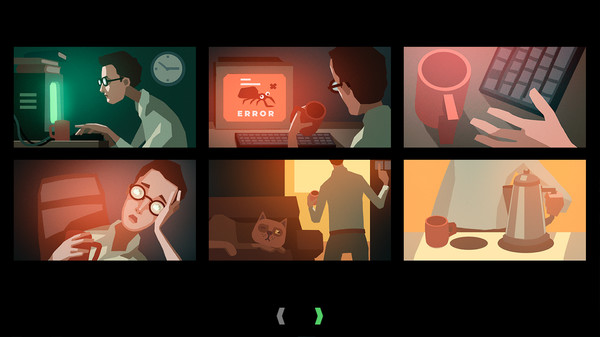 Nodes named after machine-learning algorithms — Steam store
The Texture of Difficulty
On difficulty the reviews split down the middle. "Braindead, saw the bottom in two hours" sits beside "I hunted for hints by level 8" and "gold medals are genuinely hard." Both agree the learning curve is front-loaded—one long review says "once you get color-sorting, 75% of the game is over." (Recorded playtimes run 1.4 to 39 hours; HowLongToBeat's main story is around six.)
The negatives keep returning to the quality of the difficulty. Nodes carry error, input samples are tiny, so the same wiring gives a different distribution each run. One reports a working solution that only passed after reordering nodes. Buy hardware and old solutions speed up to gold. "Not deterministic" recurs again and again.
Here's the core a design vocabulary can name. A puzzle's basic grammar is determinism: same input, same output. You watch how your move landed and update your hypothesis. RNG and small samples fog that resolution. The "not deterministic" complaint isn't taste—it points at a grammar violation. The verb "sort" is clear; the ground for testing it wobbles.
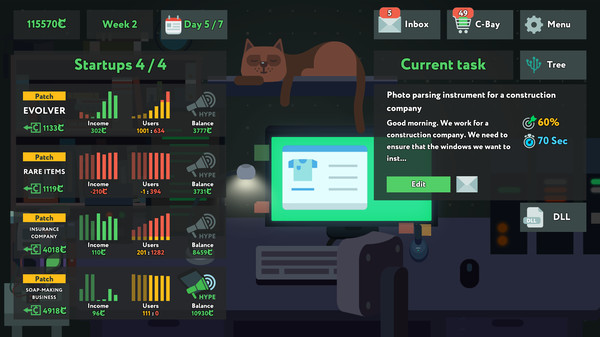 Levels graded by a time limit and star tiers — Steam store
Sources
This piece was written by reading the Steam store's user reviews as of 2026-07-13. No review text is quoted directly; typical claims are reconstructed.
- Steam: while True: learn() (Very Positive; 7,428 of 8,136 positive across all languages = ~91%, 88% of 3,158 in English, 85% of 21 in the last 30 days)
- Read via WebFetch: the top 10 helpful positives and top 11 negatives, mostly English, including references to developer Luden.io and comparisons with TIS-100 and Human Resource Machine.
- Context: Metacritic's metascore is 73. I also weighed the store's promise, "learn how machine learning really works!", against what reviewers actually felt.
Closing
The store promises you'll "learn how machine learning really works" and lists "programmers who want new concepts" among its audience. From the reviews, there's a consistent gap between that promise and the experience. Even a positive review from a self-described software-engineering professor ends by calling the programming-and-ML pitch "hot air marketing speech." Even defenders share the negatives' observation on that one point.
So who is it for? For someone who wants to stroll painlessly through the atmosphere of machine learning. The node-wiring, the real algorithm names, the outbound links—they're designed as an entrance to learning, not a substitute. Anyone after deterministic, bottomless optimization should walk to the TIS-100 shelf instead. Take the label with a grain of salt and it's a broad, likable little game.
Against Steam's ~91% across all languages ("Very Positive"), from a design view I give it 7.0. The reason is in the difficulty section: the verb "sort" is clear, but the determinism that lets you test it wobbles under RNG and upgrades, and the puzzle's spine thins there. Still, the subtracted board, the friendly grammar, and all those "I learned without noticing" voices are real. Start it with small expectations and a few good hours with a cat await.
 A desktop moment shared with a cat — Steam store
Where are you with this game?
Press one and the game goes on your shelf. You can see it on your account page.
Reactions (no login)
Anonymous • one of each per visitor per day
Read next
Related reviews
Autonauts
Ein Automatisierungspuzzle, in dem man auf einem menschenleeren Planeten landet, Holz hackt und Stein schlägt und den Robotern genau die Handgriffe beibringt, die man selbst gerade ausgeführt hat. Mit kurzen, aus Scratch-artigen Blöcken zusammengesetzten Skripten und dem geringen Speicherplatz eines einzelnen Roboters baut man Produktionslinien von der Landwirtschaft bis zur Industrie auf. Ein Titel des schottischen Studios Denki.
Trüberbrook
Ein Point-and-Click-Adventure um den amerikanischen Physiker Hans Tannhauser, der 1967 mit einer gewonnenen Reise in ein abgelegenes westdeutsches Dorf kommt. Auf der Suche nach einer gestohlenen Abhandlung gerät er in eine Geschichte über eine andere Dimension, die sich tief im Dorf verbirgt. Ein Werk des deutschen Studios btf, dessen Schauplätze als reale Miniaturen gebaut und fotografiert wurden.
Nauticrawl
Ein rundenbasiertes Puzzle aus der Ich-Perspektive, in dem man in eine von einem feindlichen Planeten gestohlene, unbekannte Maschine steigt und ein Bedienfeld ohne Handbuch und ohne Tutorial allein durch Ausprobieren von Hebeln und Schaltern entschlüsselt, um zu entkommen. Ein Werk von Spare Parts Oasis, bei dem das Armaturenbrett selbst zum Rätsel wird.


