DESIGNER-STUDY · 2026-09-01
Inside Tom Francis's Philosophy — Name the complaint, then build it
Gunpoint, Heat Signature, Tactical Breach Wizards
Introduction — He used to be the one giving scores
A man who spent nine years scoring other people's games went and made one himself. That is Tom Francis, from the UK. He finished Gunpoint (2013) on weekends while working full time as a critic at PC Gamer.
What interests me is how he describes his own method. "I think my process is to play a game, articulate what I wish was different, and make a game that does it that way" (PC Gamer, 2020 ↗). The reviewer's gesture became the designer's procedure, unchanged.
This is not a review. I read across his blog, talks and interviews to find what he fixates on, where he stumbled, and how he carried it. Every quote here comes from a source I opened myself.
Background — A first game built on weekends
Tom Francis has made three games: Gunpoint (2013), Heat Signature (2017) and Tactical Breach Wizards (2024). His studio is called Suspicious Developments.
Gunpoint is a stealth puzzle game about rewiring a building so the guards open the doors for you. Our review lives at Gunpoint.
The title of his own talk sums up where the first game came from. At GDC Europe 2013 he spoke on "How Reviewing Games for Nine Years Helped in Designing Gunpoint." The session description promises "a bit of the awkwardness, glee, guilt and hypocrisy of someone criticising accomplished developers while making a bumbling attempt at their own first game" (GDC Vault, GDC Europe 2013 session description ↗).
He does not hide his methods either. In 2015 he started a series showing how to make a game from scratch: it is "aimed at absolute beginners" and "only uses free software" (his blog, 2015-07-09 ↗).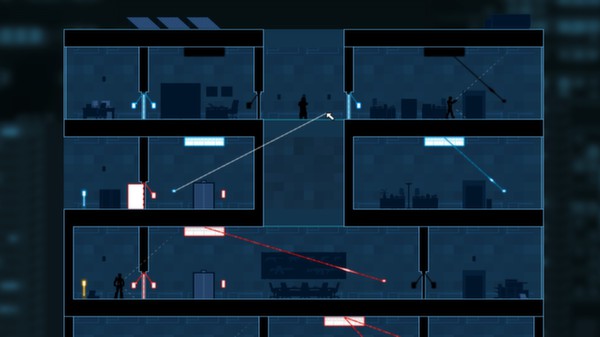 From the official screenshots on the Gunpoint (2013) Steam store page
Philosophy — Write the rules, then let go
One claim runs through everything: play, name the complaint, build that. The 2020 sentence above is the compact version.
The blog holds a worked example. His Tactical Breach Wizards pitch (February 2018) opens like this: "January last year, I was playing XCOM 2 and thinking 'This is so good, and yet has so many clarity problems – I wish there were more indie XCOMs'" (his blog, 2018-02-02 ↗). The complaint became the spec.
The second pillar is rules over special cases. On Heat Signature: "I think most of it comes from creating rules of the simulation, rather than special cases with a particular intent." And: "I usually find if you make a consistent logical simulation, players create their own catastrophes" (Game Developer, 2018 ↗).
He gives this a name. "I call a problem or solution emergent if it happened as a result of the game's general rules, not because a developer specifically intended it to happen." And then the payoff: "the developer doesn't need to predict your strategy to make it work, they just write the rules, make sure you know them, and let you play" (his blog, 2018-07-30 ↗).
His attitude to planning matches. "I do plan, a lot, but it's more like navigation than a strict design document." And: "the plan is always just 'what seems most promising on paper – try this first'" (his blog, 2014-01-25 ↗). A heading, not a blueprint.
Obsessions — Move the maths, not the interface
One move recurs. Rather than adding a display to explain a problem, he shifts the numbers underneath until the problem stops existing. Gunpoint's jump is the cleanest case.
In his words: "when I watched people play, they'd often click quite close to the character and never discover their full jump strength potential." He first considered adding a ring or a gauge. "But in the end I found a way to do it without adding any new visual elements."
The fix: "However far away the cursor is when you start holding the button, that becomes the game's new standard cursor distance for a maximum strength jump." And the one-line summary: "So whatever the player's expecting, the game's maths silently recalibrates to match it" (his blog, 2015-06-05 ↗).
He is equally unforgiving about bad explanation. At GDC 2012: "You can't assume the reader is a reasonable, interested, intelligent human being," and "You have to get to the point, incredibly quickly, in plain and simple language" (his blog, 2012-03-17 ↗). If it does not land, that is not the reader's fault.
The same instinct shapes his turns. From the Tactical Breach Wizards pitch: "You can play out a turn as many times as you like before you commit – you can keep rewinding and changing your orders until you're happy with the result" (his blog, 2018-02-02). Experiment is not scored against you.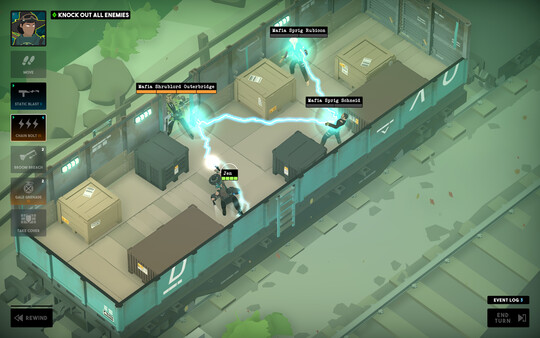 From the official screenshots on the Tactical Breach Wizards (2024) Steam store page
Failures — "To be honest, this feature was probably a mistake"
He has written repeatedly that his own prototypes started out dull. On Gunpoint's central mechanic: "The Crosslink was just a theoretically interesting idea, most testers just said it had 'potential'."
In the same post: "the first versions of Gunpoint didn't have much going for them," and "It still wasn't what you'd call 'a fun game', though, it needed years of thought" (his blog, 2016-06-22 ↗). He does not soften the early versions.
With Heat Signature he calls a whole feature wrong. Of the modular ship destruction: "To be honest, this feature was probably a mistake." In the same interview, on time: "I started it alone in December 2013," and "We finally released in September 2017, so 3 years, 9 months. Never again" (Game Developer, 2018).
He is just as blunt about team size in hindsight: "I think if we had scaled up to 8 after Gunpoint, we would have made a bad game next, then no games at all" (his blog, 2026-01-08 ↗).
There is a habit in how he reports failure. The cause is never the market or bad luck. Tester reactions, months elapsed, whether a feature earned its place — each gets one flat sentence. It reads like a review scorecard turned inward.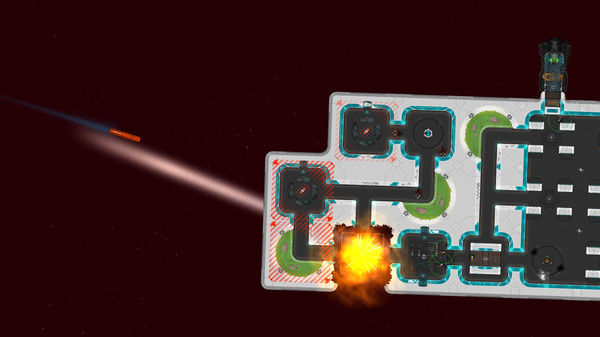 From the official screenshots on the Heat Signature (2017) Steam store page
Dilemmas — Loving a game and listing its faults
One tension he states in public: he loves a game and can still list its faults forever. On XCOM 2: "I love it, and I've played it for hundreds of hours, and yet I could talk forever about what's wrong with it... big, serious problems" (PC Gamer, 2020).
This comes from the same place as the "awkwardness, glee, guilt and hypocrisy" in his first talk's description. Keep the critic's eye while building, and your own work faces that eye too.
The wobble between asserting and hedging is on the record. In 2025, having said of letter-by-letter text animation "I think that's a bad thing...because it lacks rhythm," he immediately added: "This is not science. This is just a conjecture" (Game Developer, 2025-03-25 ↗).
There is a scale dilemma too. His first piece of advice in 2026 is "Stay as small as you can," because "A lower burn rate is a superpower." Yet on Heat Signature: "At the start of 2017 it had been 3 years, and I was itching to finish, so I hired John Winder to help me with the programming side of things" (Game Developer, 2018). The man who wants to stay small hired someone in order to stop.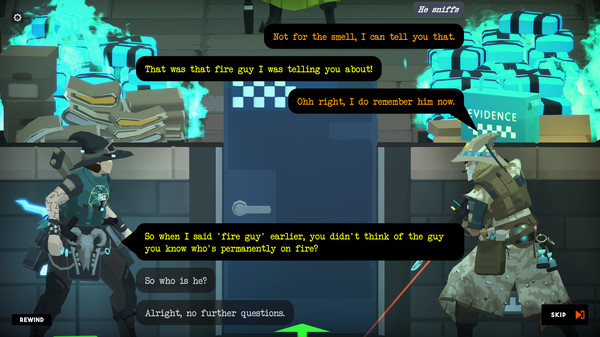 From the official screenshots on the Tactical Breach Wizards (2024) Steam store page
Influences — Derek Yu, Magicka, Douglas Adams
The influences he admits to are unusually concrete. Heat Signature began with his own day job. "It started with an interview like this, with me on the other side - I was asking Spelunky creator Derek Yu if he thought his chunky level generation could be adapted to 3D" (Game Developer, 2018). We have a study of Derek Yu too.
For how magic should behave, he names Magicka. "I love Magicka. It treats magic like a volatile, complicated science, where the most powerful effects are found by combining elements, but you're just as likely to electrocute yourself by forgetting your robe is wet when you try to mix lightning with steam" (PC Gamer, 2020).
On writing, he names Douglas Adams. "The Hitchhiker's Guide to the Galaxy could go absolutely anywhere, because he was making it up based largely on whatever seemed funny" (same interview).
And XCOM 2 is an influence in the form of a complaint, not an aspiration. With him, the game he loves and the game he wants to fix are often the same game.
Kizuki's reading — He never threw away the scorecard
What follows is my reading. I read Tom Francis as the designer who never threw away his scorecard.
My grounds are that the shape of his sentences has not changed in fourteen years. The four points from his 2012 talk — what type of game it is, the coolest unique thing about it, who and where I am and what I want, and one example of play — are exactly what a review's opening paragraph is asked to deliver. His 2015 fix (move the maths, add no interface) is a way of solving without adding anything that could lose marks. His 2018 rewind (retry the turn until you are happy) declines to score the player's experiments. All of it looks like design aimed at not being marked down.
Then in 2025 he footnoted his own assertion: "This is not science." The man who graded other people's games for nine years now attaches caveats to his own verdicts. The line still sitting in his blog header — "tom francis regrets this already" — reads to me as the signboard for that posture. He did not stop reviewing. He redirected the review at himself.
Closing — Where to start
Start with Gunpoint (2013). It runs about four hours and holds "write the rules, then let go" in its smallest form. Our review is at Gunpoint, and the music is covered in the Gunpoint soundtrack piece.
To watch a complaint turn into a spec, go to Tactical Breach Wizards (2024). The rewind he described in a 2018 pitch is there, playable.
He is now building Project Battleaxe in Godot, and the first dev log is titled "The Four Verbs" (his blog, 2025-06-25 ↗). The title alone tells you he starts by counting verbs.
For designers who read the same way, there is Derek Yu, whom he names on level generation, and Daniel Cook, who has published his design thinking on a blog for years. Brew the tea again, set the 2012 talk beside the 2026 advice, and the only thing that changed is how he footnotes himself.
Sources
Primary sources used in this article:
・His blog, "What I Learned From Gunpoint, And How To Make A Game," 2012-12-20
・His blog, "Game Design: The Non-Stick Plan," 2014-01-25
・His blog, "Tiny Design," 2015-06-05
・His blog, "Let Me Show You How To Make A Game With No Experience," 2015-07-09
・His blog, "What To Do If Your Prototype Isn't Fun," 2016-06-22
・His blog, "Pitch: Tactical Breach Wizards," 2018-02-02
・His blog, "What Works And Why: Emergence," 2018-07-30
・His blog, "Project Battleaxe Dev Log 1: The Four Verbs," 2025-06-25
・His blog, "15 Years of Indie Dev In 4 Bits of Advice," 2026-01-08
Reactions (no login)
Anonymous • one of each per visitor per day
Part of these series
The Designer's PhilosophyEpisode 52 of 52