REVIEW · 2017-01-30
Linelight
Two kinds of difficulty ride on the same line
Introduction
The screen holds a few thin lines. What you move is one small bar of light sliding along them. There is no jump button and no shoot button; you can only travel the line. Switches, doors, keys and lethal red lines sit on those tracks across six worlds and more than 250 levels. Made and published on 30 January 2017 under the name My Dog Zorro.
I write this from the Steam review pool. The label is 'Overwhelmingly Positive' — 1,070 of 1,109 reviews across all languages are positive, about 96% (snapshot 2026-08-07; 39 negative). The store shows the Steam-purchaser subset: 96% of 946. A Metacritic 90 badge sits on the page, alongside pull quotes from GameSpot, Hardcore Gamer (4.5/5) and PC Gamer. Every number is high.
Which is what makes the bodies of the reviews interesting: one dispute, and only one, comes up clearly. Is this a puzzle game or a game of reflexes? A 96% score all but buries that question. This piece lifts the cover off it.
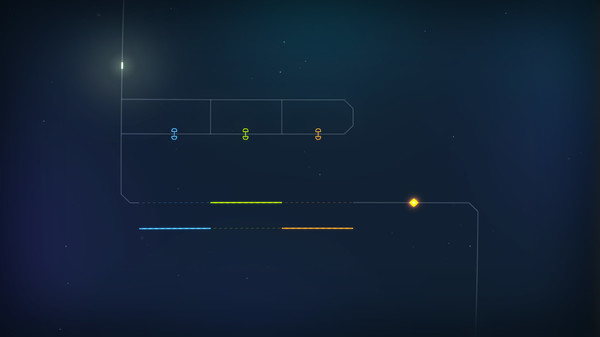 a teal background with thin white paths, three short glowing segments in blue, yellow and orange, and a yellow star — Steam store screenshot
First Impressions
Line up the helpful positive reviews and the vocabulary rhymes: elegant, minimalist, clean, relaxing, soothing — and the soundtrack always gets named. One opens by calling it an exercise in minimalism; another is impressed by the arithmetic, three hundred levels squeezed from one premise; a third notes that lines, light and sound alone moved him. Nobody is arguing about the look.
The reference points are stable too. Some file it beside LIMBO, Thomas Was Alone and VVVVVV as a small gem. One reviewer notes that people who have not played The Witness are the ones most likely to mistake this for a bag of line puzzles. A recent recommendation simply says the best puzzle games on Steam are Patrick's Parabox and this one. Its place in the lineage is settled.
The negative side does not reject any of that. Nine years of pans almost all open by granting the art and the score, and only then reach the 'but'. The fork in the verdict is somewhere else entirely.
 a magenta screen holding almost nothing but one thin horizontal line, with a small glowing white bar on it — Steam store screenshot
Putting the Mechanics into Words
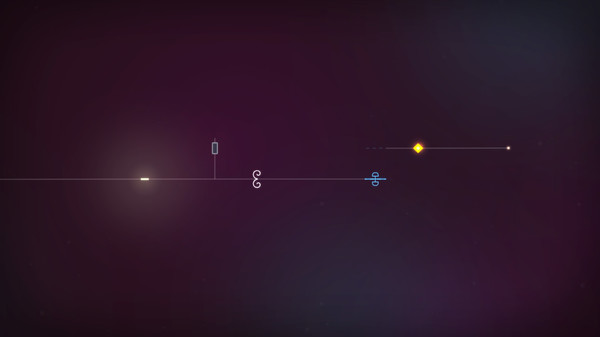
The store copy is proud of it: there is no jump button, there is no shoot button. When positive reviews keep saying there are barely any verbs, they are describing verb subtraction. One verb survives — travel along the line — and everything else has been pushed into the grammar of the lines themselves.
Reviewers organise that grammar well on their own: switches that move lines, switches that open doors, keys and locks, spools that lengthen your bar so it can hold down several switches at once, and enemies. The pool consistently sorts the enemies into three kinds — ones that move only when you move, ones that move to the beat of the music, and ones that replay your own previous movements. A beta tester's review picks out an early level where you release an enemy with a switch and then let that enemy press the switch for you, and notes it is the designer's own favourite.
So the verb count is one, but part of the grammar runs in real time. Against turn-bound enemies the board stays entirely an object of thought. The moment a beat-driven enemy appears, the board acquires a second axis: waiting, timing. That one design decision produces the fault line described below. What was subtracted was the verbs, not time.
 a three-by-three white grid with six short green switches on its edges, a yellow diamond and a tall slotted gate at the left — Steam store screenshot
How It Teaches
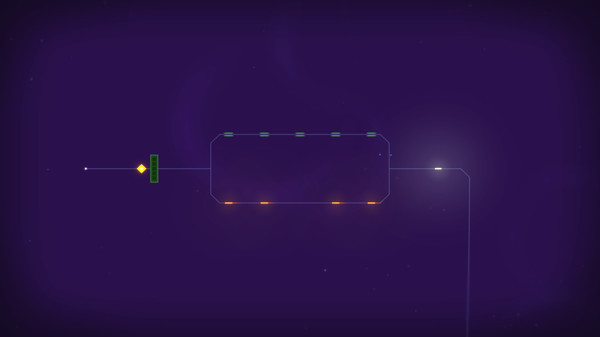
What positive reviews praise most concretely is, in fact, the teaching. Each world introduces one mechanic, lets you get familiar with it, then asks you to use it a few different ways. No padding by repeating the same idea. Three hundred levels, and each shows a different consequence. One writer puts it as: most levels illustrate a single neat consequence of the rules, so almost nothing is wasted. Introduce, vary, reprise — the pool articulates the textbook structure without being asked.
Several reviews also note that the last two worlds let the mechanics play against each other. That is combinatorial explosion held back on purpose: stack one grammar per world, then cross them all at the end. At the close of each world another light travels with you and then, wordlessly, leaves. The positive side keeps naming this as the game's story without words.
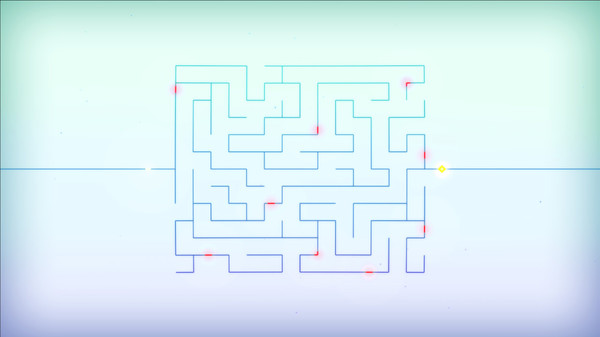
The negative side reads the same structure as filler. Some levels are the earlier puzzle again, only more annoying to execute. The enemy-crowded maze that shows up once per world asks for no thought at all. One recent pan says the opening is fine but the line-following repeats too long and the difficulty climbs too slowly. On the hidden levels: they are not a natural extension of the rules the way Baba Is You's secrets are, and they are not clued the way ElecHead's are. The teaching is careful; the clueing of the optional content was not built with the same care.
 a rounded rectangular loop of track with evenly spaced green segments along the top edge and orange ones along the bottom — Steam store screenshot
The Texture of Difficulty
On difficulty the positive side already splits against itself. One highly rated recommendation admits the puzzles are a little on the easy side and wishes for more bite. Another says the level is just right — not easy, not impossible. A third recommends it while noting it is far from the relaxing venture it bills itself as. People recommending the same game point in opposite directions because they are measuring different things.
Collect where reviewers got stuck and the difficulty separates into three. First, reading the board — low here; there are only lines, so everything visible is visible. Second, composing a solution — moderate, and even the pans mostly grant that the puzzles themselves are not hard. Third, executing — moving through at the right moment without touching a red line. The 'hard' camp means the third; the 'easy' camp means the second.
The pool even agrees on the name of the wall: World 6. Several pans say the game was a pleasure through World 5 and then spiked, and one of them opens by admitting he had read someone else say exactly that and assumed it was exaggeration. On World 5's mechanic, a reviewer notes he often could not tell whether he had the right solution and merely mistimed it, or needed to rethink from scratch. That reads to me less as difficulty itself and more as a feedback problem: the signal telling you your answer is correct gets buried under execution failure.
In something like Stephen's Sausage Roll, the hard layer is always the second one and the third does not exist, so a stuck player keeps thinking. Linelight deliberately keeps the second layer light and supplies a third. That is a choice rather than a mistake — but it arrives unannounced for anyone who bought a game about thinking.
 a large grid maze with a diagonal row of glowing red bars and small coloured switches at its corners — Steam store screenshot
Sources
Written by reading the user reviews on the Steam store page as of 2026-08-07. No review text is quoted directly; typical claims are reconstructed.
- Steam: Linelight (Overwhelmingly Positive; 1,070 of 1,109 reviews positive across all languages, about 96%, with 39 negative. The store displays the Steam-purchaser subset: 96% of 946)
- Read via Steam's appreviews data: the top 12 helpful positive reviews, the top 10 negative, and the 8 most recent (the recent set includes non-English entries)
- Compared the Metacritic 90 badge and the GameSpot / Hardcore Gamer (4.5/5) / PC Gamer pull quotes on the store page against what users complain about
- Consulted the official store description ('There's no jump button. There's no shoot button.', six hours, 250+ puzzles across 6 worlds, relaxing) and the user tags (Puzzle / Action / Minimalist / Relaxing)
Closing
Steam reads about 96% positive across all languages; my design-critique score is 8.5. Credit for cutting to one verb, growing only the grammar, stacking one idea per world and crossing them at the end — the level construction is precise. Two marks off: it introduces a third axis in the form of real-time enemies without ever saying so, and it does not let you rebind the controls. The user tags on the store, Puzzle next to Action, turn out to be an accurate description.
The gap between the developer's framing and the players' experience sits exactly here. The store copy says relaxing, Zen-like, 'getting an A+ on an exceptionally hard test while receiving a back massage'. Yet even a recent recommendation hedges that it is far from the relaxing venture it advertises, and the pans keep returning to how often you die and restart. The sales pitch describes the lightness of the second layer; what players meet is the weight of the third.
The median playtime shown on reviews is about eight hours, a little longer than the store's six. Those who chased every achievement report around ten. Technically, reports of vanishing keys and carried objects, and of progression locking up between levels, run intermittently from 2018 to the present; the developer replied personally to a 2018 pan with a contact address. Some recommendations praise that responsiveness in a solo project — and it is also true that the same class of report is still arriving nine years on. Several reviewers note that the red and orange lines are hard to separate for some kinds of colour vision.
Who it suits is legible. Anyone who can be surprised that one line yields three hundred distinct outcomes, and who treats the timing after the solution as finishing rather than chores. Anyone who wants only the difficulty of thinking — for whom sitting still in front of a board is the point — will hit World 6 and be annoyed. A 96% score does not mean this fits everyone. Two kinds of difficulty ride on those lines, and the pool divides by which one it saw.
 an inverted bright palette of white and mint, showing a densely folded maze of blue lines dotted with small red marks — Steam store screenshot
Where are you with this game?
Press one and the game goes on your shelf. You can see it on your account page.
Reactions (no login)
Anonymous • one of each per visitor per day
Read next
Related reviews
Mini Metro
A 2D minimalist puzzler in which you draw subway lines between circle, triangle and square stations in a growing city, allocating the carriages and tunnels handed to you each week, and keep the city moving until the platforms overflow. From New Zealand's Dinosaur Polo Club, grown out of a game-jam prototype.
Wilmot's Warehouse
A 2D organisation puzzle: push the delivered goods into your warehouse and file them however you decide. No rule governs the shelves, and when the service hatch opens you retrieve orders from memory alone. By Richard Hogg and Ricky Haggett, who previously made Hohokum, with 200 kinds of pictorial tile piling up.
Bridge Constructor Portal
A 2D physics puzzler in which you build bridges and ramps across 60 Aperture Science test chambers and thread vehicles through fixed portals and gels to the exit. ClockStone's entry in the Bridge Constructor series, built with Portal's own art and lore on loan from Valve.


