REVIEW · 2010-01-28
Toki Tori
Fetch every egg with only the tools you were dealt
First Impressions
Line up the helpful positives and nearly all of them write the same sentence: I was fooled by the art. "Sickeningly cute." "A true brain-teaser disguised as a cute kiddy game." "Very cute, but it destroys you with well-crafted puzzles." The chick and the pastel forest are the door. What is behind the door is unsentimental, and that surprise is the core of the praise.
The negative vocabulary points at the same fact. "Guess and check." "Hard for the sake of being hard." "Only one solution per level." "A chore." The gap between the art and the difficulty is a joke to one side and a mis-sell to the other. What splits is not the verdict on the content but the reading of that gap.
Steam's overall sits at 88% positive: 1,878 of 2,138 reviews across all languages, labelled Very Positive (snapshot 2026-09-15). English only, it is 875 of 1,023, or 85.5%. A calm, high number on the surface, with two incompatible measuring sticks underneath.
Putting the Mechanics into Words
The verbs are decided before the level starts. The goal never changes — collect every trapped egg and get out — but the toolbox does. Build a step, lay a bridge, warp across a gap, freeze a creature. Ten tools are said to exist in total, and each level specifies which of them you get, and how many.
In Puzzlebyrinth's terms, this is a grammar rewritten level by level. Most puzzle games fix the verb set and vary the board. Toki Tori does the opposite and changes the verbs first. Every level therefore opens on the question of what you can do at all.
The counts are also the hint. Three bridges means the game has told you there are three crossings. When reviewers praise the "specified inventory" for creating variety, this announcement is what they are enjoying. Stuck on a level, the right move is to recount your tools rather than restare at the board.
There is also the Eyes tool, unlimited on every level, which freezes the game so you can survey the whole map. Several positives name it as the time to look before you move. Raising your observation resolution is here an institution — a tool in the bag. Next to Stephen's Sausage Roll, which makes you walk the board to read it, Toki Tori issues reading time as a ration.
The Texture of Difficulty
When "too hard" and "just right" sit on the same page, the useful question is where each reviewer got stuck. Sorted that way, the pool describes three different difficulties: reading a level through, trial and error, and the hands.
Positives praise the first. "Fair and reasonable." "Starts easy, gets genuinely challenging, stays finishable." Negatives attack the second: visual red-herrings everywhere, and "no way to tell if you're on the right track." The third is a minority but a persistent one — precision, and controls that several say want a gamepad.
The second complaint follows directly from the design. Where a level has one solution, partial progress earns no partial credit. You spend the inventory without ever learning whether you were close. A single beautiful path is also a path that returns nothing along the way. That is a question of reach rather than a defect: it suits players who solve before they move.
The Steam version's rewind is what closes the gap. Several positives say they would have quit without it. But it lowers the cost of retreat, not the difficulty — a revision that removed the cleanup after failure rather than the failure itself.
How It Teaches
The developer's store text says tools arrive gradually as you progress, and the positive side agrees: good pacing, difficulty that climbs in steps. Handing out one tool at a time works.
The trouble is what comes next. Teaching tools one by one teaches each tool, but not their combinations. The moment three tools are in play, orderings and placements multiply. Only the entrance to the combinatorial explosion is left as homework, and the negative cry — "how was I supposed to figure that one out?" — almost always goes up right there.
Two testimonies in the pool confirm the shape. One review dismisses the game as too hard for kids and too boring for adults. Another reports five- and six-year-olds enjoying it, with an adult's help at certain points. These do not contradict each other. The opening is designed for one audience and the back half for another. Where Snakebird Primer split the difficulty off into a separate package, Toki Tori switches layers inside a single game.
Place in the Lineage
Three years later the same studio threw nearly all of this away. Toki Tori 2+ has no inventory, two verbs — whistle and stomp — no discrete levels and no tutorial. The first game rations verbs per level; the sequel fixes the verbs and asks you to read the world instead.
The two review pools are mirror images. Toki Tori 2+'s positives write that having no instructions is half the fun, and its negatives are angry that it is nothing like the first game. Here the positives call it a pure puzzle game, and the negatives tell you to buy the sequel. Each rejection is the other side's virtue turned over.
Subtraction usually shows best in a sequel. But what remains after subtracting depends on what was being handed out before. The first game distributed its tools level by level, and that is exactly why "only two" meant something in the second. Playing them in order is worth it for that reason.
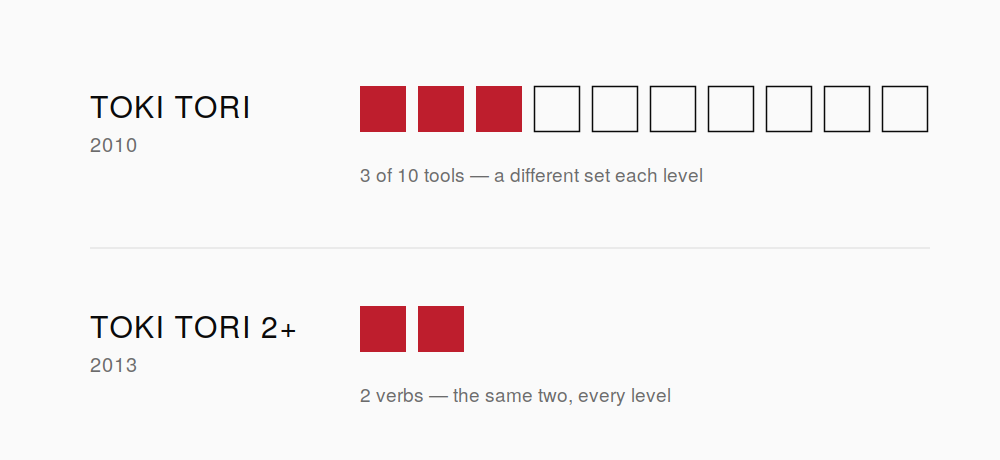 Verbs granted per level: Toki Tori hands out a few of its ten tools, while Toki Tori 2+ fixes the set at two — whistle and stomp (diagram)
Reviews Consulted
Written from the Steam store review pool as of 2026-09-15. No review text is quoted directly; typical claims are reconstructed.
・Steam: Toki Tori (1,878 of 2,138 reviews positive across all languages = 88%, Very Positive; English only, 875 of 1,023 = 85.5%)
・Read the top 20 helpful positive, top 15 helpful negative and 8 recent reviews via WebFetch.
・The release history (Game Boy Color 2001, WiiWare 2008, Steam 2010) and the tool set were cross-checked against the store page and the English Wikipedia entry for Toki Tori.
・Note: Steam's image CDN was unreachable from this run's environment, so no screenshot could be inspected. Rather than publish images we had not seen, the only figure here is one we drew ourselves.
Closing
I give it 7.5, harsher than Steam's 88%. Not because of the quality of the difficulty but because of how progress is returned. A single correct path reads beautifully, yet while you are stuck it hands you nothing for far too long.
There is also noise in the number. Several negative reviews report that some levels stay locked after purchase unless you join the developer's Steam group. That is a storefront decision rather than a design one, but a share of the downvotes is aimed at it. Read the percentage with that separated out.
On length, assume less than the "dozens of hours" the store claims. A straight run is an evening or a few; the bonus levels and the achievements are a different order of magnitude. One recent negative cites the grind of collecting a thousand eggs as its reason.
It suits players who like to plan the whole sequence from a still board before they move. It does not suit people who think with their hands, or who need to feel the answer getting closer. Buy it for the art if you like — but the art only protects you for about ten levels.
Where are you with this game?
Press one and the game goes on your shelf. You can see it on your account page.
Reactions (no login)
Anonymous • one of each per visitor per day
Read next
Related reviews
Toki Tori 2+
A puzzle adventure across an open forest island where your only moves are whistle and stomp. You never unlock new abilities — only knowledge of how each creature behaves — in Two Tribes' 'Metroidbrainia.'
Thomas Was Alone
A 2D puzzle-platformer in which you switch between coloured rectangles, each given exactly one ability, and combine them into stepping stones across 120 levels. A narrator reads out what the shapes are thinking as you go. Released in 2012 by Mike Bithell's Bithell Games.
Escape Goat 2
A 2D puzzle platformer about escaping a trap-filled stronghold with a goat and its mouse companion. Each room is a single screen, solved with jumps, an immortal mouse that crawls walls and stands on switches, and a magic hat that swaps the goat's position with the mouse's. Over a hundred rooms across ten zones, from MagicalTimeBean in 2014.


