REVIEW · 2014-03-24
Escape Goat 2
The split is not about facts — both sides name the same late-game precision demands; one side files them under optional content, the other meets them in the middle of the road
First Impressions
Start with the numbers. Steam counts 460 reviews across all languages, 438 of them positive: 95%, Very Positive, as of 2026-09-05. Only 22 are negative. For a small 2014 release that is a settled verdict, and the posting rate has long since thinned out — the most recent handful are scattered across 2024 and 2025.
What surprised me on reading them is that the two sides write the same sentences. The late rooms kill you on timing. The controls float. The hidden keys are almost impossible to find. All three turn up regardless of the thumb. Strip the signs off and you could not reliably sort several of these paragraphs into their columns.
That is an unusual shape. A split normally comes from two readings of one fact. Here there is barely any argument about the facts at all. The disagreement is about which part of the game those facts belong to. The fork in the evaluation sits not inside the work but on the map each reader is carrying.
The positive side files the precision demands under optional hidden rooms. The negative side reports meeting them in the last stretch of the main path. Both tripped on the same stone; one calls it off the road, the other calls it the middle of the road. Neither is lying. Compare them and the stone does not move — what moves is the width of the road.
So what this review pool records is not really the quality of the game. It is where each player drew the line between the campaign and the extras. The players drew that line, but the design is what made them draw it, and that is the argument of this piece. What follows traces where the line dissolves, first through the mechanics and then through the controls.
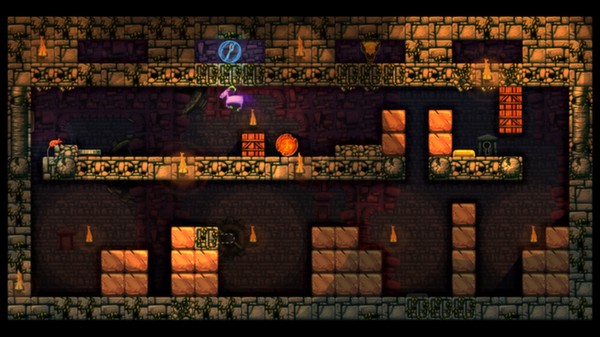 Escape Goat 2 in play — the first image listed on the Steam store page — Steam store screenshot
Putting the Mechanics into Words
The verb list is short. The goat walks and jumps. It throws the mouse. Hand the mouse the magic hat and the goat swaps places with it. The store page names only three ingredients — machinery, the environment, and a friendly mouse. The subtraction is already visible on the signboard.
Each room is one screen. The store page states there are more than a hundred rooms across ten zones. The moment you enter, everything you need is on screen; nothing is hidden outside the frame. In terms of observational resolution this game scores close to full marks.
The mouse is described as immortal. It crawls walls, slips through gaps, stands on switches, and pulls enemies away. It absorbs every job the goat cannot do. That makes it a device for multiplying solutions without adding a single verb — as subtraction goes, this is good work.
Up to here the skeleton looks like a Sokoban-like: few verbs, a closed single screen, a companion whose failure costs nothing. One positive review calls the game a one-room puzzle game and says that alone was enough to sell it.
The difference is the input. A Sokoban move is one tile, fully discrete. A move here contains jump height, take-off position, and the instant a switch is pressed. It is a continuous quantity. That single property generates almost every argument in the review pool.
 Escape Goat 2 in play — the third image listed on the Steam store page — Steam store screenshot
Feel of the Controls
One sentence recurs on the negative side more than any other: knowing exactly what to do and not being able to execute it. Another not-recommended review puts it as a platformer first and a puzzle game second. A third sums it up as too much arcade and not enough puzzle.
The vocabulary is consistent too — floaty, inelegant, trial and error, precision platforming. One long-playing negative review lists the whole set together: pixel-perfect demands paired with floaty movement, switches that do not telegraph what they moved, and a slow wait after each death.
What matters is that the positive side reaches for the same words. The most-upvoted recommendation says the growing reliance on timing exposes inconsistencies in the controls. Another says the optional hard levels ask for pixel-perfect positioning and split-second timing, and that this is where the engine's limits start to show.
Translated into the vocabulary I use here: the game pushed observational resolution to its ceiling and did not raise input resolution to match. There is a step between what you can see and what your fingers can reproduce. After you solve the room, a second solving is still waiting, and it uses a different skill.
A step like that is not a defect in itself. Plenty of games make crossing it the whole point. The problem is that this one does not announce the step in advance. The short store description offers machinery, the environment, and a mouse. The word timing appears nowhere on it.
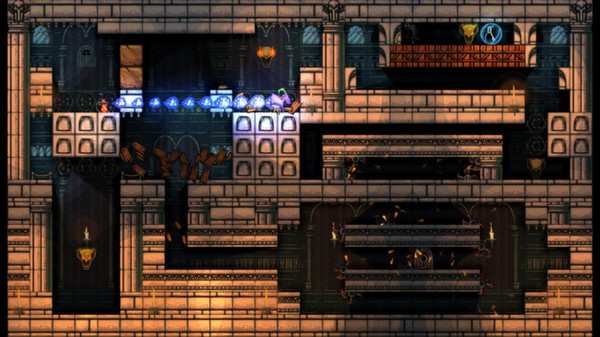 Escape Goat 2 in play — the fifth image listed on the Steam store page — Steam store screenshot
The Texture of Difficulty
The negative reviews sort the stuck-points into three kinds. First, stuck on discovery: the hidden keys and hidden rooms cannot be found. Second, stuck on input: the plan is clear but the fingers cannot keep up. Third, stuck on repetition: the late rooms make you redo the same motion over and over.
Of the 22 negative reviews, almost none makes the first kind its main grievance. They cluster on the second and third. A good game ruined by its final levels. Mindlessly repeating the same thing. Finding a needle in a haystack, while in mid-air. Every one of those is a sentence about execution, not discovery.
The positive side, by contrast, enjoys the first kind. The reviewer who wrote that the hidden keys are shockingly hard to find treats that as a summer project rather than a complaint. The same person calls the first game's bonus pack masocore torture and prefers this game's hidden rooms to it.
So the quantity of difficulty is not the issue. The composition is. Difficulty of discovery is welcomed; difficulty of input is received as a tax. The single word hard points at the substance of the play for one group and at something subtracted from the play for the other.
The gap with the professional press falls along the same line. Britton Peele's GameSpot review scored it 7 and described a smooth curve and easy-to-learn controls, while the user pool is full of the word spike. Rather than deciding who is right, it reads better as a difference in how far each writer had gone.
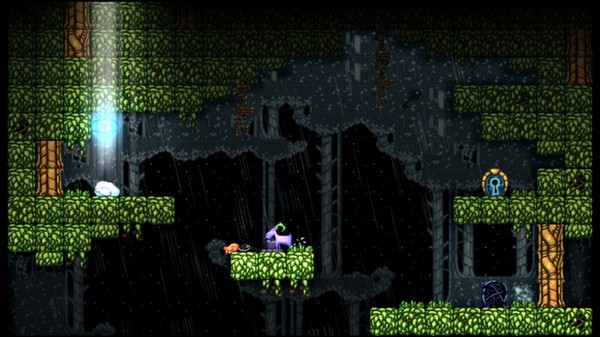 Escape Goat 2 in play — the seventh image listed on the Steam store page — Steam store screenshot
Place in the Lineage
Line it up against its neighbours and the position becomes clear. Stephen's Sausage Roll puts all of its difficulty on the discovery side. Its input is fully discrete: one move, one tile. The accident of knowing and not being able to do it cannot happen there, and the kind of difficulty never swaps out.
Toki Tori 2+ also runs on two verbs and keeps its demands on input deliberately low. Closure, on the other hand, carries a discovery layer made of light and shadow while still asking for precise jumps. Escape Goat 2 belongs to that second lineage.
Comparison with the first game is the single most common topic in the pool. The first was nearly flawless. The polish went up but the magic did not come back. It got bigger without necessarily getting better. A German-language recommendation says the original had a pleasant learning curve while this one turns difficult very quickly.
What is interesting is how the first game's bonus pack gets used. The people defending this game's hidden rooms almost always invoke it. The same step existed in the original — but it sat in a clearly separate wing, behind a door you opened yourself after finishing the campaign.
This game added wings and joined them with a map. Movement got freer, and the border between campaign and extras got thinner in the same stroke. The line-drawing problem I worked through in who is 100% completion for shows up here as a problem in the design itself.
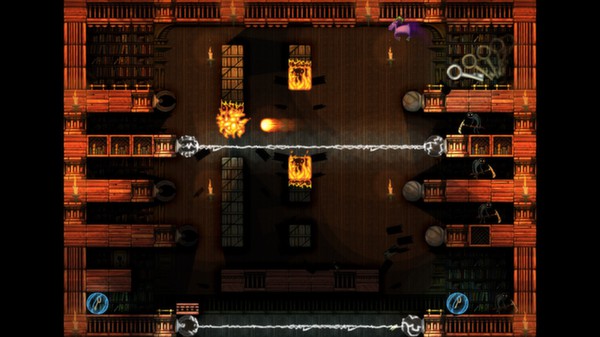 Escape Goat 2 in play — the ninth image listed on the Steam store page — Steam store screenshot
The Reviews I Read
This piece was written from the Steam store page's user reviews as of 2026-09-05.
・Steam: Escape Goat 2 (438 positive of 460 across all languages, 95%, Very Positive)
・Read: the top 10 positive by helpfulness, the top 10 negative (out of 22 negative reviews in total), the 12 most recent, and all 3 Japanese-language reviews — 35 in total, overlaps included.
・The account of the mechanics and the content count was checked against the store page's own description as primary source: machinery, the environment, the immortal mouse, ten zones, more than a hundred rooms, and the level editor.
・For professional coverage I read Britton Peele's GameSpot review, scored 7/10.
・All images are screenshots published on the Steam store page and their URLs were verified to resolve. The image files themselves could not be downloaded from this run's environment, so the captions record only their order on the store page and make no claim about what they depict.
Closing
I give this a 7.8, one notch below Steam's 95%. There is only one deduction, and it is not about the amount of difficulty. It is that the kind of difficulty swaps out partway through, and that the swap is never announced in advance.
It opens with difficulty of discovery and moves to difficulty of input near the end. The signboard offers machinery, the environment, and a mouse, so a player who came for discovery is handed a different sport in the closing stretch. Most of the 22 negative reviews are written about that moment of handover.
The 95% is also correct, though. Many on the positive side run the story in a few hours and get off there, satisfied. People who never set foot on the step have no reason to mention it, and the rating should be read as the sum of the game's quality and the quality of the place where players step off.
The room design itself still holds up. Putting everything you need on one screen and multiplying the solution space with a single device — an immortal mouse — is a model of adding solutions without adding verbs. I have no quarrel with the positive side's view that the craft improved on the first game.
The recommendation is easy to phrase. If you intend to run the story and stop, take it without hesitation. If you are going for 100%, go in knowing the sport changes on you halfway. Decide where your own line sits beforehand, and the game will not break its promise.
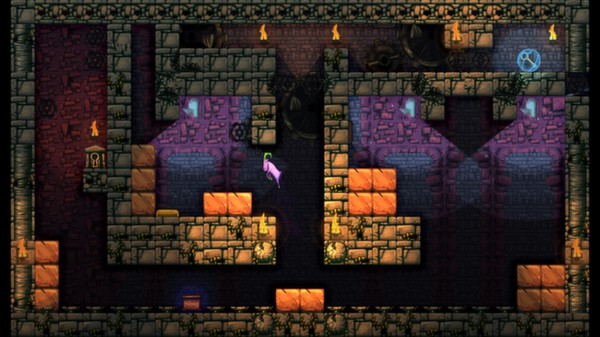 Escape Goat 2 in play — the eleventh image listed on the Steam store page — Steam store screenshot
Where are you with this game?
Press one and the game goes on your shelf. You can see it on your account page.
Reactions (no login)
Anonymous • one of each per visitor per day
Read next
Related reviews
FRACT OSC
A first-person musical-exploration puzzle set in a vast synthesizer-built ruin, where you actuate glowing nodes and sound rigs to wake dormant machinery and music back to life. There's almost no instruction; working out what is even interactive is itself the puzzle. Phosfiend Systems, 2014, winner of IndieCade's audio design award.
Sokobond
A 2D Sokoban puzzle where you move a single atom around a grid and bond it with the atoms it touches to assemble a target molecule. Each atom's number of free 'hands' is the only grammar; tiles that break, double, and rotate bonds arrive one per chapter. By Alan Hazelden and Lee Shang Lun, 2014, scored by Allison Walker.
Brothers - A Tale of Two Sons
Two brothers set out to find the Water of Life for their dying father. The left stick moves the older brother and the right the younger, both at once, and you cross ravines, waterways and the bones of giants by pairing what each of them can do. Every line is spoken in an invented language. Directed by Josef Fares at Starbreeze Studios, released in 2013.


